

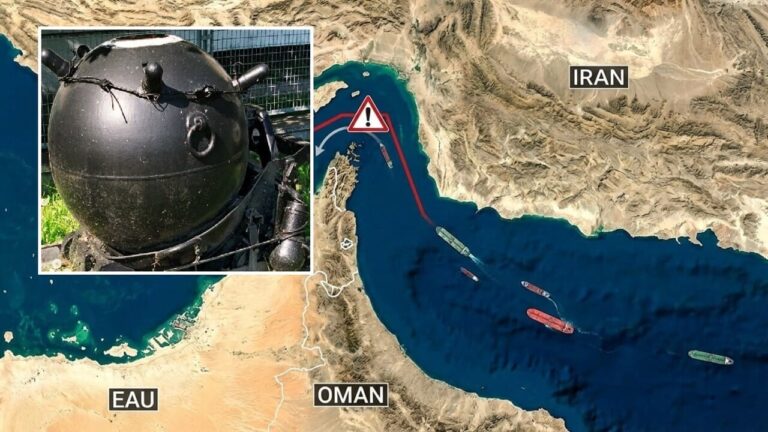
There is no passage through the Strait of Hormuz. Now, the blockade has become double, after the start of the operation decided by Donald Trump which will target any vessel moving to and from Iranian ports. But in the 34 kilometer wide body of water there is also the problem of mines to consider. A new pressure from the White House on NATO members is focusing on this aspect and Italy is also called into question: mine-hunting ships are needed and our Navy is among those allies that possesses the most and with cutting-edge characteristics. What will Giorgia Meloni answer?
The US blockade of Hormuz: the mine problem
After the Iranian one, the US blockade of the Strait of Hormuz is now also in force. According to the Wall Street Journal there are more than 15 American ships conducting the operation. Trump has threatened attacks similar to those against drug trafficking vessels, saying in a social media post that they would be targeted “using the same system of elimination we use against drug traffickers aboard their vessels at sea.”
“Any vessel entering or leaving the blocked area without authorization will be subject to interception, hijacking and capture,” says Centcom, the US Central Command. Centcom itself had previously announced that two destroyers – USS Frank and Petersen Jr and USS Michael Murphy – are in the area as part of a mission to remove “sea mines previously laid by Iran’s Islamic Revolutionary Guard Corps.”
In the relatively shallow waters of the Persian Gulf, Iranian forces may have placed explosive mines, although it is unclear how many. In any case, a recent report from the US Congress quantifies the Iranian arsenal at around 5,000 mines. These are floating devices capable of containing explosive charges of up to 1,000 kilograms: the explosion of these devices creates a violent bubble of expanding gas and a shock wave capable of breaking the keel and destroying the electronics of the ships above.
Because Trump needs minesweepers, even Italian ones
According to sources cited by CNN, the US Navy would have serious shortages of minesweeping ships in the Persian Gulf region. The reason is having repatriated the 4 Avenger class minehunters located in Bahrain for the planned radiation. For this reason, the reclamation mission is now entrusted to another type of ship, the aforementioned USS Frank and Petersen Jr and USS Michael Murphy, adapted to the role.
The latest live news on the war in Iran
This is also why Trump would have asked NATO allies to send warships to the Strait of Hormuz. The US president himself had announced that, together with the United Kingdom “and a couple of other countries”, they were sending minesweepers into the Strait of Hormuz. In reality, the first refusals have already arrived: Keir Starmer refused to join the blockade of the Strait and, according to what the TelegraphGreat Britain will not send any frigates. And Italy? Giorgia Meloni had said she was willing to participate in a naval operation, but once a truce had been reached and not in an open war scenario. Yet, requests from the US would have arrived on the table at Palazzo Chigi.
Which ships does the Italian Navy own?
The Italian Navy boasts one of NATO’s most advanced specialized minehunter fleets. The official pages of the Navy list 8 “Gaeta class” minehunters – Alghero, Chioggia, Crotone, Gaeta, Numana, Rimini, Termoli, Viareggio – and 2 “Lerici class” – Milazzo and Vieste – The Navy underlines that these units have a hull in a special fiberglass which allows two priority needs for a minehunter to be satisfied simultaneously: absolute non-magnetic, which makes them “invisible” to mines, first achievable with wooden constructions, and a high anti-shock resistance previously only achievable with steel constructions.
The Colaninno family’s billion-dollar challenge: this is how they can help the Navy reopen Hormuz
These ships, approximately 50 meters long, carry highly specialized crews and operate with very high frequency sonar to detect mines. They also use wire-guided underwater vehicles for remote destruction of ordnance, supported by deactivator divers. The Italian Navy has already carried out mine clearance operations since the 1990s, including clearance operations in the Adriatic Sea after the war in the former Yugoslavia and the two Gulf wars.
The pressure on Giorgia Meloni: “She cannot obey yet another order from Trump”
Multiple newspapers report contacts between the White House and Palazzo Chigi, with the Trump administration reportedly requesting naval assistance from the Italian Navy. But the government has not clarified its position on the topic and Giorgia Meloni’s orientations on the topic are not known.
Thus, the matter reaches Parliament. For the group leaders of the 5 Star Movement in the Foreign and Defense Commissions of the Senate and Chamber, “Meloni cannot obey yet another order from Trump, who now claims to drag us into his crazy war on Iran by imposing the sending of Italian minesweepers into the Strait of Hormuz, no longer for a post-conflict mission but in a high-risk context, given the naval counterblockade decided by Trump in the Strait”.
Because Eni wants Russian gas in Italy again
“Meloni has a duty to come to the chamber, because such a decision must pass through Parliament and we will be there to tell her to keep Italy out of the illegal war wanted by Trump and Netanyahu – write Senator Alessandra Maiorino and deputies Francesco Silvestri and Arnaldo Lomuti – A war that is already putting our soldiers deployed in Lebanon as part of the Unifil mission at risk on a daily basis, with Israeli tanks blocking and ramming Italian vehicles and IDF soldiers they shoot at our armored vehicles, even touching one of our soldiers who has fallen to the ground. In response to these intolerable episodes, the government should show a minimum of dignity by immediately notifying Tel Aviv of the denunciation of the Italy-Israel military cooperation memorandum, which today is renewed for another five years”.