

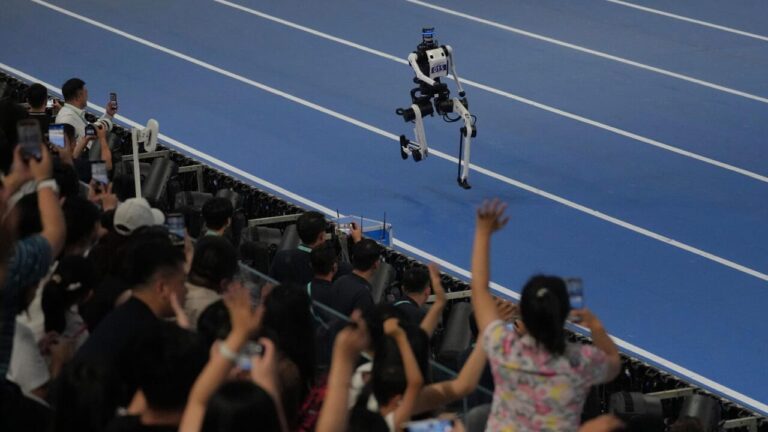
Humanoid robots are no longer a promise, and they are no longer a form of futuristic entertainment. This is the message that comes from Beijing, where the World Robot Conference (Wrc) 2026 ended, an international event which saw the participation of 300 exhibitors, the launch of 311 new prototypes powered by artificial intelligence and the presence of around 3,000 latest generation robots.
Very fast robots but without control
Among the most emblematic presentations, the humanoids from Unitree Robotics took center stage: the G1 model amazed with its fluidity of movements and athletic abilities; the brand new “Superman”, however, tested on an athletics track in the concurrent World Robot Contest (the world games of humanoid robots), reached a speed of 45.6 km/h and beat Usain Bolt’s world record in the 100 metres, demonstrating however obvious limitations, such as the difficulty in slowing down after the point of maximum acceleration – in some videos you can see prototypes crashing into barriers and even short-circuiting.
Hyperrealistic humanoid robots
Although the focus of this edition of the WRC was on practical and ready-to-build machines, the prototypes of UWorld 1 inevitably ended up in the spotlight, the hyper-realistic humanoids designed by UbTech for the emotional support and care of the elderly. They are advanced models, equipped with silicone skin designed to perfectly replicate the texture and appearance of the human epidermis.
What is most surprising is the ability of robots to replicate facial expressions and hold emotionally aware conversations, rotating their necks and articulating their hands during interaction with humans.
Among the eccentric but apparently functional solutions, Qiji by Daka Robots was presented, a robotic horse that can be ridden by the user, a 300 kg quadruped capable of walking and carrying the ‘rider’ on duty thanks to its four mechanical legs. The usefulness? The ability to transport heavy loads even on rough terrain.
The Galbot G1, on the other hand, is an android on wheels with an elevating torso, designed to totally autonomously replenish the shelves of supermarkets and pharmacies. Instead, it manages to sort 1,816 parcels per hour with a declared accuracy of 98% X Square of Wall-B. Born as a robot for domestic environments – it is able to grab objects, collect waste, tidy up and carry out complex cleaning -, thanks to an additional metal arm it is an excellent ally in factories and industrial environments.
The solutions presented at the WRC are multiple and adaptable to different contexts, including domestic ones, but what strongly emerged from the event forums is great caution. The main point of artificial intelligence integrated into a physical body – the so-called Embodied Ai – is not so much the hardware, but the necessary training of the prototypes. If models like ChatGpt draw heavily on web texts, a robot must learn physical perception ‘in the field’. In this sense, Wang Xingxing, founder of Unitree, estimated that it will take up to 10 years before we see robots capable of handling unexpected tasks with 80% autonomy. Efficient on the assembly line under human supervision, robots still seem uncomfortable within the four walls of the home.