

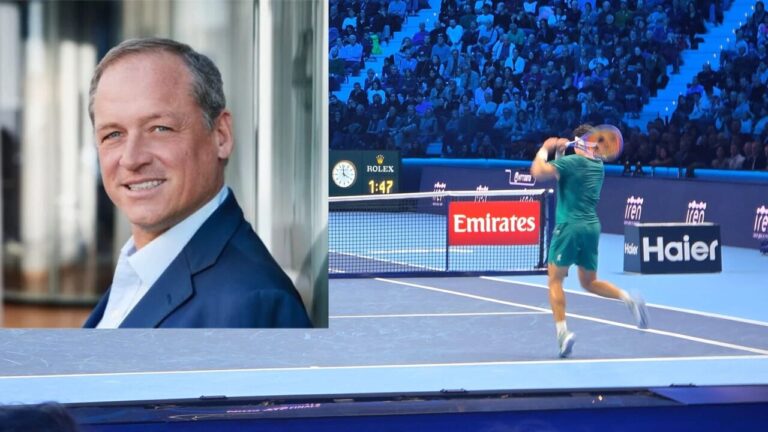
Emirates extends premium economy to the entire fleet operating in Italy. He emphasizes this to The Vermilion Marco D’Ilario, country manager of the Emirates airline since 1 January 2026, during a meeting on the sidelines of the ATP Finals in Turin, where Emirates is a Platinum sponsor. The objective is to increase the supply of seats in an intermediate class which is recording higher-than-expected occupancy rates without eroding the business’ sales.
A growing market segment
The complete reconfiguration of the aircraft will bring the intermediate cabin on all routes served by the carrier. According to D’Ilario, the commercial data confirm the existence of an autonomous and well-profiled demand, made up of both leisure travelers and those who travel for work (duty travel). “We had the business that was always full; the premium economy filled up and the business continued to be in great demand,” explains the manager. Italy was among the first markets chosen by the Dubai company for the launch of this product.
A new separator between the seats and the U-Dream headrest (also available in economy) has also been introduced on Italian flights to increase privacy and ergonomics during long-haul flights. “In Italy there are many people willing to spend a little more to enjoy the trip more starting from the flight,” underlines D’Ilario, highlighting how the legroom (pitch) and the catering service come close to the standards of the upper classes.
24-hour assistance during the Middle Eastern crisis
Among other things, D’Ilario’s entry into the group marks his direct return to air transport after a 17-year career in the sector and an 11-year period dedicated to technology applied to travel. An achievement defined by the manager himself as “a long-held dream finally realized”, put to the test almost immediately by international geopolitical tensions with the attacks on the cities of the Emirates. Despite the difficulties, the balance of the first months is positive: operational management and the response of the Italian market have allowed us to quickly overcome the critical phase, “consolidating confidence in the results of 2026”.
And managing emergencies set a very complex machine in motion. D’Ilario recalled the activation of the procedure crisis management 24 hours a day, guaranteeing re-routing and hotel assistance to passengers stranded abroad until their complete return and reimbursement of their tickets. “Leadership is not a medal that hangs, it is won every day”, comments the country manager, reiterating the company’s line on flight safety: “Zero compromises: if there are no total safety and security conditions, you can’t fly”.
Operation in Italy and the intermodality effect
Since August, the company has returned to full operational capacity on the Italian market. Emirates operates 49 weekly connections to Dubai from the airports of Milan, Rome, Venice and Bologna – where the Airbus A350 was introduced – in addition to the weekly direct flight to New York. The flow of Italian passengers transiting through the Dubai hub has exceeded the volumes recorded before the recent geopolitical tensions. At the same time, the importance of integrated train-air transport is growing. Thanks to intermodality agreements, passengers can reach the main airports starting from the railway stations of 25 Italian cities with a single ticket. 75% of these packages are purchased abroad by tourists from Africa, India and the Far East headed for centers such as Vicenza, Bolzano, Pisa, Florence and Naples.
In terms of territorial presence, the carrier has inaugurated a new Retail Office in Rome. This is not a traditional ticket office, but a space dedicated to “personalized consultancy to build tailor-made itineraries”.