
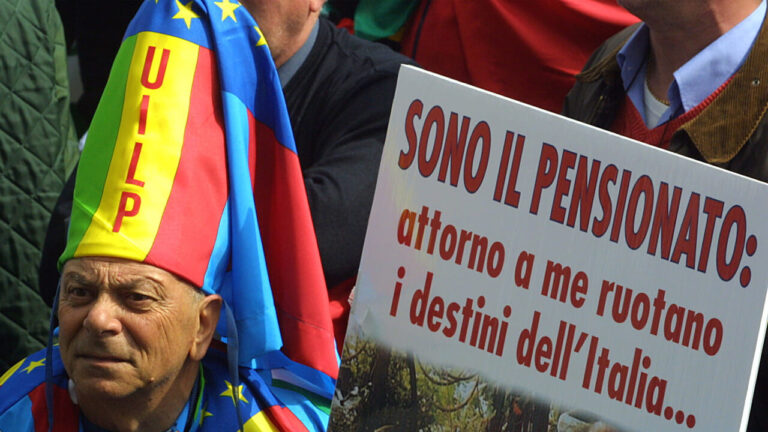
Retired at 71. And with monthly checks that risk becoming “starvation”. The dossier on self-employed and para-subordinate work developed by Nidil Cgil with the CGIL pension observatory has raised an alarm on the incomes of collaborators and VAT numbers and on their pensions. “While inflation is galloping, with the budget law the government only deals with first class professionals”, stated the union, while “more than 700 thousand workers have inadequate incomes and starvation pensions”. Nidil Cgil is the trade union category of the CGIL that represents and protects atypical workers: temporary workers, collaborators, self-employed, unemployed.
“Inadequate incomes and starvation pensions”
The union, with the CGIL pension observatory, has developed a survey on self-employed and para-subordinate work starting from the latest INPS data on separate management, relating to 2025. Inps separate management is the compulsory social security fund established by law 335 of 1995 for self-employed workers without a professional fund, collaborators (co.co.co.) and other para-subordinate or atypical figures.
The union highlighted how, in a period of inflation, the budget law has “extended the fiscal benefit of the flat tax to 15% for the so-called Serie A professionals, referring to the extension of the flat tax envisaged in the budget up to 100 thousand euros of revenues, while for those who earn less no intervention is foreseen”.
“Para-subordinate work, around 209 thousand exclusive collaborators, and around 460 thousand individual VAT numbers see their wages remain poor”, states Nidil CGIL. “If we add to these the sports collaborators, around 70 thousand, the picture becomes even more worrying”: this is the alarm over an emergency that would affect over 700 thousand workers with “inadequate incomes and starvation pensions”.
700 thousand workers in emergency
The union’s analysis considered the exclusive collaborators, co.co.co. (coordinated and continuous collaboration contract) of various types still employed in the private and public sectors (such as call center operators or kindergarten teachers in some municipalities); professionals with exclusive VAT numbers not registered with professional associations (from archaeologists to advertising graphic designers, from tourist guides to translators, up to riders) and sports collaborators, instructors and more.
The incomes for these workers, the union underlined, “remain insufficient for a dignified life today: on average 8,880 euros per year for exclusive collaborators; 18,187 euros for professionals with exclusive VAT numbers; 7,108 euros for sports collaborators”. The prospect is that of having starvation pensions in the future, “with exit at 71 with the minimum or, for the most ‘lucky’, thirty years of contributions to have 654 euros a month”. In 2026 the minimum INPS payment is 611.85 euros per month (7,954.05 euros per year on thirteen monthly payments), which rises to 619.80 euros per month with the extraordinary increase of 1.3%.
The pension in the separate INPS management
To accrue twelve months of pension seniority in the separate INPS management, contributions must be paid calculated on a minimum annual income. If you earn less, fewer months are recognized. In 2025, an employee needed at least 18,808 euros gross to obtain a full year. But only 12% of the 209 thousand exclusive collaborators reached this threshold. 31%, despite paying contributions, have not accrued even a full month.
Among young people, only 7.4% have credited twelve months. Among women only 8.7%. For professionals with a VAT number, just 34.9% obtained a full year, while around 40 thousand did not even reach a month. Simply put, you can work for decades without accumulating as many years useful for retirement. In essence, low incomes and short periods of contributions actually push the goal of retirement further away for the vast majority of parasubordinate workers.
From 654 to a maximum of 885 euros per month
For collaborators, who pay a contribution rate of 33%, the hypothesis of a full year of contributions, possible with an annual income of at least 18,808 euros, would require at least thirty years of payments to accrue an allowance of 864 euros per month at age 67. A perspective which, the union underlines, concerns just 12% of the audience. In the current situation, considering the incomes of 2025 and the thresholds established by law, only men with forty years of activity can aspire to achieve the right to a pension: the amounts would range from 692 euros per month at 64 years of age up to a maximum of 885 euros at 71 years of age.
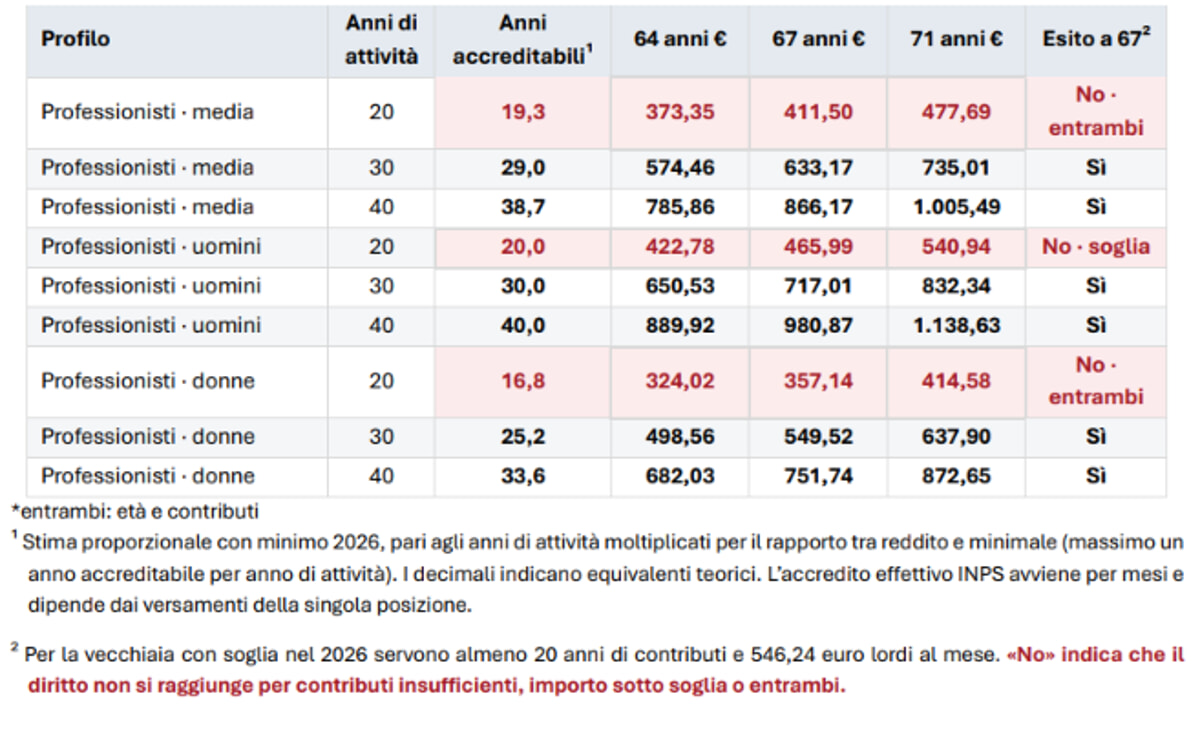
For professionals with an exclusive VAT number, subject to a contribution rate of 25%, at least thirty years of full contributions would be needed to obtain a monthly allowance of 654 euros at age 67. But only 34.9% of the audience today reaches a full year of payments.
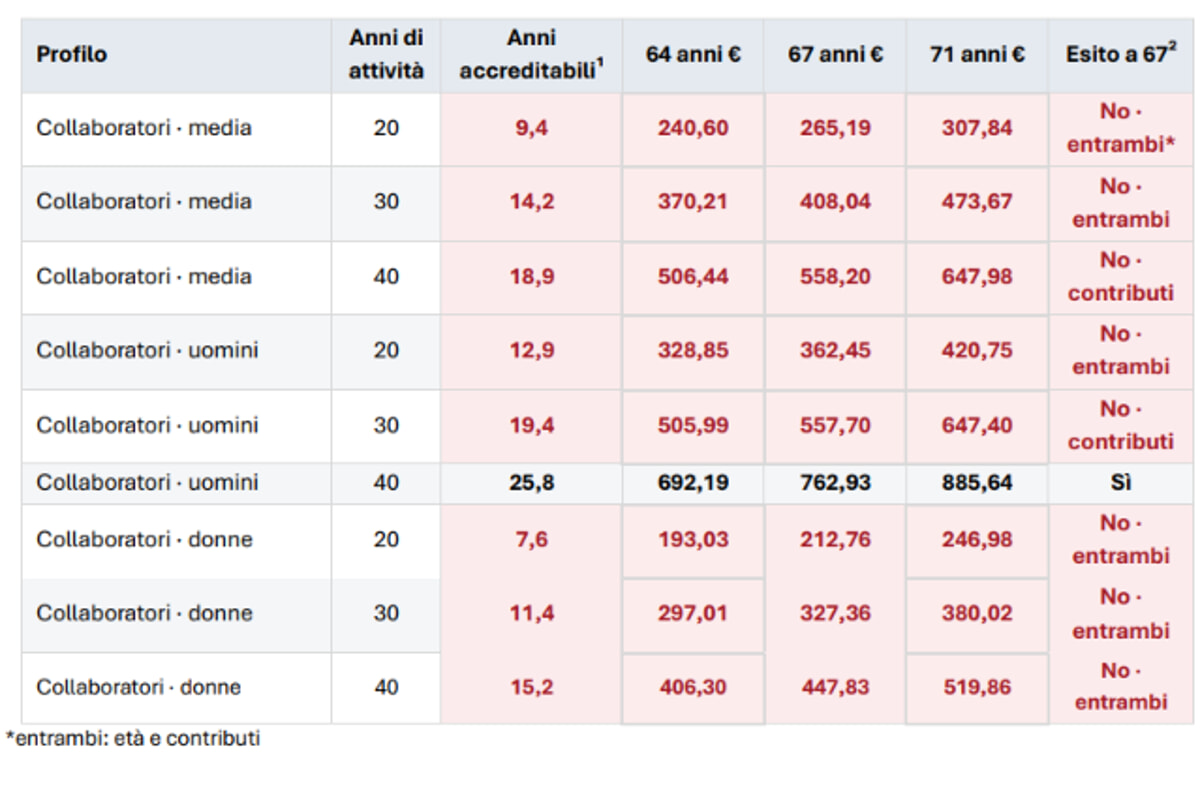
According to the CGIL’s simulations, therefore, with thirty full years of contributions a collaborator would obtain a pension of 864 euros per month at 67, while a professional with a VAT number would receive just 654. But to leave the contributory system at the ordinary age it is not enough to have accrued the required contributions: the allowance must exceed a minimum threshold set by law. For this reason “the only realistic way of accessing a pension for the vast majority of parasubordinates – according to the union – therefore remains leaving at 71 years of age or more”. At that age the amount threshold no longer applies, but the contribution requirement remains necessary. The paradox, observes CGIL, is that the separate INPS management closed 2025 with a surplus of 9.5 billion euros.
The secretary’s comment
Andrea Borghesi, general secretary of Nidil Cgil, commented on the data in the dossier, pointing out that “low incomes remain the main emergency also for this group of workers, and pensions that are impossible to reach are the direct consequence. This is the future that presents itself to 40% of the young people concerned”. To resolve this situation, the union continues to support the need for the “definition of a fair minimum remuneration not lower than that provided for the same professional figures by the national collective bargaining agreement, signed by the most representative trade union organisations, which also constitutes the minimum threshold for the definition of the remuneration of parasubordinates”.
For this reason, Borghesi had announced in recent days, “today 20 November we will be in the streets with collaborators and VAT numbers, on strike against the policies of the government which does nothing regarding income and pensions”.