

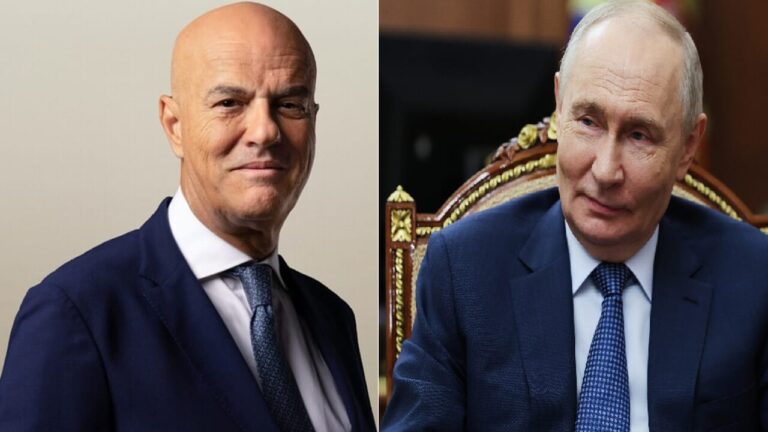
New tensions rekindle old ties. And while the war in Iran makes us rediscover ourselves vulnerable on the energy front, especially after the Hormuz blockade “doubled” by Donald Trump, there are those who profess a return to Russian gas. The latest suggestion comes from Claudio Descalzi, CEO of Eni: the blockade of imports of Russian energy products must be lifted and supplies secured. And the Kremlin has already opened up to the hypothesis. But it’s not just gas to watch out for.
What Descalzi said about gas
For Descalzi, Europe cannot afford the total ban on Russian gas, planned by the European Commission for 1 January 2027. As a guest at the League’s political training school in Rome, Descalzi underlined how the stability of Italy’s electrical and industrial network still depends inextricably on methane.
“On gas, I think it is necessary to suspend the tender that will start on January 1, 2027 on the 20 billion cubic meters coming from Russia,” Descalzi said openly. For the manager of the state company, gas is decisive for keeping the system in balance, unlike “renewables or even nuclear which we don’t have”, adding that “we need gas and we need to realize these things. We have a society that lives on this gas”. For these reasons, the Russian ban is seen as an obstacle to the country’s economic resilience.”
Davide Tabarelli, president of Nomisma energia, also echoed the words of Claudio Descalzi, which “confirm the gravity of the situation a bit. It’s true, now all the attention is and must be on oil and the products that are missing. But let’s not forget that there is also a gas problem”.
The consequences of the Russian gas eliminated in Italy: new power for Trump
Italy had recently “emancipated” itself from Russian supplies, which with the war in Ukraine had caused gas prices to skyrocket to their highest ever, but the continuation of the blockade of the Strait of Hormuz and the cross-attacks in the war in Iran are exposing us to new risks.
To replace the gas coming from Russia, Italy has increased pipe imports from Algeria and invested in new regasification plants to increase the share of LNG, liquefied natural gas. Now more than a third of the national requirement is met by imports by ship in the five active plants, with the United States and Qatar having become the most important suppliers.
Trump supplants Putin, he is the new master of Italian gas: here’s how much it costs us
But the Qatari cargoes won’t be arriving, at least for a while: with a single attack on the Ras Laffan facility, Iran knocked out 17 percent of Qatar’s export capacity, causing an estimated $20 billion loss in annual revenue. Italy is exposed, given that according to the latest available data, Qatar accounted for over a third of LNG supplies.
It means that the recomposition of post-war flows in Ukraine and the problems of Qatari gas give even more space to cargoes coming from the United States, which had already become of primary importance, as reconstructed in an article from Dossier.
How much Russian gas still arrives in Italy and Europe
Before the invasion of Ukraine, gas from Russia made up about 40 percent of our national needs. Now this share is practically close to zero. In Europe the situation is different: the European Commission indicates that the share of Russian gas has fallen to 19% in 2024 and that in 2025 it is expected to decline further to 13%, compared to 45% before the war. For LNG the first supplier is the United States, which accounts for 55 percent of the total and Russia, however, still remains the second supplier with 14.3: it means that between natural gas and LNG there are still around 36 billion cubic meters of Russian gas used on the European continent.
The EU regulation establishes the stop to Russian LNG in two stages: ban from 1 January 2027 for multi-year contracts stipulated before 17 June 2025, while short contracts will already be banned from 25 April 2026. The only valve foreseen is an emergency clause: the ban can be suspended for a maximum of four weeks in the event of a serious threat to energy security.
The opening of the Kremlin
Recently, the Kremlin has reopened the possibility of returning to exporting gas to Europe. Spokesman Dmitry Peskov, quoted by the state news agency Taxhas in fact confirmed Moscow’s willingness to continue supplies to the European Union. But not unconditionally.
“If there were to be some gas left over from supplies destined for alternative markets, why not? At the moment there is gas in abundance and we have excess quantities – explained Peskov – However, the alternative markets are very greedy and make numerous requests for supplies”.
Not just gas: the oil and fuel situation in Italy
Descalzi also spoke about the effect caused by the crisis in the Gulf on the oil market. For Eni’s CEO it is “the most important event of the last 40 years”. To give an idea, Eni’s CEO recalled historical precedents: the war in Iraq, the financial shock of 2008, the Covid pandemic and the Russian-Ukrainian crisis itself caused, in their respective periods, a contraction in supply between 3 and 7 million barrels.
Where are the refineries in Italy and who controls them
Now, due to the war in Iran, according to the manager “4.5 million products and 11-12 million crude products are missing”, a production chasm that risks destabilizing the markets well beyond the short term. In Italy, according to the latest Enea data, the utilization rate of refineries remained below 70%, compared to levels above 80% in Germany, Spain and France. Three countries (Libya, Azerbaijan and Kazakhstan) cover over 50% of total Italian imports, but the United States accounts for just under 14% of the total, a share close to historic highs.
The jet fuel problem
In Italy, the national production of jet fuel, the fuel for aircraft, barely covers half of the demand. “The problem is that more than 30 refineries have now closed in the last 15 years in Europe, so there is a structural shortage, that is, a structural shortage of diesel and also of jets, which is the other problem that is certainly progressing – said Gianni Murano, president of Unem (Energy Union for Mobility), on ’24 Mattino’ on Radio 24 – And this means that diesel prices have skyrocketed. All in all, the price of petrol at the pump is around 1.70 does not raise any major concerns, it is essentially the average of last year. The price of diesel exceeding 2 euros is clearly a warning sign.”
Fuel rationed and flights at risk? What happens, emergency plans and how to avoid the mockery of summer holidays
“Italy imports around 50% of the demand – explained Murano – At a European level there is a shortfall of 10 million tonnes, which is notable, it is massive. If we expand to also include Great Britain, this shortfall becomes 20 million tonnes and you know that Heathrow is the largest airport, at least on this side of the planet. So it is a serious problem, and it is a problem that has been accentuated by having blocked imports from Russia, from which it previously took most of its distillates, and having now blocked imports from the Middle East. We don’t see any problems either for April or May. Let’s say that there are no problems, both for imports and for refinery production. Then we will have to look at the coverage, without forgetting the emergency stocks that still exist.”
The effect on bill and fuel prices
The recent price increase linked to the crisis in Iran has already produced significant effects on the Italian economy: for the month of March, Enea estimates that the cost of imported gas could well exceed 2 billion euros, at least half a billion more than the cost that would have been recorded at the average price of the previous twelve months.
Meloni in Algeria at full throttle (but at a high price): the race against Spain to keep Italy alive
In the case of oil, less data is available for a first estimate of the extra cost of imports in March, but it is still possible to place it above half a billion euros. All this is reflected in the prices of consumer products or in consumers’ gas and electricity bills.