

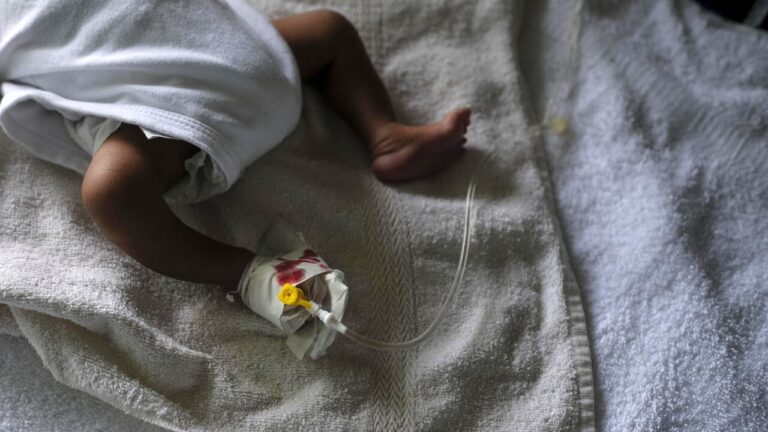
Twins but with different fathers. An extraordinary case that comes from Colombia, where a woman, who went to a genetics laboratory to discover the father of her two children, made a disconcerting discovery. As confirmed by the paternity test, the two children, born at the same time to the same mother, have two different fathers. This is a very rare phenomenon, called heteropaternal superfertilization, of which only about twenty cases have been recorded worldwide.
The case in Colombia
The story began when the woman turned to the genetics laboratory of the National University of Colombia, asking to submit her twins, born two years earlier, to a DNA test. The doctors’ surprise at the first results was such that it led them to repeat the analyzes out of caution. However, the second exam also confirmed the incredible response: the babies, despite being born from the same birth, had different fathers.
Heteropaternal superfertilization
As mentioned at the beginning of the article, this is not science fiction, but a very rare phenomenon, called heteropaternal superfertilization. In the case of close sexual intercourse with different partners, which occurred during the same ovulatory cycle, two separate eggs can be fertilized by the sperm of different men. In fact, as in the case of the Colombian woman, the two twins share the same mother, but the same is not true for the father.
The DNA test
The experts at the University of Colombia, despite knowing the existence of the phenomenon, had never come across a similar case, as highlighted to the local media by Professor William Usaquén, director of the laboratory: “To determine paternity we used a technology called ‘microsatellite markers’. After taking the DNA from the subjects, between 15 and 22 points, called microsatellites, are analyzed and then compared one by one.” “In this case – explained the expert – we analyzed 17 microsatellites in the DNA of the mother, the two newborns and the presumed father who underwent the test. We thus discovered that the genetic material corresponded to that of one of the children, but not to that of the other. I have been in charge of the laboratory for 26 years and it is the first case of its kind that we have seen, and so far also the only one”.
The conditions and the time window
As explained by Usaquén, this phenomenon can only occur in the presence of three different conditions: the mother must have two sexual intercourses in a very short period of time, poly-ovulation must occur, i.e. the release of two or more eggs, and both eggs must be successfully fertilized. A sort of “lottery” at the genetic level, which moreover can only take place in a very narrow window of time. Usually a woman produces multiple eggs, but only one is fertilized. For superfertilization, the second egg must be fertilized within 24 to 36 hours, with the window in some cases being a day or two longer.