

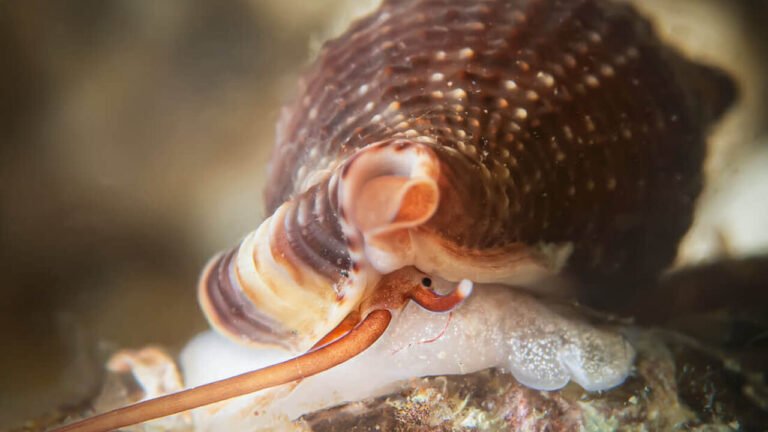
Forget traditional beauty pageants: in the world of marine biology, the closest competition features gastropods, cephalopods and bivalves. And this year we are in the final: the Mediterranean vampire snail, known scientifically as Cumia intertexta, is in fact officially among the potential winners of the title “Mollusc of the Year 2026”.
Organized by the Senckenberg Research Institute and Natural History Museum in Frankfurt in collaboration with Unitas Malacologica – a society that brings together mollusc researchers from all over the world – the competition offers a prize that is anything but symbolic: the complete sequencing of the genome of the winning species. An operation which, in the case of the small local predator, could open the doors to significant pharmacological discoveries. To triumph, however, the vampire snail will need our help: the winner, in fact, is decided by the public vote.
A competition for biodiversity
The “Mollusc of the Year” competition was born in 2020 with the aim of raising public awareness of the extraordinary diversity of molluscs, a group that includes over 85,000 species but which often receives less attention than more iconic animals, such as birds or large mammals. The prize consists in the complete mapping of the winner’s genetic code, a fundamental resource for the scientific community, as it allows us to reconstruct the evolutionary history of these animals, and to identify molecules useful for medicine and industry. In previous editions, the title has been won by spectacular creatures such as the Cuban painted snail (Polymita picta) and the shelled octopus known as argonauta (Argonaut argo).
A silent predator
Cumia intertexta was nominated as a representative of the Mediterranean by an Italian team led by the Anton Dohrn Zoological Station of Naples. It is a small gastropod that lives in the shallow seabed of the southern Mediterranean. Despite its small size, this mollusk has developed a unique survival strategy that has earned it the nickname vampire snail. In fact, it feeds on the blood of fish that rest in the cavities of the rocks during the night. Thanks to an extremely extensible proboscis, which can exceed the length of its own shell, the snail locates its prey and sucks up its vital fluids without it realizing it, after having injected a cocktail of anticoagulants and anesthetics into the prey’s body.
The interest of medicine
The true treasure of the vampire snail lies in the composition of its venom apparatus, with which it anesthetizes its prey and thins their blood before sucking it. Within this cocktail of chemical substances, numerous toxins and proteins with a cytolytic action have been identified that can facilitate access to blood vessels, enzymes that increase the pressure of the fish to speed up the ingestion of blood and neurotoxins that anesthetize the prey during the meal. Medical research is particularly interested in the anticoagulant and antiaggregating peptides present in the venom of the vampire snail, because studying how these molecules manage to keep the blood fluid in fish, which have very efficient clotting mechanisms to avoid bleeding in water, could provide the basis for new cardiovascular drugs. And obviously, the complete sequencing of its genome would allow us to make giant strides in this field.
The final vote
To support the candidacy of the Mediterranean vampire snail you have until April 26th. The challenge is open: the other finalists include equally fascinating species, such as the albino Seychelles snail Filicaulis seychellensisor the giant sea snail Triplofusus giganteuswhich exceeds 60 centimeters in length. Voting takes place on the official competition website and the winner will be announced shortly after the virtual polls close.
Read the other articles on Scienze The Vermilion