

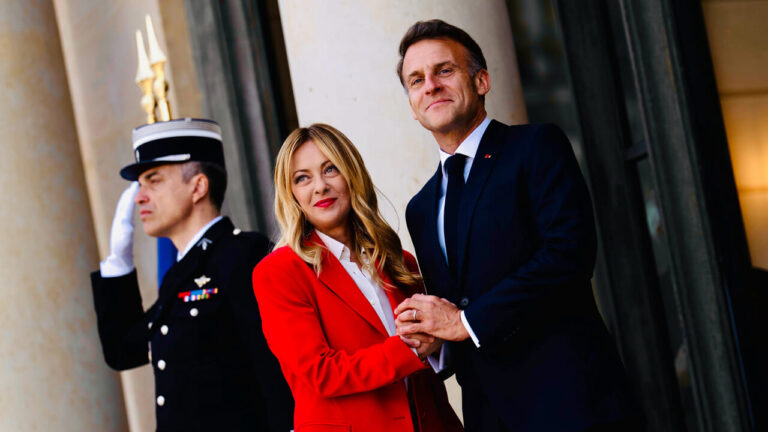
Giorgia Meloni has chosen to align Italy with France and the United Kingdom on the most urgent dossier opened by the crisis in the Gulf: the security of the Strait of Hormuz. At the summit of the “Willing” convened in Paris by Emmanuel Macron, the Prime Minister expressed Italy’s willingness to participate in a future international naval mission, but by setting some precise limits: the operation can only start after a cessation of hostilities, it must have an exclusively defensive posture and, as far as Rome is concerned, it will still require the authorization of Parliament.
The decision, in fact, marks a clear political step. Meloni did not announce the immediate sending of Italian ships to the Gulf, but he brought Italy into the European initiative which aims to guarantee freedom of navigation in one of the most delicate maritime passages on the planet. A strategic corridor through which a significant share of the world’s oil passes and on whose block not only geopolitical balances depend, but also energy prices and therefore the repercussions on the European economy.
What did the “willing” decide
In Paris, the Prime Minister explained that the reopening of Hormuz is “part of any serious negotiation project” on the crisis in the Middle East. The government’s message is clear: this is not a choice dictated by partisan interests, but by a general interest that brings together security, commercial stability and the protection of international traffic. Palazzo Chigi also insists on another point: reassuring the maritime sector and offering a protection framework to ships in transit is a necessary step if we really want to consolidate the truce and prevent new tensions on the energy markets.
The Italian contribution, at least in this phase, is described as consistent with other missions already carried out by the Navy, such as Aspides and Atalanta. In particular, we are thinking about demining activities and possible support for the protection of commercial convoys, with the hypothesis of employing frigates if the scenario makes it necessary. But the key word in the government remains prudence: the mission is considered “open”, with contours still to be defined on a technical and operational level.
The political issue now shifts to Rome. Because if the majority, with Forza Italia and Noi Moderati, has shown itself in favour, the opposition is asking for a stronger legal basis and a mandate from the United Nations. The Democratic Party asks for clarity on the rules of engagement and the international basis of the operation. The 5 Star Movement and the Green-Left Alliance put UN auspices as an explicit condition. Of the opposite nature is Action, which has already given its green light. Matteo Renzi, however, attacks the prime minister on a political level, accusing her of having returned to the European table after having attempted the card of a privileged relationship with Donald Trump.
And it is precisely the relationship with Washington that forms the backdrop to Meloni’s choice. The Paris summit in fact arrives after Trump’s criticisms and in the midst of a phase in which the United States seems to want to remain out of the way from an international mission in the Strait. The Italian government is thus trying to keep two needs together: not to break with its American ally, but at the same time not to leave Europe immobile in a crisis that directly affects its energy supplies and its commercial interests.
Trump warns NATO: “Stay away”. European leaders caught off guard