

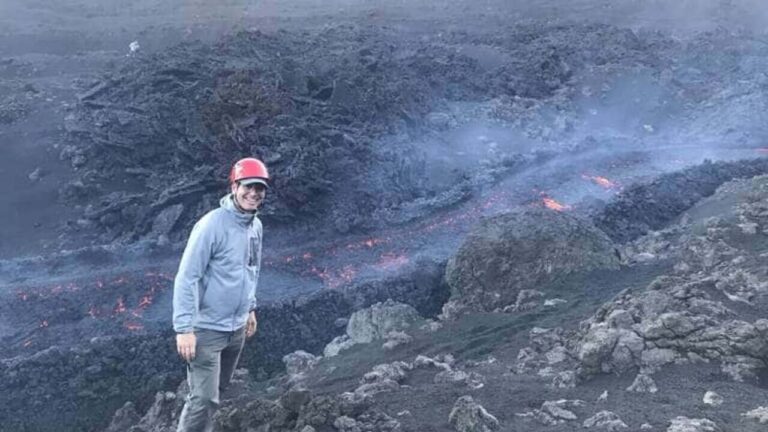
Those who live on its slopes have been saying it for centuries: Etna has a character all its own. And it is no coincidence, because it would appear to be a unique volcano of its kind: a so-called “petit spot”, but the only one in the world ever identified on land. A hypothesis that would explain its frequent and relatively non-destructive eruptions, put forward by a group of researchers from the University of Lausanne and the University of Catania, in an article published in Journal of Geophysical Research.
The anomalies of the Sicilian giant
In the global geological panorama, volcanoes are usually classified into two main categories related to plate tectonics. There are volcanoes that arise along the edges of the plates, such as those of the Pacific “Ring of Fire”, generated by the collision or separation of continental masses. Then there are so-called “hotspots”, such as Hawaii, where magma rises from plumes deep in the mantle, regardless of plate boundaries.
Etna, however, clearly does not fit into any of these definitions. Despite being close to a subduction zone, its eruptive activity and the chemical composition of its lavas present characteristics that have left geologists uncertain for decades: its position is eccentric compared to classical models and the volume of material emitted does not correspond to the typical parameters of margin volcanoes.
The petit spot theory
The new study proposes a third way: Etna would be a “petit spot”, a category of volcanoes described only in the last 20 years, very small and young and usually positioned on the ocean floor. Their genesis does not depend on large convective currents in the mantle, but on simple fractures of the lithosphere, the outermost and rigid layer of the Earth. When a tectonic plate flexes or stretches, cracks are created that allow small amounts of magma, located just beneath the crust, to rise to the surface. Until now, “petit spots” had been observed exclusively in underwater contexts, such as off the coast of Japan or Greenland. If confirmed, Etna would represent the first and only case in the world of this phenomenon occurring on land.
A fissure one hundred kilometers deep
The study explains that the formation of the Sicilian volcano would be linked to the bending of the African plate as it slides under the European one. This movement would have generated enough tension to tear the earth’s crust, creating a natural conduit that draws magma from a depth of about 100 kilometers. It would therefore not be an immense and deep magmatic reservoir like that of the large hotspots, but a system fueled by crustal relaxation processes.
This fissure structure would explain why Etna is so active: the path to the surface is constantly open or easily reactivated by regional tectonic movements. The research analyzed the geochemical and geophysical data of the area, highlighting how the composition of Etna’s lavas is compatible with the gas-poor magmas typical of oceanic petit spots, although the total volume of the volcano has grown significantly over time due to the persistence of the fracture.
Identifying Etna as a petit spot is not just a question of scientific taxonomy, but has direct implications on understanding volcanic risk. The study suggests that Etna will continue to exhibit frequent activity but characterized by lava flows which, although spectacular and sometimes dangerous for local infrastructures, rarely take on the catastrophic explosive character of subduction volcanoes. Furthermore, this discovery opens up new avenues in geology: researchers will now have to verify whether there are other minor volcanic systems, so far misclassified, that could respond to the dynamics of the continental petit spot, changing our Earth’s heat map.