

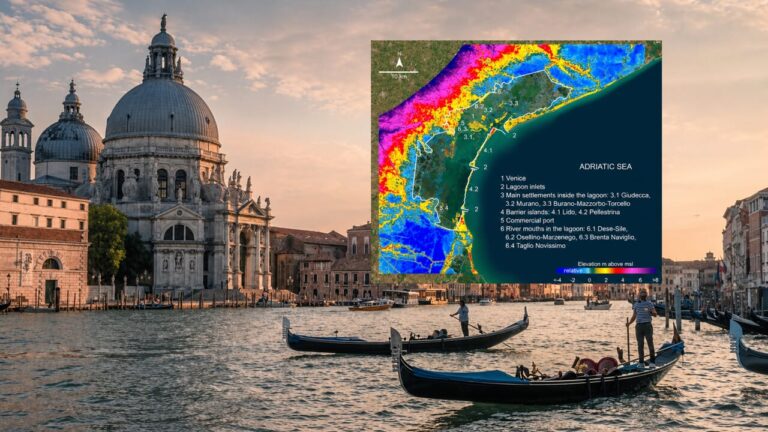
For over 1,500 years Venice has lived in symbiosis with its lagoon, between shallows and tides. In the last century, however, the balance has been broken: high water is no longer a temporary inconvenience, but an existential threat. Climate changes are causing the slow and constant rise of sea waters, while the lagoon city sinks under its own weight. And adaptation and mitigation interventions, however valuable, will not be enough to save it in the long term. According to a study published in the journal Scientific Reportswithin a couple of centuries the only way to preserve the most iconic monuments of the Serenissima could be the most radical one: dismantling them and rebuilding them inland.
The MOSE is not enough
Currently, the main defense of Venice is entrusted to the Mose, the system of mobile gates designed to isolate the lagoon from the sea during extreme tidal events. But its effectiveness has a technical expiration date. The research – carried out by an international team of experts including researchers from the University of Salento, Ca’ Foscari and Ismar Cnr – explains that the mobile gate system was designed to intervene in the event of extreme events, not for permanent closure. With the water level continuing to rise, however, in the coming decades the barriers may have to remain raised more and more often, even for weeks at a time, almost constantly isolating the lagoon from the sea, with very high costs and critical consequences for biodiversity and port activity.
The hypothesis of lifting through water injections
To try to buy time, the researchers evaluated even more invasive engineering solutions. One of the proposals discussed concerns the fight against subsidence (the sinking of the city) through the injection of sea water into the subsoil. The objective would be to inflate the rock on which the city rests, raising it by about 30 centimetres. The operation has actually been proposed, even though it would have astronomical costs and would pose significant structural risks for the historic buildings.
Even with a similar strategy, however, the truce would only be temporary: together with the MOSE, it could defend Venice up to a one meter rise in sea water levels. Current projections say we could surpass it by the end of the century. And at that point, the measures necessary to save the city will become even more extreme: a breakwater barrier that completely isolates the lagoon would, for example, protect the city up to a five-metre rise in water levels, but would irreparably modify the lagoon environment and city life.
The scenario in 2300
Isolating the lagoon with a barrier of rocks, according to the calculations contained in the research, would cost between 500 million and 4.5 billion euros. Of the masonry embankments also 30 billion. But if current pollution trajectories do not undergo a net deviation, by 2300 sea levels could rise five meters higher than current levels. And at that point, no barrier or underground injection will be able to protect the town. The only possibility to preserve the thousand-year history of Venice will be to give up the lagoon, moving the Basilica of San Marco, the Doge’s Palace and the other incredible monuments of the city to safe areas inland. The cost would exceed 100 billion euros. And the city that has challenged the sea for over 15 centuries could be forced to abandon it permanently. This – obviously – if we are unable to effectively combat the climate changes we are causing on our planet.