

That this is a delicate moment can be understood from the palpable tension within the governing majority. In her speech in Parliament on Thursday 9 April, the Prime Minister clearly indicated this, even evoking the possibility of resignation: “It would probably have been convenient, on a tactical level – urged Meloni – to invoke the elections to play on the surprise effect, on the division of the opposition forces and, in the worst case scenario, leave the task of putting a face on the difficult months to come to someone else”.
The reference is to the energy shock which could have significant consequences, with increases in the prices of fuel but also of raw materials and, consequently, repercussions on all Italian consumption. A crisis that is grafted onto a situation of strong structural fragility for our country, beyond the optimistic proclamations of recent months by the executive.
The risk of “stagflation”
The real specter hovering over the economy is that of stagflation: a phase of low or no growth accompanied by high inflation. This is a phenomenon that particularly characterized the 1970s, following the oil crisis linked to the Yom Kippur war, and is typically associated with strong energy shocks.
It’s a particularly difficult scenario for governments to manage. If we intervene to support growth, we risk further fueling inflation; if instead you aim to contain prices, you could end up depressing the economy even more. For Italy, the risk is amplified by the high public debt, which limits the margins for fiscal intervention: any new support for families and businesses must deal with increasingly stringent budget constraints.
The ECB’s alarm on inflation and halved estimates for growth
It is no coincidence that, precisely in this regard, Rome is pushing to modify the stability pact which, however, Meloni’s own political group contributed to signing and which is today being contested.
During the 2022 energy crisis, following the Russian invasion of Ukraine, the Italian government spent tens of billions to control bills and fuel: measures that were effective in the short term, but difficult to replicate on a large scale. Today the fiscal space is narrower, also in light of the return of European budget rules. This means that any new interventions will have to be more targeted and probably less generous. And above all not painless: the cut in excise duties, introduced in March and extended until May 1st, for example, had an impact of around one billion euros per month, resources subtracted from other budget items.
Meanwhile, the risk is that rising energy costs will result in a new wave of inflation and a significant brake on growth. According to the ECB, the rise in energy prices could bring inflation back “above 2% in the short term”, while an increase of up to 3.1% is expected in the second quarter of 2026.
These are, of course, predictions: no one knows at the moment how the crisis in the Middle East will evolve. However, it is indicative that, at least for now, European authorities, such as Energy Commissioner Jorgensen, are calling for a reduction in energy consumption.
Meanwhile, Italy’s growth forecasts for 2026, developed in Standard & Poor’s Global Economic Outlook, have also been revised downwards: from 0.8% to 0.4%. Data that fits into a context of structural fragility for the country that has continued for years.
Industrial growth and production during the Meloni government
Despite a particularly substantial Pnrr (which will enter its final phase in 2026), Italy in 2025 grew less than Spain and France and about half the European Union average. More generally, as can be understood from the graph below, growth was not particularly sustained during the years of the government led by Giorgia Meloni, who focused more on financial stability than on supporting the real economy.
Another signal comes from industrial production, i.e. the index that measures the physical volume of goods produced by the manufacturing industry. It is one of the most used indicators to evaluate the health of the real economy, because it reflects the demand for goods, business investments and the trend in employment in the sector. According to Istat, this index is in almost continuous decline starting from 2022.
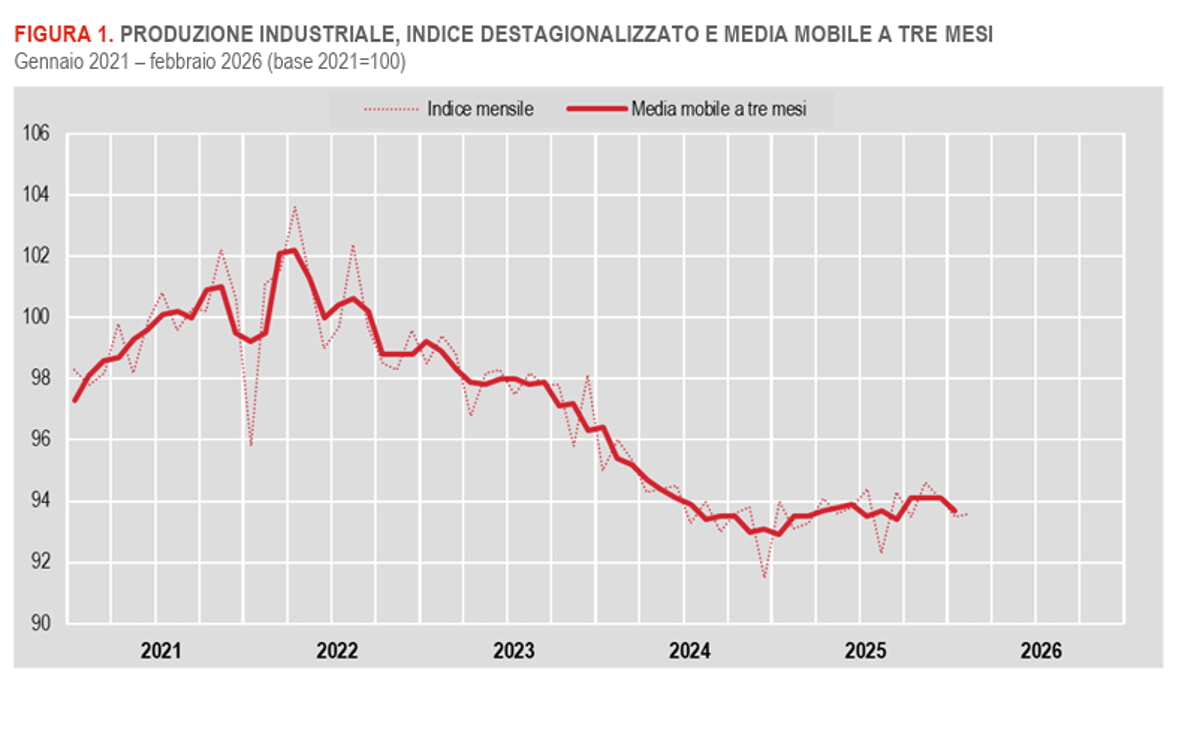
A dynamic also linked to the energy shock following the Russian invasion of Ukraine, which put pressure on the most energy-intensive sectors in particular, including the automotive sector. The trend, however, does not bode well, especially if energy price increases continue. And the repercussions can also be seen on one of the structural nodes of the Italian economy for over thirty years: wages.
The problem of low wages (and its structural causes)
The problem of low wages certainly did not arise with the Meloni government. As already observed, Italy has been suffering from substantially stagnant wage dynamics for years, with wages stuck at the levels of the 1990s. A phenomenon that has become very relevant again starting from 2022, when inflation started to bite again, heavily impacting the standard of living of families.
Just to give an example: between 2019 and 2024, contractual wages lost 10.5% of purchasing power due to strong price growth. Today the scenario presents itself again with the energy crisis, despite the timid signs of recovery also felt thanks to the government’s tax wedge cut, which has lightened the contribution burden on paychecks for incomes up to 40 thousand euros.
The real Achilles’ heel of the Italian economy, however, is linked to other factors, primarily productivity. Labor productivity measures the average value of goods and services produced by each worker in a given period of time. For a company, high productivity translates into greater profits, growth and competitiveness; at a national level it directly affects GDP. It is also a key factor for workers, because it tends to be accompanied by higher wages, better opportunities for professional growth and, not infrequently, a reduction in hours worked for the same pay.
The problem is that labor productivity in Italy has been stagnant for years and, in the last five, has even recorded a decline compared to the main European countries, as can be seen from the graph above. The increase in employment claimed by the government in recent years is instead concentrated in sectors such as tourism, catering, retail trade and logistics: areas characterized by low added value, low productivity and a high incidence of involuntary part-time work, often associated with poor working conditions.
Inflated prices, the document that reveals the extra earnings on electricity bills
The other big elephant in the room is the cost of energy, which in Italy remains significantly higher than in other European countries. Just to give an example, according to data from the GME (Energy Markets Manager), the average price of wholesale electricity in Italy was around €116/MWh, compared to 87 in Germany, 65 in Spain and 61 in France in the period between January and October 2025.
A ballast that weighs on industrial production (and, indirectly, also on wages) which does not allow us to look at the coming months with too much serenity. And that doesn’t make you sleep peacefully even near Palazzo Chigi.