

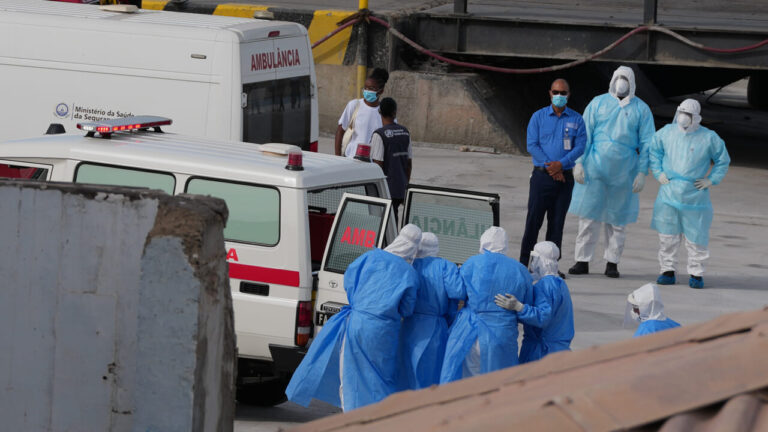
A Dutch flight attendant has been admitted to isolation in Amsterdam hospital with mild symptoms compatible with hantavirus. It is not yet a confirmed case, but it is a sign that the tracking of the epidemic linked to the Mv Hondius cruise ship is expanding beyond the confines of the ship: airports, international flights, passengers who have already returned to their respective countries and contacts that occurred during movements following disembarkation.
The woman, originally from Haarlem, according to what was communicated by the Dutch Ministry of Health to the public broadcaster Noshad come into contact in Johannesburg with the 69-year-old Dutch passenger of the Mv Hondius, who later died on 26 April in South Africa. The flight attendant has mild symptoms and has been hospitalized and isolated while awaiting tests. The contact apparently occurred after the Dutch passenger, already ill, had briefly boarded the KLM flight which left Johannesburg on 25 April and headed to Amsterdam (KL592). The airline explained that, given her health condition, the crew decided not to allow her to fly. The woman was then taken off the plane and died the next day in a Johannesburg hospital.
Hantavirus, the case that rewrites the contagion among cruise ship passengers (and among those who have already flown home)
KLM said that, as a precaution, the public health service is informing all passengers on that flight. The Dutch National Institute for Public Health and the Environment (Rivm) has indicated that there is evidence of possible person-to-person transmission of the Andes variant of the hantavirus, but has specified that this is a very rare event and linked to very close contact.
Three dead on the MV Hondius
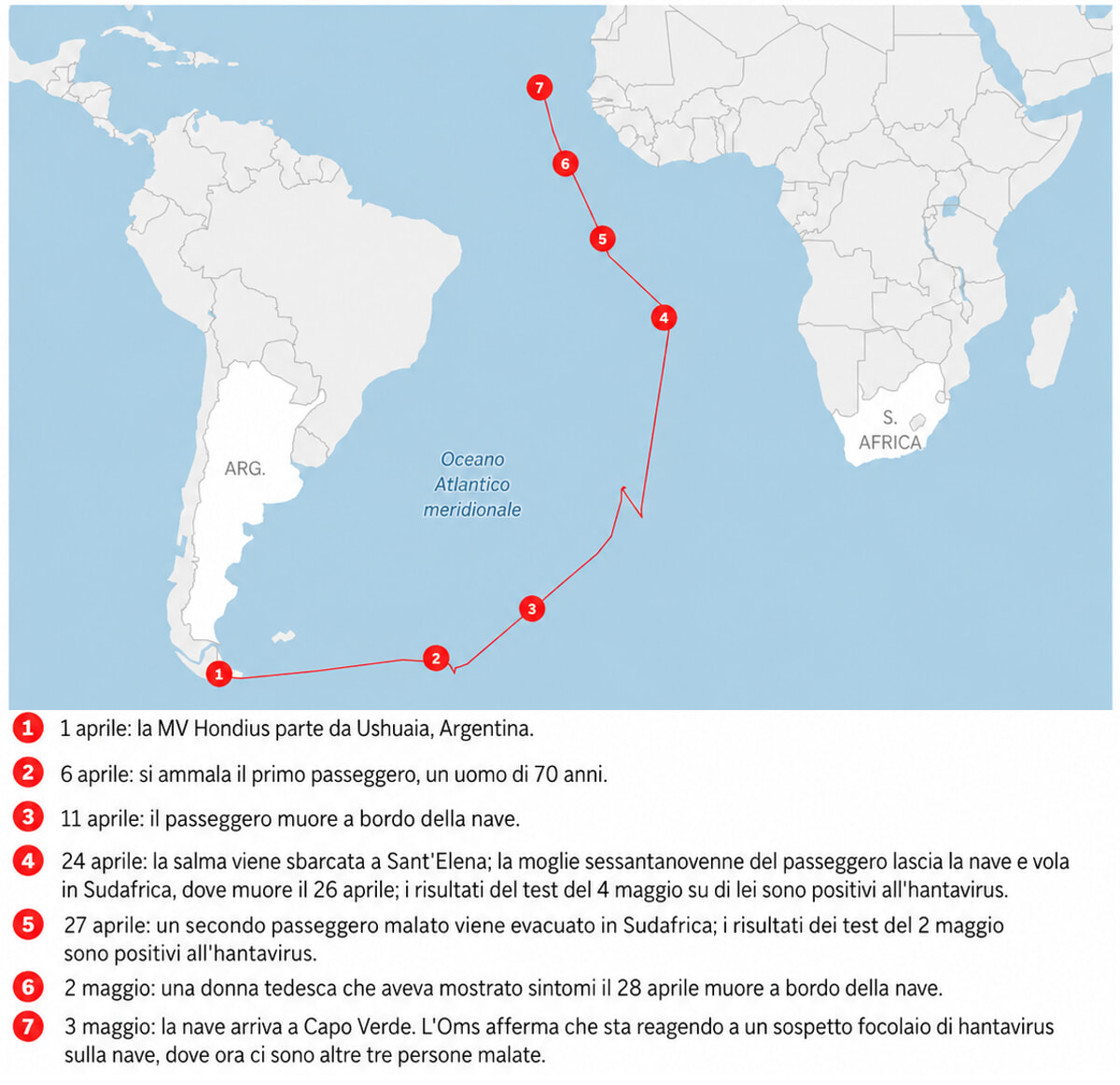
The story began on board the Mv Hondius, a cruise ship flying the Dutch flag and managed by Oceanwide Expeditions, which left Ushuaia, in southern Argentina, for a cruise in the South Atlantic. There were around 150 people on board, including passengers and crew, of 23 different nationalities. It is hypothesized that the Dutch couple – who later died – contracted the virus during an excursion to Ushuaia, Argentina, where they visited a landfill and where they may have come into contact with mice carrying the infection.
To date, international health authorities have recorded eight cases linked to the outbreak and three deaths: the Dutch couple and a third person of German nationality.
The first death occurred on April 11 when a Dutch passenger died on board the ship after developing a severe respiratory syndrome. His wife, 69, later landed on the island of St. Helena while experiencing symptoms such as fever, headache and gastrointestinal distress. From there, on April 25, he took an Airlink flight to Johannesburg, where his condition worsened.
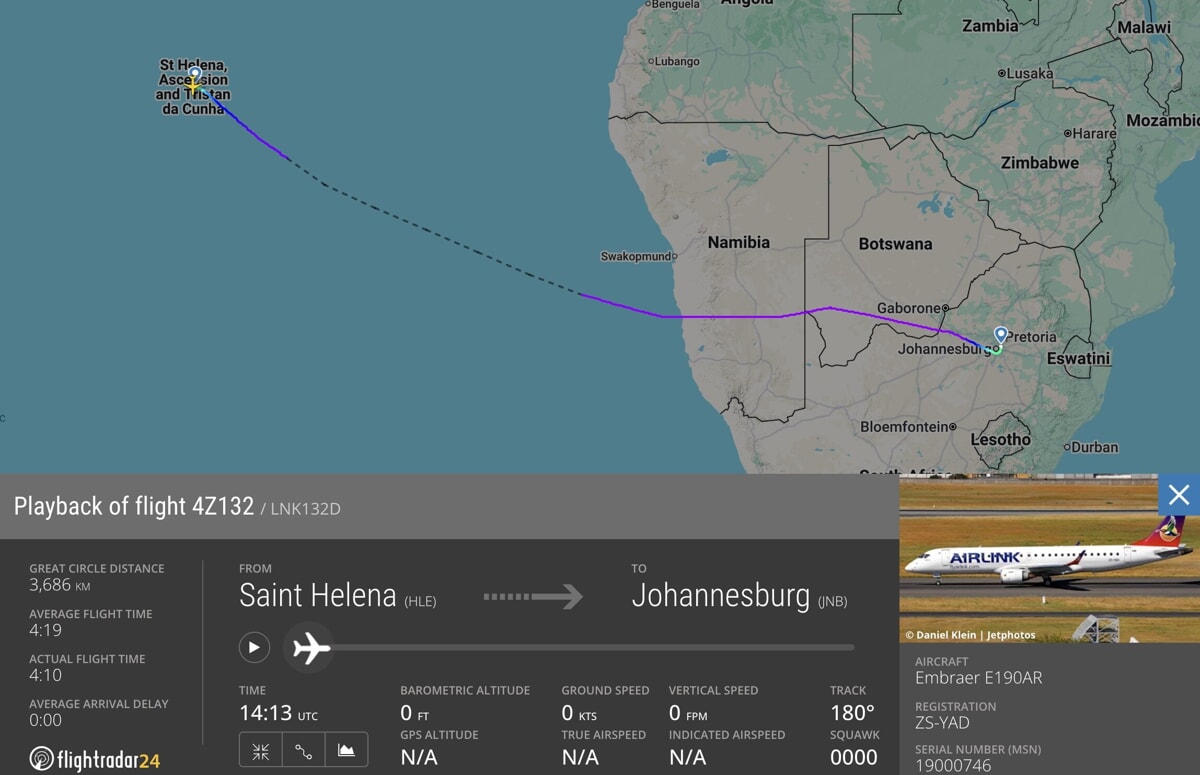
On the same day, April 25, the woman attempted to board the KLM flight to Amsterdam, but was stopped because she was too ill. She died on April 26 in the emergency room of a hospital in the South African city. The third victim, a German citizen, died on May 2 on board the Mv Hondius, after developing symptoms compatible with pneumonia.
The main concern now comes from the 23 people who landed in Santa Elena on April 22 and who until three days ago were able to travel around without having received any health alert. Many of these people would have returned home, among them – according to what was reported by the passengers who remained on board – there were Australians, Taiwanese, Americans and English.
The Andes variant, the one that can pass from man to man
The strain identified in the outbreak is the Andes hantavirus, a variant present mainly in some areas of South America, in particular Argentina and Chile. It is the only hantavirus variant for which limited person-to-person transmission has been documented.
However, this does not mean that it spreads like the flu or Covid. The World Health Organization and European health authorities emphasize that human-to-human contagion is rare and generally requires very close and prolonged contact. The risk for the general population is considered low. The concern, in this phase, concerns above all the reconstruction of the chain of contacts: those who have shared cabins, journeys, flights, treatments or moments of assistance with people who are already symptomatic.
Hantaviruses, in the vast majority of cases, are transmitted from rodents to humans through contact with urine, feces or saliva of infected animals, often by inhaling contaminated particles in closed or poorly ventilated places. Symptoms may begin with fever, muscle aches, headache, nausea, or diarrhea, but in more severe cases may progress to respiratory failure, shock, and cardiopulmonary compromise.
The ship towards Tenerife
The Mv Hondius, after remaining off the coast of Cape Verde, left the area headed towards Tenerife, in the Canary Islands. Spain agreed to receive the ship after a request from the WHO and European authorities, explaining that Cape Verde would not have the medical capacity necessary to manage the entire operation.
Before departure, three people were evacuated: two with symptoms and a third considered a close contact of one of the victims. Two patients have arrived in the Netherlands, while an asymptomatic German passenger, indicated as a close contact of one of the dead people, is expected to be taken into care in Germany for checks. Also in this case there is currently no talk of a new confirmed case.
Infectious disease specialists were sent on board the ship to monitor the situation during navigation. According to the authorities, the passengers and crew members still on board do not show symptoms. Once arrived in the Canary Islands, the ship should undergo health checks, screening of passengers and crew, contact management and subsequent transfer to the countries of origin.
Tracking expands in Europe
The case of the Dutch flight attendant is not the only sign of the extent of tracking outside the ship. In Switzerland, a passenger on the Mv Hondius was hospitalized in Zurich after testing positive. The wife, despite having no symptoms, has placed herself in precautionary self-isolation.
France was also involved in the checks: the French Ministry of Health announced that a French citizen was identified as a contact case because he was on a flight taken by one of the infected people before hospitalization. This is not a positive case, but a person potentially exposed and therefore included in health surveillance.
In the United Kingdom, meanwhile, health authorities are monitoring British citizens who were on board the ship or who disembarked before the alarm. Some may be asked to isolate as a precaution, given the long incubation of the infection, which can last several weeks.
It is not a global alarm, but a chain to be rebuilt
The MV Hondius case is not a global alarm, but it has become a delicate test for international health. The ship has crossed multiple territories, some passengers have already disembarked, others have taken international flights, and now tracing must follow a network of contacts distributed between South America, Africa and Europe.
The news of the KLM flight attendant hospitalized in Amsterdam changes the point of observation: the attention is no longer only on the ship, but also on the contacts that occurred after the disembarkation of the sick. In particular, some critical issues would result from the difficulty of the WHO in obtaining the list of the 85 passengers on the flight in which the Dutch woman infected with the hantavirus who died shortly after disembarking was present, contacts who could fall ill in the next 8 weeks.
Add The Vermilion as your favorite source on Google