

Evgen is sitting in the garden of Sasha’s house. He repairs vehicles for volunteers. There are long pauses of silence between them, while they drink coffee. They speak Russian, they always have. Russian-speaking, but not pro-Russian. They could never be. Their neighborhoods, here in Kharkiv, have been devastated by the Kremlin’s criminal rampage. As is Saltivka, a living example of that destruction.
The following day Evgen must accompany Genia and Ihor, two other volunteers, for an evacuation to Donbass. There is also an Italian with them, Andrea, who arrived with an armored van. Here we think about survival percentages and this van increases them compared to a normal vehicle. The war continues to mark lives, even if it seems to have disappeared from the newspapers or relegated to reports of attacks that forget those who suffer them: their names, their stories, who they really were.
The journey of volunteers who save Ukrainian civilians
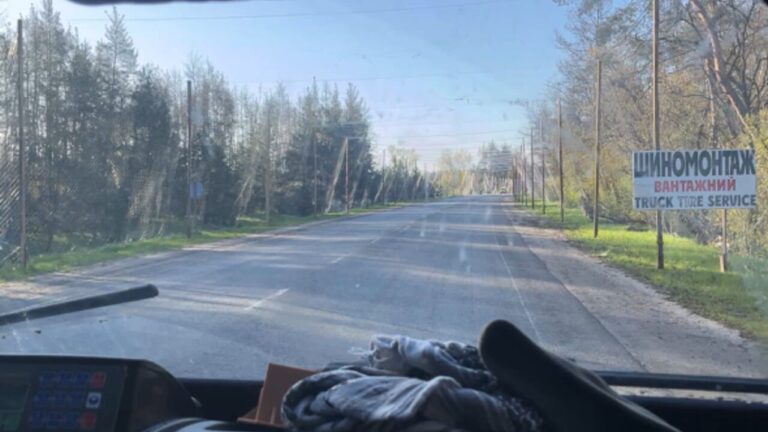
On the road to Kramatorsk the drone beacons have just activated. We are racing at around 130 per hour, speeding under a tunnel of nets protecting the access road. It’s a race against time and against the invisible.
In Sloviansk, in a school, volunteers load the first people. A Kab alert, the flying bombs, comes in just as they are checking the documents. You have to go to the basement. Guided bombs have become, together with drones, an everyday occurrence.
The refugees are then taken to Lozova, about fifty kilometers west of Kramatorsk, to another school complex which hosts hundreds of people assisted by the United Nations and Caritas. We find Valentina, who ran away from Kostyantynivka with her daughter. It shows a chat on Viber: “Every morning here they write how many people are dead, missing or injured. In the last week alone we have lost ten.”
Valentina says that there is a lack of doctors in the city: “When people are injured, they are destined to a slow death. It happened to an elderly woman whose legs were torn apart by a mine. She could have been saved if there had been a doctor, but instead she bled to death. I don’t know what I would do to that Putin if I found him in front of me. I would throw a bomb at him, really. For all the children and acquaintances who died.”
Civilians fleeing Donbass
Yulia is queuing at the entrance to the building to register. “It’s the third time we’ve had to flee: we did it in 2014, at the beginning of 2022 and now. My husband stayed in Sloviansk to make sure things don’t get stolen from our house; he says that’s his whole life. If the front were to get closer again, I’ll go and grab him by the hair. I would really like to go home, my roots are there. But I can’t.”
Yevhen Zvonyaryov, 57, is one of the volunteers who continue to carry out evacuations without stopping: “For me it is not a job, but a spiritual necessity born to react to the panic of 2022”. Yevhen has seen the face of the conflict change. If at the beginning the fear was artillery, today the nightmare is drones: machines that see, aim and hunt.
“One day I was unloading aid and I didn’t realize that a drone was right above my head. Luckily it didn’t hit. I believe that God is watching over me from up there, that he knows that my time hasn’t come yet, that I have to stay here, on this earth, because in this way I can make myself useful to others.”
Dossier is the exclusive subscription investigative section of The Vermilion. If you want to support our journalistic work and subscribe, visit our shop window by clicking here.