

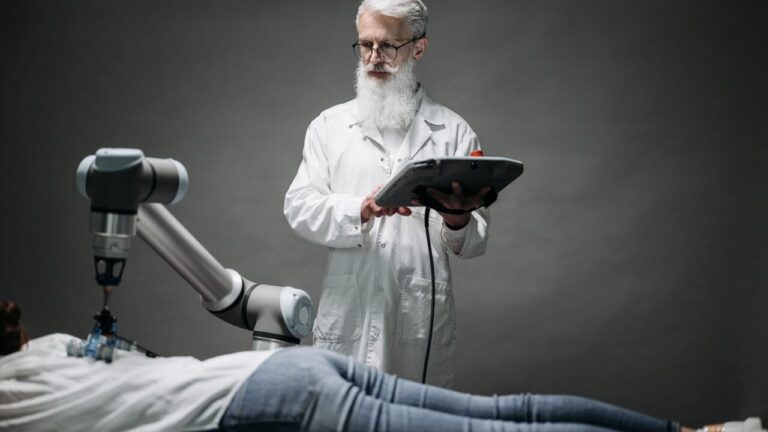
Artificial intelligence is making its way into hospitals around the world. And if today more and more doctors and nurses use it daily in their work, at the same time a growing share is worried about the excessive reliance on AI in daily practice. A recent survey carried out in the United States and discussed in an article published on Naturereveals for example that 75% of healthcare professionals interviewed are afraid that the habit of using artificial intelligence tools in clinical practice could compromise, in the long run, their professional skills, especially in contexts where they cannot rely on new virtual assistants.
The case of endoscopy
One of the proofs of this deterioration comes from gastroenterology. In fact, the article cites research published recently on Lancet Gastroenterology and Hepatologywhich monitored nineteen expert endoscopists, with at least 2 thousand colonoscopies under their belt, during the introduction of an artificial intelligence system for the identification of adenomas, a form of benign polyp. The results indicate a clear decline in performance: in the three months before the tool’s arrival, on average endoscopists identified an adenoma in 28.4 percent of endoscopies performed.
In the following three months, the percentage of diagnoses made during endoscopies performed without AI assistance dropped to 22.4 percent. An evident drop in performance, which the authors of the study attribute to the fact that the participants, once accustomed to the new tool, were “less concentrated, motivated and aware of their responsibilities”, when they found themselves making cognitive decisions without the assistance of the AI.
A loss of knowledge
The loss of effectiveness, in this case, therefore does not seem to be linked to a real loss of practical and theoretical notions, but rather to a behavioral change and a decline in attention due to the habit of delegating part of one’s responsibilities to the AI. The fear of several experts, however, is that the decline in performance caused by the massive use of these new tools could also affect more general skills, such as learning, and the cognitive processes necessary for problem solving.
To illustrate the problem, it may be useful to refer to a study carried out in a field distant from medicine, but equally specialized and based on fundamental theoretical skills: that of computer engineering. The research, conducted by Anthropic, involved fifty-two programmers engaged in a coding task. Half of the group was given the support of a digital assistant, while the others worked using only normal online documentation resources. The developers assisted by the algorithm completed the task in slightly shorter times, but showed that they had learned less while carrying out the tasks: subjected to a questionnaire designed to verify the skills acquired, the programmers who had had the assistance of the AI obtained results 17% lower than those who had carried out the task based only on their own strength.
What to do?
The problem is obviously not new: every new tool that facilitates learning and carrying out cognitively complex tasks is destined to make us dependent in some way. Even using the internet, or Wikipedia, or GPS, or relying on computers and telephones is a way of externalizing our knowledge, and makes us less capable when we have to do without it. However, with AI this phenomenon could come into play to the nth degree. And many think that it is a problem that needs to be addressed before it is too late, especially for key professions such as those related to health, where we would not want to depend on the internet connection or the functioning of computers and smartphones to ensure optimal diagnoses and treatments.
“Today we are witnessing a strange disconnect between performance and learning,” commented Kevin Crowston, information scientist at Syracuse University in New York, in an interview with Nature. “Many people can have high-level results because they are basically borrowing the knowledge of artificial intelligences, but without developing that same knowledge themselves.”