

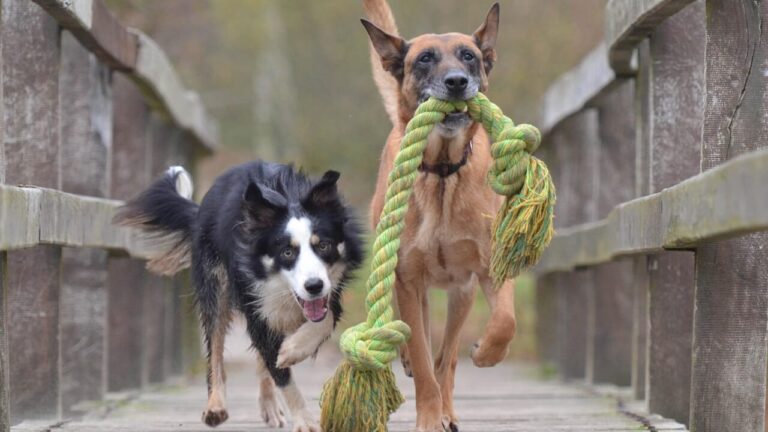
It’s not always just the desire to play. For some dogs, attachment to the ball, rope or favorite toy can turn into a compulsive behavior, with characteristics that resemble those of addictions observed in humans.
This is indicated by new research published in the journal Royal Society Open Scienceconducted by scholars Alja Mazzini and Stefanie Riemer.
When the ball becomes more important than the food
The work extends the results of a previous experiment and tries to understand which dogs are most predisposed to developing extreme motivation towards playing. During the experiments, the dogs were subjected to various tests. In one of these they could choose whether to focus on the favorite toy, on the food or on the interaction with the owner. The specimens with the highest scores continued to look for the ball even when food rewards or attention from the owner were available. When the toy was made unreachable or hidden, some remained in a state of agitation for a long time, staring at the location of the object or persistently trying to retrieve it.
Even after all toys were removed, several dogs failed to relax for the next 15 minutes. In some cases the agitation was so intense that the animals tried to force or damage the container in which the object had been enclosed. The researchers also observed dogs willing to continue playing even though they were visibly tired or had minor injuries. Precisely the continuous search for gratification, despite possible negative consequences, is one of the criteria used to identify behavioral addictions in human beings.
The most predisposed breeds
The highest scores were recorded especially among sheepdogs, followed by terriers and retrievers. In particular, among the dogs most represented in the group with compulsive behaviors were above all the Belgian Shepherd Malinois and the Border Collie, followed by the Labrador Retriever.
It’s not a coincidence. These are breeds selected for generations to work alongside humans, maintain concentration for a long time, chase a target, retrieve objects or carry out repetitive activities with very high motivation.
The Malinois is frequently used by law enforcement and in research activities. The Border Collie was selected to lead and control livestock, while the Labrador has a strong predisposition for retrieving. These characteristics, precious in work and in dog sports, could in some specimens favor the development of an excessive interest in playing. The study therefore indicates a possible genetic component, although the environment, training and habits created by the owner can contribute to strengthening certain behaviors.
However, the authors speak of “addiction-like” behaviors, not of a clinical diagnosis equivalent to gambling addiction or video game addiction in humans. Further research will be needed to establish precise diagnostic criteria and understand how widespread the phenomenon is among all dogs.
In the meantime, owners can prevent excesses by alternating play with walks, olfactory activities, self-control exercises and moments of rest. If the ball becomes the animal’s only interest and its absence causes severe suffering, it is advisable to contact a veterinary expert in behavior.