

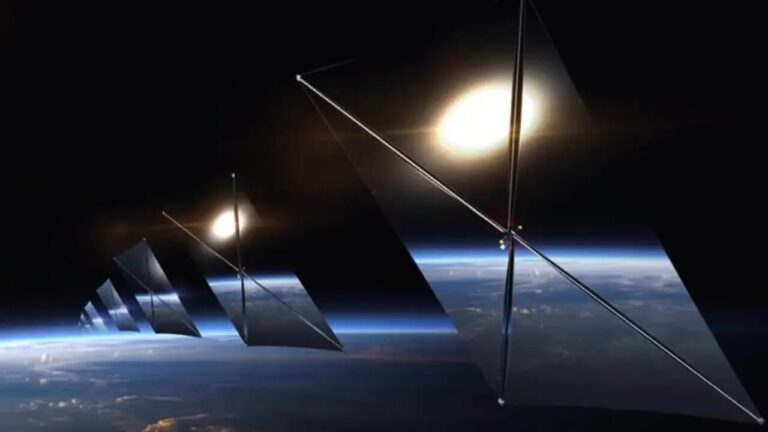
Soon even darkness could become a service to be turned on and off on command. It is the project of Reflect Orbital, a Californian startup that is developing a constellation of satellites equipped with large reflective surfaces, designed to channel the Sun’s light towards targeted areas of the Earth’s surface after sunset.
The idea is to offer “sunlight on demand” to photovoltaic parks, construction sites, rescue teams, remote areas and possibly agricultural fields or event spaces. Founder and CEO Ben Nowack has indicated, during presentations and interviews, a possible rate of around $5,000 an hour for the light produced by a single mirror, provided you sign a contract for at least a thousand hours a year.
Built a space mirror, launching soon pic.twitter.com/z6oWzQoeI0
— Ben Nowack ☀️🌎🪞 (@bennbuilds) March 11, 2026
The project has already attracted protests from astronomers, biologists and light pollution experts, who fear consequences for scientific observations, the circadian rhythms of people and animals, ecosystems and the safety of drivers and motorists. Reflect Orbital, however, just got a crucial first green light. On July 9, 2026, the Space Bureau of the Federal Communications Commission authorized, with a series of conditions, the deployment and use of the first demonstration satellite and the radio frequencies necessary to control it.
The test and the commercial roadmap
The first prototype of Reflect Orbital, called Eärendil-1 (yet another name taken from Tolkien’s universe, already plundered hands down by American big tech companies such as Palantir and Anduril Industries), will operate in a near-polar orbit of around 640 kilometres. Once positioned, the satellite will deploy a mirror made of reflective material of approximately 18 metres, designed to direct a beam of sunlight towards the Earth’s surface, creating a circular light spot with a diameter of approximately five kilometres.
Obviously, the test will only be the beginning: Eärendil-1 will be able to produce in the area on which it will concentrate its light beam a brightness comparable to that of a full moon night, but the startup plans to scale the constellation in the coming years, and by 2028 it aims to launch 1,000 satellites equipped with larger mirrors, up to 55 meters wide, capable of reflecting a brightness equivalent to 100 full moons for about two hours a day. The goal for 2030 is to put 5,000 satellites into orbit, rising to a fleet of over 50,000 by 2035, capable of providing up to 36,000 lux for several hours, simulating full daylight. The use that Reflect Orbital has in mind is a hybrid one: its technology – they explain – could replace night lighting, help during disasters and emergencies, and provide hours of extra lighting to photovoltaic parks, increasing their production capacity.
Also in this case the company’s forecasts are gradual. With more than 5,000 satellites in 2030, Reflect Orbital estimates a capacity factor increase of about 1 percent, providing 50 watts per square meter for twenty minutes. Only in the scenario foreseen for 2035, with over 50,000 satellites, the company hypothesizes an increase of up to 20 percent, thanks to an irradiation of 300 watts per square meter for three hours.
The economic model
The business model proposed by Ben Nowack, co-founder and CEO at Reflect Orbital, is based on the delivery of light on demand. The company plans to charge about $5,000 per hour for light reflected from a single mirror, tied to a minimum annual contract of 1,000 hours. For the lighting of extraordinary events or emergency situations, costs will be higher due to the complexity of coordinating a greater number of satellites, necessary to bring the brightness to daytime levels. In the case of photovoltaic parks, the company instead provides for a sharing of the revenues deriving from the electricity produced during additional night hours. According to its inventors, this technology could therefore reduce the use of fossil fuels, also making it possible to extend work shifts on construction sites and improve agricultural harvests. The possible agricultural benefits, however, remain commercial hypotheses and must be compared with studies reporting the negative effects of night light on the biological cycles of plants and pollinating insects.
The precedent of the Russian mirror
If you look carefully, it is not the first time that the possibility of reflecting the Sun’s light towards the Earth at night has been tested. In 1993, the Russian space program led by engineer Vladimir Syromyatnikov carried out the Znamya 2 experiment. An ultrathin aluminized Mylar mirror 20 meters in diameter was deployed via centrifugal force from an undocked Progress M-15 spacecraft from the Mir space station.
The mirror produced a bright spot about five kilometers wide, which crossed Europe from France to Russia traveling at about eight kilometers per second.
The device was subsequently re-entered into the atmosphere. A second experiment, Znamya 2.5, failed in 1999 when the reflective surface became entangled in a shuttle antenna and tore during deployment. The program was later abandoned due to lack of funds.
Astronomers’ concerns
Despite the green light from the government agency, there is strong criticism from the scientific community, ecologists and astronomers. The American Astronomical Society has expressed clear formal opposition: in a letter addressed to the FCC it underlined that the initiative does not serve the public interest and risks compromising the work of astronomical facilities financed with federal funds, as well as introducing risks to human health, agriculture and wildlife.
Scientists fear that artificial lighting at night could seriously disturb circadian rhythms, i.e. the biological cycles of light and dark that regulate sleep, wakefulness, flowering of plants and the migratory routes of animals. Regarding these concerns, the FCC has clarified that they do not fall within its competence, and that it has only evaluated the technical aspects relating to radio frequencies and the safety of disposing of the satellite at the end of its operational life.
According to US federal government doctrine, activities in space are not subject to terrestrial environmental protection regulations. This effectively leaves a regulatory void on the commercial use of nighttime sunlight, which large American technology companies once again appear intent on exploiting without regard for the opinion of the rest of the planet.