


Hundreds of large fires are ravaging as Canada faces a new acceleration of the fire season. As of July 14, the Canadian Interagency Forest Fire Center recorded 835 active fires. The hectares of greenery burned are over 1.9 million, an area comparable to the entire Puglia region. The national alert level was raised to 4 out of 5, a sign of an extraordinary mobilization of firefighting teams, land vehicles and aircraft. The climatic conditions, between extreme heat and prolonged drought, continue to fuel new outbreaks.
Fires in Canada: Native communities at “risk of destruction”
The most critical situation is recorded in northwestern Ontario, where 160 fires are active. Authorities ordered evacuations for several communities, including Armstrong and the Native Canadians of Lac La Croix, Collins, Whitesand and Lac des Mille Lacs. Numerous residents have been relocated to Thunder Bay, while some arterial roads have been closed for safety reasons.
Wabakimi provincial park will remain closed until at least July 20. According to provincial MP Sol Mamakwa, the Native community living in Collins may have been completely destroyed, although there is no official estimate of the damage to buildings and infrastructure yet.
Containment operations involve forest firefighters, specialized teams, helicopters and water bombers. On the front of the fire, which extends for approximately 1,750 hectares, 13 ranger teams, ten support teams and eleven helicopters are involved.
Smoke from fires in Canada invades the United States
The smoke caused by the fires in Canada has worsened the atmospheric conditions of large parts of the country, even influencing the concentration values of harmful particles in the United States. Smoke emissions carried high concentrations of “PM2.5,” the finest and most health-threatening particles, across the Great Lakes to the Midwest and Northeastern United States.
Smell smoke this morning? Its coming from a wildfire outbreak in Ontario. While it should not impact air quality much today, smoke at the surface could increase Wednesday into Thursday, potentially reducing visibility and air quality. High temperatures may also be limited. pic.twitter.com/6QdV5965nt
— NWS New York NY (@NWSNewYorkNY) July 14, 2026
In Toronto, on the morning of July 15, the air quality index reached the “10+” level, classified as a “very high” risk. Health authorities have urged the population to limit outdoor activities, particularly for children, the elderly and people with respiratory or cardiovascular diseases.
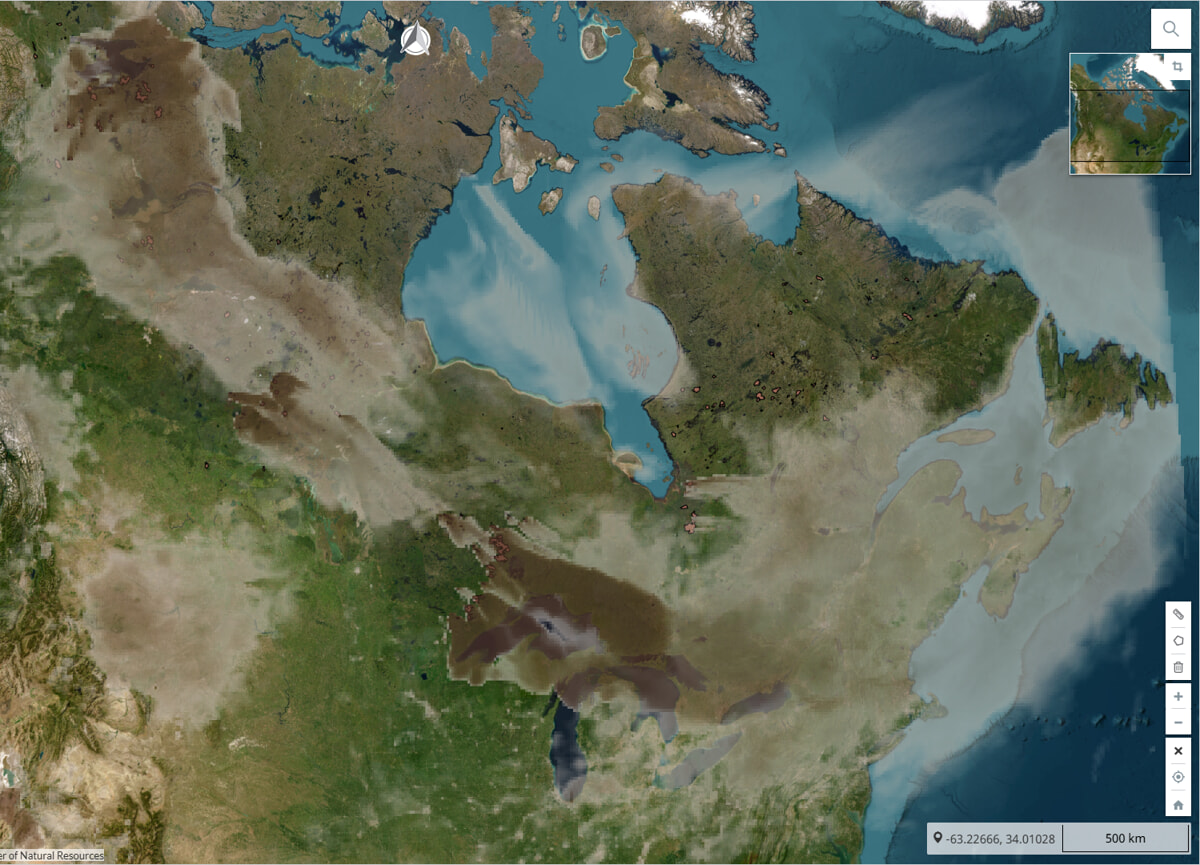
The situation remains evolving, with the authorities involved in containing the fires and managing evacuations: weather conditions will continue to play a decisive role in the coming days.
The video of the train inside the fire: “We are surrounded”
A local story that tells part of the ongoing emergency comes from Armstrong, Ontario. The video is shot in the cabin of a freight train that passes through the flames that broke out in the woods, while the railway worker communicates via radio: “We are surrounded by fire”.
This is near Armstrong, Ontario.
When will the Canadian National Railway Company make a statement about this incident? pic.twitter.com/6bKJYugeR0
— Sol Mamakwa (@solmamakwa) July 14, 2026
Canadian National confirmed that three convoys, some carrying flammable materials, were stopped and the crews were safely evacuated. According to initial reconstructions, a locomotive hit its own train due to the poor visibility caused by the smoke, contributing to the spread of the flames. Despite the gravity of the situation, all the operators managed to save themselves. The investigations are still ongoing.