

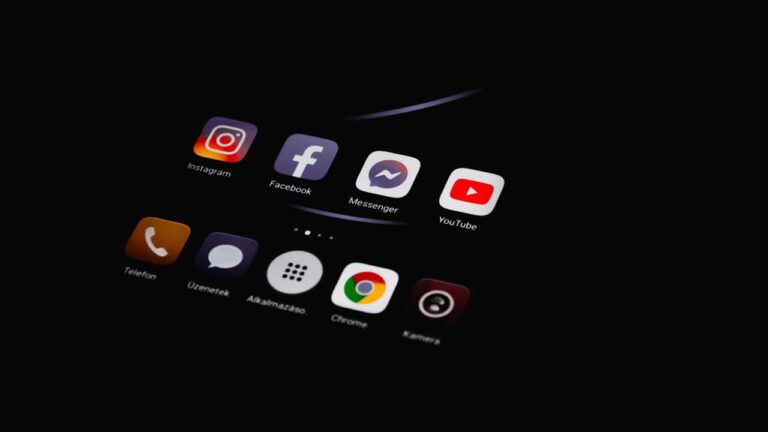
UK sets nightly social media curfew for 16- and 17-year-olds. Affected applications should be unavailable, by default, between midnight and six in the morning. In addition, in the same age group, some functions designed to prolong use, such as automatic video playback and continuous streams of personalized content, will also have to be automatically deactivated. The United Kingdom continues to regulate social platforms: the British government intends to present the first regulations by the end of 2026, with entry into force expected in spring 2027.
How the social night curfew will work
The system must be activated automatically on accounts recognized as belonging to users aged 16 or 17. Overnight, platforms will have to stop access and limit mechanisms such as “infinite scroll”, which loads new content into the feed without requiring conscious action, and autoplay, which starts one video after another.
The government’s declared objective is to prevent turning 16 from producing a sort of “leap into the void”: until that age, in fact, London wants to ban the main platforms from offering social accounts; immediately afterwards, the children would otherwise have access to all functions without limitations. According to Technology Minister Liz Kendall, the new rules will be “crucial” to help young people sleep, concentrate on study and spend more time with family and friends.
The final list of applications subject to the curfew has not yet been published. In the broader plan for under 16s, the government has indicated Snapchat, TikTok, YouTube, Instagram, Facebook and X. Services intended primarily for messaging, such as WhatsApp and Signal, should however remain excluded.
The ban on under 16s
The measure for 16- and 17-year-olds is just part of Britain’s crackdown. From 2027, the affected platforms will not be able to allow under-16s to open or maintain a social account. Companies will need to adopt more effective systems for verifying or estimating the age of users. The government has specified that not everyone over 17 will necessarily have to upload a document: elements already linked to the accounts can also be used, such as their seniority, a verified credit card or other data capable of confirming that the user is of age.
The declared model is that of Australia, where from 10 December 2025 platforms must take “reasonable measures” to prevent under-16s from having an account. The responsibility falls on big tech, not on kids or parents. Fines can reach 49.5 million Australian dollars, approximately 30 million euros.
The government experiment
The British decision is accompanied by a study commissioned by the Department for Science, Innovation and Technology and conducted on 309 families. For a month, children between 13 and 17 years old experimented with three different formulas: a limit of 15 minutes per day per application, a curfew from 9pm to 7am or the complete removal of selected social networks.
Participants reported going to bed earlier, resting better, and being able to concentrate more on classes and studying. In some families, time spent together and face-to-face conversations have also increased. The curfew proved to be the simplest solution to integrate into daily habits.
Which apps cannot be “spyed” after the EU extension to Chat Control
The researchers themselves clarify that this is a qualitative study, based on a limited sample and self-reported experiences, not designed to establish a causal relationship or to produce results that are generalizable to the entire population. And negative effects also emerged: irritability, tensions in the family, feeling of isolation and moving towards other screens. Some young people also intensified their use of social media in the hours immediately preceding the lockdown.
The “loophole” to get around the block and doubts
It is precisely the possibility of deactivating the curfew that arouses the strongest criticism. Ellen Roome, mother of Jools Sweeney, who died aged 14 in 2022 in circumstances she believes were linked to an online challenge, told BBC that “setting a limit that can be removed is not enough.” According to Roome, leaving control in the hands of teenagers is equivalent to placing a bottle of alcohol out of their reach, but close enough to retrieve.
Is “Chat Control” really the beginning of mass surveillance? What changes for our messages and lobbies in the field
The English Commissioner for Children, Rachel de Souza, called the announcement “a positive step”, especially for the deactivation of infinite scrolling. However, he asked for clarification on how the curfew will be applied and how its effectiveness will be verified. The government consultation also revealed broader objections: the risk of pushing minors towards less regulated services, the privacy consequences of age verification systems and the possibility of limiting access to information, social relationships and online communities that are particularly important for the most vulnerable young people.