

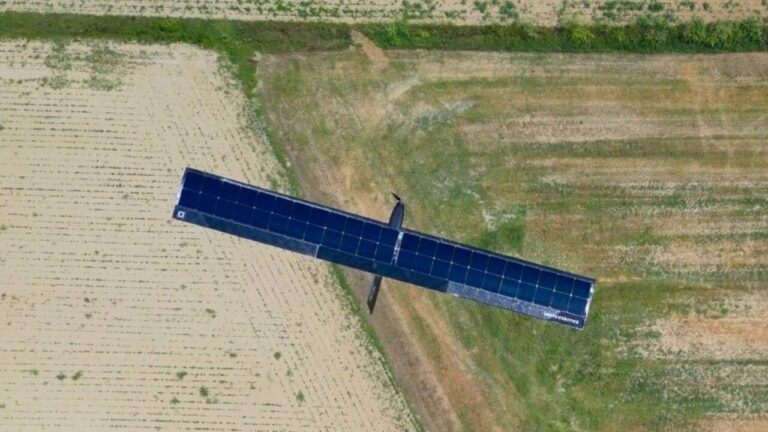
In recent days, in the Treviso countryside, a small Made in Italy drone has established a world record: the longest continuous flight for an unmanned fixed-wing aircraft under a three-metre wingspan. The drone, called Guardian XL and developed by the Vector Robotics company of Mogliano Veneto, flew continuously for 24 hours and 5 minutes without ever landing. The objective of the test was to verify the effectiveness of integrating photovoltaic cells onto ultra-lightweight structures, and success will pave the way for long-range environmental monitoring, security and emergency telecommunications missions.
The technology of primacy
The Guardian XL represents a significant development in the field of small unmanned aircraft. With a wingspan of 2.96 meters and a take-off weight of just 3.1 kilograms, the aircraft manages to overcome the flight limits traditionally associated with small aircraft, thanks to a structure made with new generation fibers and polymers, which guarantee the necessary structural rigidity while keeping the overall mass extremely low.
High-efficiency photovoltaic cells are integrated into the upper surface of the wings, intended to power an electric motor designed to operate without emissions and with an almost zero noise level. This model is the direct evolution of the previous Guardian solar drone, designed by Vector Robotics in collaboration with the Emilian company Npc Spacemind, a system already in use by several local police forces, civil protection departments and some armed forces. Take-off occurs via manual launch by a single operator, simplifying logistical procedures in the field, while the top speed of the vehicle can reach 90 kilometers per hour.
The test flight
The experimental flight took place in a rural area of the province of Treviso. The drone remained at altitude for a total of 24 hours and 5 minutes, maintaining a constant transmission of data and images captured by the camera installed on board to the ground control station. Although the duration of the test exceeded the twenty-four hour threshold, the landing took place with an energy reserve equal to 50% of the total capacity of the on-board battery, demonstrating that the aircraft can significantly extend its maximum stay in the air.
“Long duration flights are already possible with very large unmanned solar aircraft, with twenty or thirty meters of wingspan,” explains Andrea Beggio, CEO at Vector Robotics. “The real technological difficulty was managing to overcome the twenty-four hour mission with an electric drone that was so small, light and much cheaper than larger models. This world record opens up very interesting prospects.” The goal declared by the Venetian company is now to extend the autonomy to allow continuous and autonomous flights for days, weeks or months.
Possible operational uses
The drone is designed to accommodate a load of between 200 and 300 grams, a capacity that allows the integration of a wide range of surveillance equipment. The devices that can be installed include high-definition cameras, infrared thermal sensors, multispectral cameras and small modules for repeating radio signals. In the civil sector, one of the primary applications concerns preventive environmental monitoring, in particular for the early localization of forest fires during the summer season.
The Guardian XL can autonomously patrol isolated or difficult to access wooded areas, reporting in real time the geographical coordinates of potential outbreaks to rescue teams on the ground. The same technology finds application in the surveillance of critical infrastructures and logistics networks, such as energy production plants, photovoltaic parks, port areas and industrial hubs, where continuity of monitoring and the silence of the carrier constitute fundamental safety requirements. In investigative or military contexts, the tool also allows you to monitor targets of interest from above in a discreet way, providing continuous information support to law enforcement or armed forces.
Autonomy and future prospects
The management of the data collected during the missions relies on a digital transmission system designed to minimize electromagnetic interference, guaranteeing the clarity of the video streams sent to the ground station. For operations requiring local storage, the drone is equipped with an internal memory that records physical and image data, ready to be downloaded and analyzed after returning to base. The operation of the vehicle is guaranteed in a range of external temperatures ranging from -10 to +45 degrees centigrade, with a tolerance to winds that can reach 30 knots.
The range of the direct radio link usually varies between 10 and 30 kilometers, depending on the morphological conditions of the terrain and the power of the transmitters. However, the programmed autonomous navigation capability allows the Guardian XL to navigate pre-set routes that extend for hundreds or thousands of kilometers, freeing the aircraft from the need for a continuous connection with the operator on the ground. In humanitarian emergency scenarios or following natural disasters such as earthquakes and floods, the possibility of installing a radio repeater also allows emergency communications to be quickly restored for rescuers operating in the affected areas.