

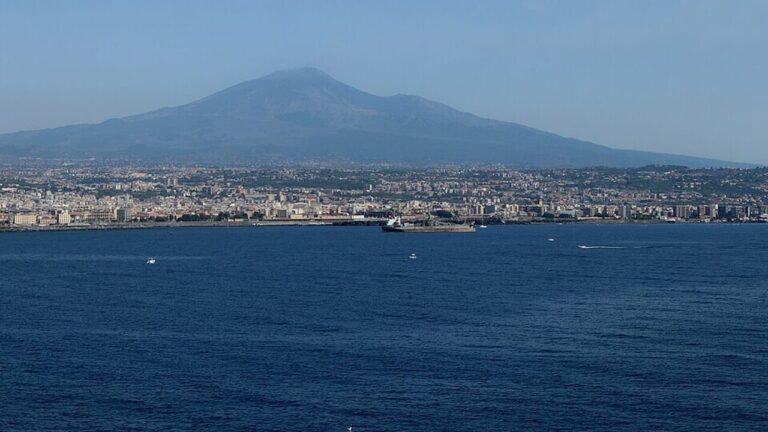
It lies hidden one and a half kilometers deep, right in front of the coast of Catania. It is known as the North Alpheus fault, a fracture in the earth’s crust that extends for over 80 kilometers and remained “invisible” for a long time beneath a thick layer of marine sediments. A new Italian-French study in which the University of Catania participated has just described its characteristics and behavior with precision never achieved before, demonstrating that it is a still active geological structure, with the potential to generate earthquakes with a magnitude greater than 6. The discovery, published in the journal Tectonics, redefines the map of natural risks for one of the historically most vulnerable areas of the entire Mediterranean basin.
Exploring the abyss
For decades, the North Alpheus fault remained invisible due to technological limitations that make the exploration of the great sea depths complex. The new discovery was possible thanks to the integrated use of underwater robots and very high resolution images, with which the researchers mapped the morphology of the seabed with a level of detail in the order of a single meter.
This approach allowed us to obtain an extremely precise three-dimensional representation of the recent deformations of the Earth’s crust, which revealed submerged slopes, depression zones and a singular triangular-shaped platform that rises approximately one hundred meters above the surrounding areas, located in correspondence with a clear deviation of the path of the main fault.
Reconstruction in the laboratory
The movement of the structure was analyzed by combining direct underwater surveys with physical simulations conducted in the laboratory. The North Alpheus fault is a right-slip fault, a mechanism characterized by the horizontal sliding of rock blocks relative to each other, similar to the famous San Andreas fault in California. Experiments were carried out in the laboratories using special sand boxes to reproduce the stratification of the sediments, obtaining models which, subjected to lateral shear forces, exactly replicated the geometries and secondary fractures observed on the seabed, confirming both the direction of flow and the evolutionary dynamics of the geological system of the fault.
To establish the recent activity of the fault it was necessary to find a certain temporal reference point in the sediment layers that make up the seabed. The key was identified in a significant thickness of volcanic fragments, known as lapilli, originating from the violent eruption of the Elliptical, an ancient phase of Etna which occurred approximately 16,700 years ago. This volcanic level functioned as a precise natural chronological marker: by measuring the dislocations suffered by this layer due to tectonic movements, experts recorded vertical displacements of between 3 and 6 meters, obtaining irrefutable proof that the fault continued to move and deform the seabed in geologically recent times.
The seismic risk
According to the experts’ analysis, the North Alfeo fault belongs to a type of geological structure called Step (Subduction-Transform Edge Propagator), fractures that develop along the edges of subducting tectonic plates, and was formed at the point where the Ionic plate sinks beneath the Calabrian block. This is a geodynamic structure similar to that of the Caribbean region, where the subduction of the South American plate under the Caribbean one recently favored the violent earthquake in Venezuela on 24 June 2026, originating from a 3.5 meter slide along the San Sebastián fault.
Based on the dimensions of the fault and the displacements observed, the authors estimate that some segments of the North Alfeo can produce earthquakes of the order of magnitude 6-6.3. The study therefore provides valuable elements for updating seismic hazard models in eastern Sicily, an area already devastated in the past by historical events such as the 1693 earthquake and the 1908 Messina earthquake.