

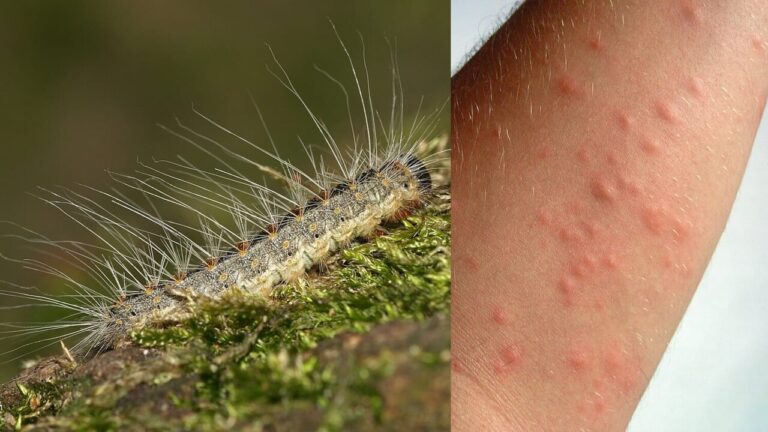
There is no need to touch the caterpillar. In some cases you don’t even need to see it. All it takes is being near an infested oak tree for the microscopic stinging hairs dispersed in the air to reach the skin, eyes or respiratory tract.
This is the most insidious characteristic of the oak processionary moth, Thaumetopoea processionea, an insect that in the summer of 2026 caused particularly large infestations in several areas of Europe, bringing the problem back to the attention of health authorities.
The most surprising data comes from a study published in 2025 onInternational Journal of Environmental Research and Public Health. During its development, a single larva produces on average approximately 857 thousand microscopic stinging hairs. In case of heavy infestation, a single oak tree can accumulate between 10 and 24 billion.
It is not the easily visible long white hairs that create the biggest problem, but much smaller bristles that are produced starting from the third larval stage. They contain stinging substances, including the protein thaumetopoein, and can detach from the animal’s body or accumulate in nests. The wind is then able to transport them for hundreds of meters. And it’s a danger that doesn’t immediately disappear when caterpillars become butterflies. Bristles left in old nests, in vegetation or on the ground can retain their stinging ability for years.
What happens if the hair gets on the skin
The most common consequences are itching, redness, wheals and dermatitis, but contact can also involve the eyes, throat and respiratory tract. In some cases there are breathing difficulties and, more rarely, significant allergic reactions. The risk also concerns dogs, horses and other animals. The point is that you don’t need to touch the caterpillar directly. The bristles can be carried by the wind and land on grass, clothing, branches and other surfaces. It is therefore possible to develop symptoms simply by frequenting a heavily infested area.
The infestation that closed a swimming pool in Berlin
Berlin has become one of the symbolic cases of the problem. In 2026, the high number of oak processionaries required the removal of nests in numerous green spaces. The Strandbad Jungfernheide, a seaside area surrounded by greenery in the German capital, has been closed since the end of May due to the heavy infestation, so much so that the matter ended up before the administrative court of Berlin.
Local authorities also use professional vacuum cleaners to remove larvae and nests. The procedure is considered one of the safest mechanical solutions because it allows the animals and part of the contaminated material to be eliminated from the bristles at the same time. Berlin explicitly advises citizens not to try to eliminate the nests themselves.
And Germany is not an isolated case. If the processionary moth is endemic to Italy and Mediterranean countries, it is reported more and more frequently towards the north. In the Netherlands, a monitoring conducted in 2026 on more than 122 thousand oak trees found the processionary moth in 13 percent of the trees monitored, about double the previous year. In some areas of the northern provinces the infestation was much higher.
In Switzerland, the Federal WSL Institute received many more reports in 2026 than in previous years and recorded for the first time in the eastern part of the country an infestation affecting several hectares of an oak forest.
Even in Great Britain the species is now permanently present in the south-east of England. The resident population was identified in London in 2006, probably after accidental introduction through oak trees imported from continental Europe. In June 2026 the Forestry Commission issued a new warning, underlining that the hot spring had accelerated the development of the larvae.
The role of climate change
The oak processionary moth is a thermophilic species, that is, it favors high temperatures. Several studies indicate that a warmer climate and dry spring and summer periods can increase the probability of survival, spread and emergence. The species, once concentrated mainly in warmer regions, is reported more and more frequently towards the north and it is considered plausible that the increase in temperatures contributes to the increase in the frequency and intensity of infestations.
An even more evident phenomenon concerns the pine processionary moth, Thaumetopoea pityocampa, a close relative of the oak moth. Its northward expansion into Europe has been documented for decades, and rising winter temperatures have allowed the larvae to survive in areas that were previously climatically too cold. In France the species has reached the Paris region.
What to do if we see a nest
The first rule is simple: do not touch the caterpillars or the nests and do not try to remove them yourself. Even an old, apparently empty nest can contain large quantities of stinging hairs. The interventions must be carried out by equipped personnel.
Particular attention should be paid to children and pets. If strong skin reactions, eye problems or breathing difficulties appear after possible exposure, it is advisable to contact a healthcare professional; for animals it is necessary to contact the vet in the presence of important symptoms.
Defeating the processionary once and for all, however, is not realistic. Insecticides, mechanical removal, and biological treatments with nematodes can reduce populations locally, but none of these systems guarantee permanent elimination of the insect. Furthermore, indiscriminate treatments can damage other species that live on oak trees. For this reason, the strategy increasingly adopted by the authorities is to intervene especially in areas frequented by people and learn to manage a risk which, with a warmer climate, could become more frequent.