

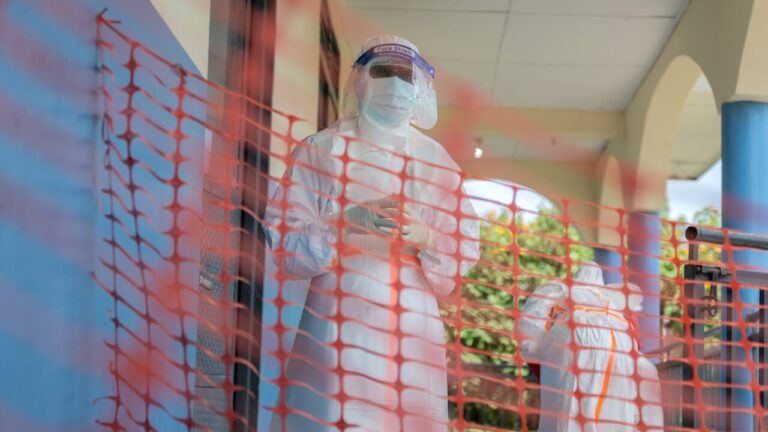
The Ebola outbreak caused by the Bundibugyo virus in the Democratic Republic of Congo continues to expand faster than the health response. Africa CDC and the World Health Organization are now calling for an urgent strengthening of containment measures: faster diagnoses, contact tracing, new beds, greater availability of ambulances and laboratories and more support for health workers.
The alarm comes after the mission conducted on 4 and 5 August by the leaders of the WHO and Africa CDC between Uganda and the Democratic Republic of Congo. The most difficult situation is in the eastern province of Ituri and in particular in the Bunia area, which has become the epicenter of the emergency.
Almost 4 thousand cases and over 1,800 deaths
As of August 4, Congo had reported 3,973 confirmed cases, 1,801 deaths and 776 recoveries in 51 health zones distributed across five provinces. In just 24 hours, another 99 cases and 52 deaths had been reported. Around 90% of infections are concentrated in Ituri. However, only 75% of contacts of infected people are followed up by health authorities, against a target of 95% considered necessary to quickly interrupt chains of transmission.
The pressure is also increasing on hospitals: 674 people were hospitalized and in North Kivu the treatment centers had reached an occupancy equal to 139% of available capacity. According to UNHCR, Ebola cases have also appeared in at least five of the 69 IDP camps in Ituri.
“The epidemic is outpacing our response in some areas of eastern Congo,” warned WHO Director-General Tedros Adhanom Ghebreyesus.
The virus could have been circulating since January
Complicating the situation may have been a long delay in identifying the outbreak. An investigation anticipated by Science suggests that the virus had been circulating in the Mongbwalu mining area since January, at least four months before the epidemic was officially declared.
Interviews with health workers, survivors and victims’ families would have made it possible to reconstruct hundreds of suspected cases prior to the alarm. By the time the authorities recognized the epidemic, therefore, transmission may have already been widespread.
Ervebo, the vaccine already authorized against Ebola, is being tested
Meanwhile, an important piece of news arrives on the research front. The WHO Vaccine Panel recommended that Ervebo, the only Ebola vaccine already authorized, be included in a randomized clinical trial during the outbreak. Ervebo was developed against the Ebola Zaire virus and not specifically against Bundibugyo. However, preliminary studies on animals have indicated possible cross-protection, especially against lethal forms of the disease.
At the same time, other trials have already started with monoclonal antibodies, the antiviral remdesivir and their combination. Oxford has also started the first human study of the ChAdOx1 BDBV vaccine candidate, developed specifically against the Bundibugyo virus.
The goal is to find effective tools while the epidemic is still ongoing. Africa CDC and WHO, however, underline that the priority remains to interrupt infections in the area, especially through early diagnosis, access to treatment and collaboration with local communities. No general travel or trade restrictions are currently recommended.