

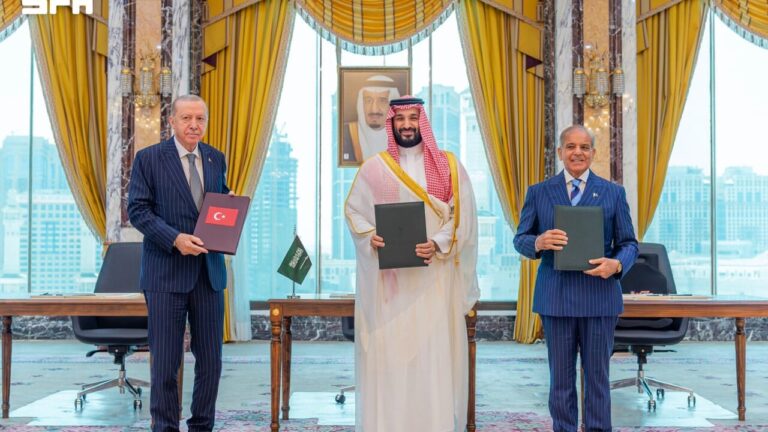
An attack against one will be considered an attack against all. The formula inevitably recalls Article 5 of NATO and is the most important passage of the Mecca joint defense agreement, the Mecca Pact signed on 7 August 2026 by Saudi Arabia, Turkey and Pakistan.
Mohammed bin Salman, Recep Tayyip Erdogan and Shehbaz Sharif sat around the same table. Three countries which, put together, represent a military combination that is difficult to ignore: Turkey has the second largest army in NATO, Saudi Arabia is one of the main economic and energy powers in the Middle East, while Pakistan is the only Muslim country equipped with nuclear weapons.
The pact brings together three of the major Sunni powers in opposition to the “Shiite crescent” of which Iran represents the main political center after having built a network of alliances in recent decades that crosses Iraq to reach Hezbollah’s Lebanon and the Houthis of Yemen.
Ankara also clarified that the pact is exclusively defensive and is not directed against any particular country. Riyadh has ruled out that a sectarian military axis is emerging or that the agreement has anything to do with a nuclear arms race.
Something in the Middle East has changed.
To understand the political significance of the Mecca Pact we must place it alongside the other great regional architecture built in recent years: the Abraham Accords. Born in 2020 under the first Trump administration, the agreements led to the normalization of relations between Israel and the United Arab Emirates, Bahrain and Morocco, in addition to the agreement with Sudan. In 2025, Kazakhstan also joined the project. The American strategic objective has progressively become more ambitious: to build a Middle East in which Israel is integrated diplomatically, economically and, indirectly, also in terms of security with a growing part of the Arab and Muslim world.
However, the big missing piece has always been Saudi Arabia. On July 24, 2026, Donald Trump placed an explicit condition on Riyadh: the United States will not proceed with the agreement to develop Saudi civilian nuclear power if the kingdom does not normalize relations with Israel by entering the Abraham Accords. Saudi Arabia, for its part, continues to call for an “irreversible” path towards the birth of a Palestinian state before the recognition of Israel.
Two weeks after that American request, Mohammed bin Salman signed a security guarantee in Mecca not with Israel, but with Türkiye and Pakistan.
Because Saudi Arabia, Türkiye and Pakistan have become closer
Then there is another important circumstance. The agreement was not improvised after the last battles: second Reuters the negotiations had been going on for almost a year. And during the war against Iran the three countries had already begun to function as a sort of regional diplomatic nucleus. There CNN reported on April 8 how Pakistan had become a major mediator between the United States and Iran, leveraging its relationships with both sides. Islamabad had worked through confidential channels together with Turkey and Saudi Arabia, as well as Egypt, contributing to the search for a truce and inviting the Americans and Iranians to negotiate directly in Pakistan.
Also because all three have a lot to lose from the transformation of the Middle East into a permanent battlefield. Saudi Arabia has seen Iranian missiles and drones reach its territory and fears for oil facilities, ports and billion-dollar investments from the Vision 2030 program. Turkey has intercepted Iranian missiles that entered its airspace. Pakistan borders Iran directly and has one of the largest Shia communities in the world.
It is not a pact against Iran. And not just against Israel either
Here lies the paradox. The Mecca Pact may serve to protect Saudi Arabia from Iran, but at the same time it also represents a form of deterrence against Israel. Reuters highlights that the three governments share concerns about the increasingly aggressive military posture of both Iran and Israel. The British Royal United Services Institute interprets the agreement as a tool to counterbalance Iranian hegemony and at the same time create a deterrent capacity against Israel, not as preparation for a war with Tehran.
This makes it too easy to imagine two perfectly opposed blocks.
Saudi Arabia and Israel may have converging interests in containing Iran. Ankara is a member of NATO. Riyadh remains a major strategic partner of the United States. Pakistan and Saudi Arabia have had military relations that have lasted for decades. But at the same time none of the three countries want to completely entrust their security to Washington or accept that Israel automatically becomes the center of the new regional order.
The 8 thousand Pakistani soldiers already in Saudi Arabia
Furthermore, the Mecca Pact does not start from scratch on a military level. Pakistan and Saudi Arabia had already concluded a mutual defense agreement in 2025. Islamabad has provided training and technical assistance to Saudi forces for decades and, according to Reutershas deployed around 8 thousand soldiers in the kingdom, as well as fighters, drones and air defense systems. Ankara and Islamabad also collaborate in military industry and training, while Saudi Arabia is a major buyer of Turkish drones.
The new agreement therefore brings military relations that already existed separately under a single umbrella. And this is probably the most important step.
The problem of the American umbrella
For decades the Gulf security architecture has been relatively simple: oil and regional stability in exchange for American military protection.
The wars that began after 7 October 2023 have undermined this certainty. Israel fought in Gaza, entered southern Lebanon, occupied territory in Syria and waged military campaigns against Iran. Tehran in turn struck Saudi Arabia, Kuwait, Bahrain, Qatar, the Emirates, Oman, Jordan and Israel. Precisely this succession of crises has fueled growing doubts in Riyadh about the reliability of the US security umbrella.
The Mecca Pact can be read as an answer to this problem: not to abandon the United States, but not to depend only on the United States.
Abraham Accords vs. Mecca Covenant
The contrast is between two possible models of the Middle East. The Abraham Accords start from Washington and revolve around the progressive integration of Israel with the Arab states: diplomacy, trade, technology, investments and strategic cooperation. The Mecca Pact instead starts from the Muslim powers of the region and tries to build a second level of security: autonomous military cooperation, collective deterrence and the possibility of moving without necessarily waiting for an American guarantee.
The two architectures could even coexist. But they compete on one decisive point: who sets the rules of the new Middle East. Washington would like the path to pass through normalization with Israel. Riyadh, Ankara and Islamabad are demonstrating that they want to keep another possibility open.
And this is perhaps precisely the most important innovation of the Mecca Pact: not the birth of an anti-Israeli or anti-Iranian front, but the birth of an alternative.