

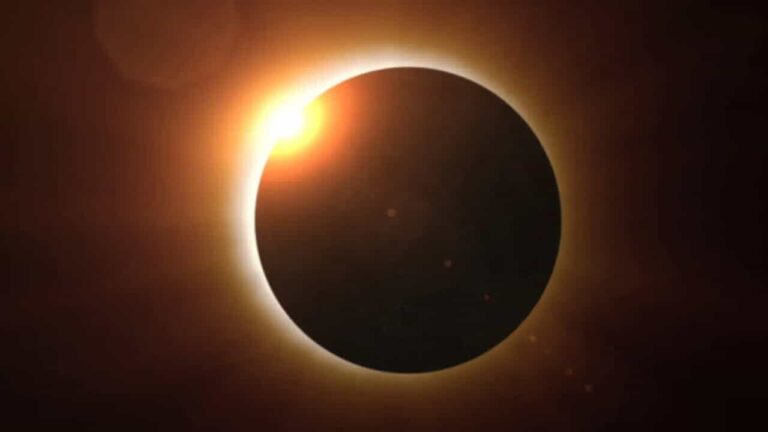
The Sun “hiding” behind the Moon. We’re almost there. Eyes turned to the sky. The moment of the most awaited astronomical phenomenon of the summer is approaching: today, Wednesday 12 August, the total solar eclipse will be visible from much of Europe, north-west Africa and North America. Italy is not in the geographical range in which the coverage of the solar disk will be total: here the eclipse will be partially visible. But it will still be a significant and spectacular event, with a darkening of almost 95% in the north-west regions.
In addition to the hope of finding a cloudless sky to enjoy the observation, the issue of choosing the observation point remains: the phenomenon will take place at sunset, with the Sun very close to the horizon. It means that to really see it you need a completely open view towards the west, free from buildings, hills or rocks. Here is a practical guide to enjoy the show: it is the first total solar eclipse in Europe since 1999.
A total solar eclipse occurs when the apparent dimensions of the Moon and Sun are perfectly equal in the sky, allowing the lunar disk to completely mask the solar disk. The phenomenon requires that our satellite is near the perigee, i.e. in the phase of maximum proximity to the Earth along its orbit. This is exactly what will happen on August 12: the Moon will be approximately 367 thousand kilometers from us, just three thousand kilometers away from the point of closest approach reached two days earlier.
The eclipse in 5 phases
There are 5 phases of the total solar eclipse expected today: from the first “contact” between the Sun and Moon to totality and beyond. In some areas, such as Italy, the phases will not all be visible: coverage will only be partial and will vary greatly depending on where you are. The first phase begins with the first contact between the Sun and the Moon, i.e. when the lunar disk begins to “hide” the Sun, and will continue for about 30 minutes with the Moon dipping further and further into the solar disk.
The second phase is one of the most spectacular: those who see the total eclipse will be able to enjoy a spectacular “ring of diamonds”, because when the last fragment of the Sun is still visible, beams of light will be produced around the Moon, also due to the craters and valleys that mark our natural satellite. Immediately afterwards the most awaited moment will begin, that is, the totality of the eclipse, with the Moon completely covering the Sun: a sort of “early night” which will last a maximum of 2 minutes and 18 seconds, depending on the position from which it is observed.
Once the minutes of total eclipse have passed, you will once again be able to see brilliant “pearls of light” around the lunar disk. Finally, slowly, the Moon will return to “free” the Sun and the eclipse will end.
How and where you see best
The total solar eclipse will be visible from much of Europe, northwestern Africa and North America. The band of totality, the one in which the Moon will completely cover the Sun, is about 293 kilometers wide: it starts from Arctic Russia, and then crosses Greenland, western Iceland, a small piece of Portugal and, finally, an extensive band of Spain.
In Italy the visibility of the eclipse will be partial, but in some areas coverage percentages will be around 90% and above. The northwestern regions, in particular, will be able to enjoy an almost complete spectacle of the darkening of the solar disk. In our country the show will take place with the Sun already close to sunset, starting from around 7.30 pm, and depending on the position the maximum coverage of the Sun could even occur after sunset.
The percentages of blackout in Italy
The northern regions represent the best alternative for those who do not want to miss the show, but cannot travel to countries where the eclipse is seen with 100% coverage: the darkening of the solar disk, in some areas of the north, will still exceed 90%. The maximum possible coverage between our regions, as explained by the Union of Italian Amateur Astronomers (UAI), will be in Liguria, where the Sun will be obscured by up to almost 95%. Only from the north-west regions, however, will it be possible to observe the eclipse until the end. This is because, as mentioned, the show will take place with the Sun already close to setting, starting from around 7.30 pm, and therefore central and southern Italy will only be able to admire the initial phase.
Here are the indicative times of the eclipse in the different areas of Italy: in the north-west the maximum darkening will exceed 90% and should reach around 8.21pm. In the central regions, however, the maximum darkening will be around 70%, with the peak around 8.11pm. In the south the maximum visibility will be around 7.56pm, then in many areas the sunset will make the show invisible.
A question (also) of safety
Meanwhile, appeals have come from many quarters to watch the eclipse safely. “Eye health comes before the show: on August 12th do not look directly at the solar eclipse”, is the appeal launched by Massimo Nicolò, health councilor of the Liguria region and ophthalmologist. “The eclipse is a very fascinating event, but we must not forget that looking directly at the sun can cause serious and irreversible damage to the retina and in particular to the macula, responsible for central vision. Therefore the message I want to address to citizens is very simple: do not look at the solar eclipse except with certified devices, sunglasses are not enough to protect your eyesight”, he added.
Therefore, during the eclipse you must not look directly at the Sun but you must use a suitable solar filter. Glasses for watching the eclipse must have filters that comply with the international standard “Iso 12312-2” and come from reliable manufacturers and retailers. The Ministry of Health recommends using only eclipse glasses certified according to international standards. Any other means must be avoided. And therefore it is not sufficient to wear normal sunglasses (even if overlapping), x-ray films, smoked glass, CDs or improvised photographic filters. They do not guarantee any protection from ultraviolet and infrared rays. In this case, do-it-yourself remedies are a danger.