

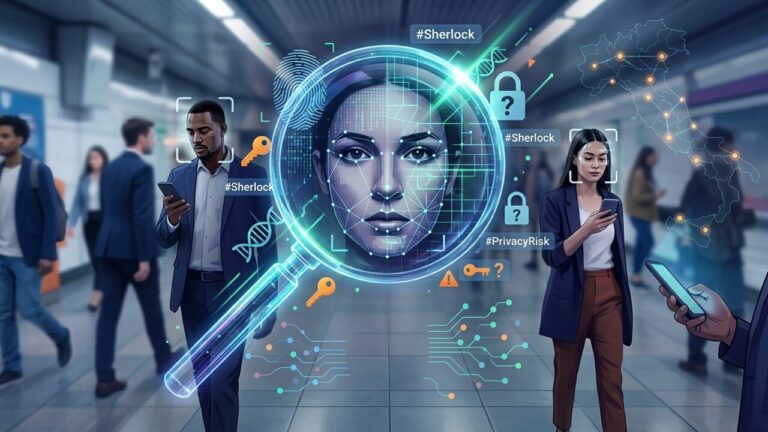
The trend of facial research using artificial intelligence has also landed in Italy, after becoming a real trend in the United States. A trend that reopens the debate on privacy. At the base of everything there is an app, or rather a constellation of apps, which (almost) all refer to Sherlock, the well-known detective born from the pen of Arthur Conan Doyle. Sherlock appears as a hashtag in the reels posted – especially on TikTok – and in the name of the application itself: doing a search at the time of writing, there are at least a dozen.
What Sherlock is and how it works
The functioning of the system can be found in the descriptions on the digital stores (Android and Apple), but there are countless creators who briefly explain the mechanism behind Sherlock. Creators paid by companies to push their followers to download the app and, why not, purchase subscriptions or credit packages to test it. Because yes, these are applications that require an initial investment and are unlikely to deliver what they promise. Fortunately, it comes to mind. But let’s proceed in order.
According to what is said on social media, a frame stolen from a passer-by, or even a screenshot of a profile on any app (including dating apps) would be enough to identify the subject, the social profiles and any articles or content in which the face, name and surname may appear. You load the image into the app, let the algorithm work and at the end of a short wait, here is the digital ‘identity card’ of a face unknown to us. In reality, the user receives a percentage of visual affinity and direct links to the sites where the image appears. But the results are far from those promised and massively advertised.
On social media, as mentioned, there are thousands of reels in which users mostly belonging to Gen Z ‘set up’ alleged social experiments or pranks on friends and acquaintances using one of these facial search apps. Basically, this is a big lie, a super aggressive marketing process conducted to maximize the temporary virality of apps, which make extensive use of AI. On TikTok, many videos promise instant and infallible identifications, but they are nothing more than content expertly edited for promotional purposes.
The privacy debate
Having said that the nature of the facial recognition system is fallacious and unlikely, aimed at deceiving and monetising, in the United States the explosion of Sherlock apps has sparked legal and political debate, as there is no univocal law on privacy overseas. And analysts say these tools are empowering the public to exploit sensitive and dangerous technologies, increasing the risks of doxing and harassment.
And in Italy? The app, to date, can be freely downloaded from both the Google Play Store and the Apple App Store, where various variations of Sherlock have climbed the download charts. And this despite the fact that biometric profiling in the European Union is strictly regulated by Regulation 2016/679, whose rules integrate with the mandatory prohibitions introduced by the AI Act, the first law in the world on artificial intelligence. The developers protect themselves by including words in the Terms of Service according to which the app is to be used only for the exclusive verification of their photos. But the clause is grotesque: nothing prevents a user from taking a photo of a stranger and inserting it into the system to trace his identity. The violation of privacy is undeniable.