

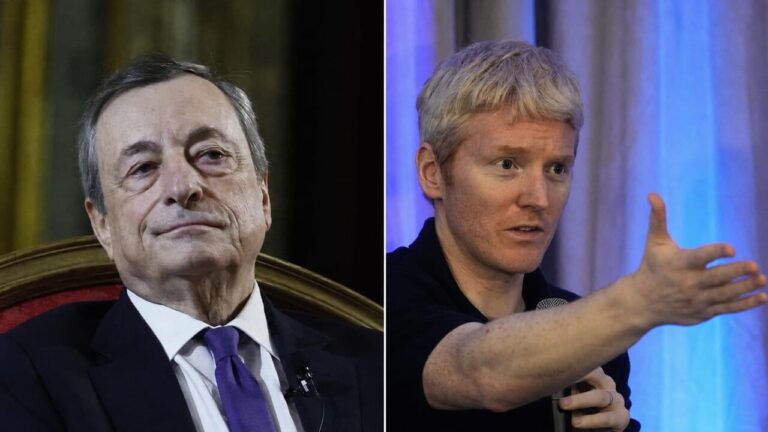
There’s a new think tank in Europe. In truth it doesn’t explicitly present itself that way, but it has every appearance of being so. And of a certain weight. The members have important CVs, in various respects. It is called “Rhine Group”, the new entity with presidents Mario Draghi and Patrick Collison, founder of Stripe and member of the Board of Directors of Meta. Inside there are other heavy names from big tech and global finance, with a notable Italian share. Among others, there are also Andrea Pignataro, owner of Ion, and Luca Ferrari of Bending Spoons, recently listed on WallStreet.
A Swiss association that works behind closed doors: what is Rhine Group
“Decline is not inevitable, but it is the direction we are moving in if we do not act urgently,” the Rhine Group manifesto reads. As mentioned, the co-presidents are Draghi and Collison. The operational management is instead entrusted to the former liberal MEP Luis Garicano. “The reform agenda is very blocked,” Garicano explained to El Pais. The project involves research commissioned from experts and at least annual meetings between economists, politicians and businesses.
The aim is precisely this: to translate the recommendations of the Draghi report into facts. In 2025, the Commission claimed to have already completed more than half of the initiatives envisaged by the Competitiveness Compass, inspired by the report drawn up by Mario Draghi. However, an independent audit cited by the Financial Times instead, it considered only 43 out of 383 recommendations to be fully implemented.
The Rhine Group’s legal notice qualifies it as a Swiss association based at the trust company L&S Trust Services in Geneva, represented by Garicano. Concretely, “an independent and non-partisan association whose purpose is to foster educational dialogue and develop and promote evidence-based public policy solutions”, we read. The meetings are held under the Chatham House Rule: information can be used, but not attributed to the person who provided it.
Who sits at the table of Draghi’s “Swiss group”.
In addition to leading Stripe, an online payments platform, Patrick Collison has sat on Meta’s board of directors since April 2025. He is also among the supporters of Ee Inc, a campaign promoted by the startup ecosystem to obtain a single European corporate form. In March 2026, the Commission presented a very similar proposal: digital incorporation in 48 hours, symbolic minimum capital and common rules for stock options.
Also sitting at the Swiss table are Tobi Lutke from Shopify, Sebastian Siemiatkowski from Klarna and Michael Miebach from Mastercard. Then there is Jorg Kukies, former Goldman Sachs executive, former undersecretary, advisor to Olaf Scholz and German Finance Minister. In 2026 he moved to Morgan Stanley after the expected incompatibility period. Members also include the editors of the Financial Times and the Economist, Roula Khalaf and Zanny Minton Beddoes, and the publisher of Le Monde Louis Dreyfus.
Alexis Kohler, former secretary general of the Elysée with Emmanuel Macron, is now executive vice president of Societe Generale. In 2022 he was placed under formal investigation for possible conflicts of interest linked to family relationships with the shipping group MSC. Kohler has always denied any wrongdoing. In July 2026, the Paris Court of Appeal considered part of the episodes to be time-barred, while according to the complainant association Anticor, facts after 2014 remain in question.
Another member, Siemens President Jim Hagemann Snabe, is simultaneously the European Commission’s special envoy for industrial artificial intelligence and an advisor to C3 Ai. The appointment prompted 41 MEPs to ask for clarification on potential conflicts of interest. Benoit Coeuré, president of the French Competition Authority, also sits in the Rhine Group.
The Italians inside Rhine Group
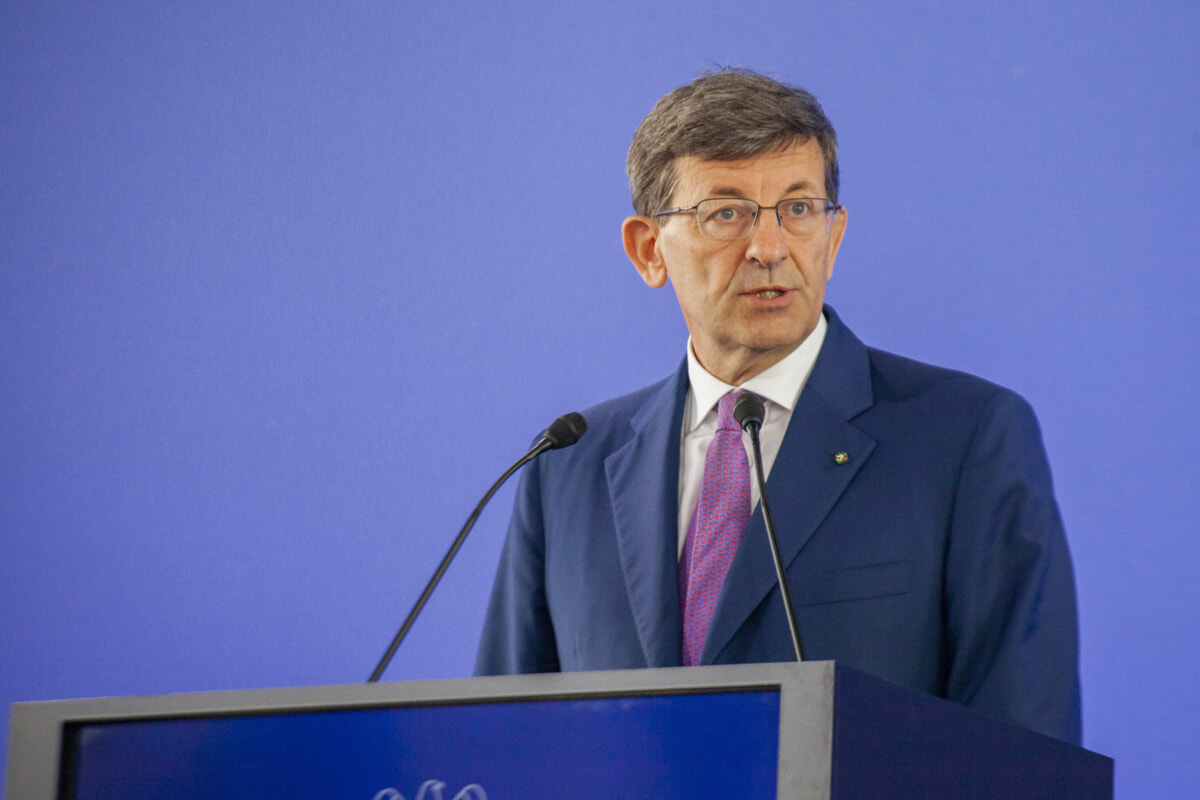
The Italian colony within the Rhine Group is large and there is a certain continuity with figures in the Draghi government. There is Francesco Giavazzi, economic advisor to Palazzo Chigi also working on the Pnrr. There is also Vittorio Colao, minister for technological innovation and digital transition and former CEO of Vodafone. After completing his government experience, he returned to General Atlantic, today as vice president for the EMEA area.
Among the members is Andrea Pignataro, founder of Ion Group, a conglomerate that controls infrastructures and large quantities of financial data critical for Italian financial infrastructures and beyond.
How Andrea Pignataro became the richest man in Italy (with billions in debt)
The official list also includes Luca Ferrari of Bending Spoons, a Milanese company that is decidedly lively in the acquisition market. After the purchase of Evernote, WeTransfer, Vimeo and Aol, the Milanese group was listed on Wall Street in 2026 with a valuation of approximately 18.4 billion dollars. Its growth has been accompanied by major restructuring and significant staff cuts.
Bending Spoons, who is behind the “everything-eating” Italian unicorn
Alongside the entrepreneurs sits Lucrezia Reichlin, professor at the London Business School, who directed the ECB’s research from 2005 to 2008 and sits on the boards of Morgan Stanley, Ageas and Messaggerie Italiane. She is the daughter of the historic PCI leader Alfredo Reichlin and the former parliamentarian Luciana Castellina.
Another academic presence is Francesco Decarolis, professor at Bocconi, specialized in antitrust, public procurement and regulation of digital platforms. He has worked as a consultant for the European Commission, Palazzo Chigi and Antitrust. And finally Beatrice Weder di Mauro, an economist with Swiss and Italian citizenship, chairs the Center for Economic policy research. She was a member of the German government’s Council of Economic Experts and held corporate positions at UBS, Roche, ThyssenKrupp and Robert Bosch.