

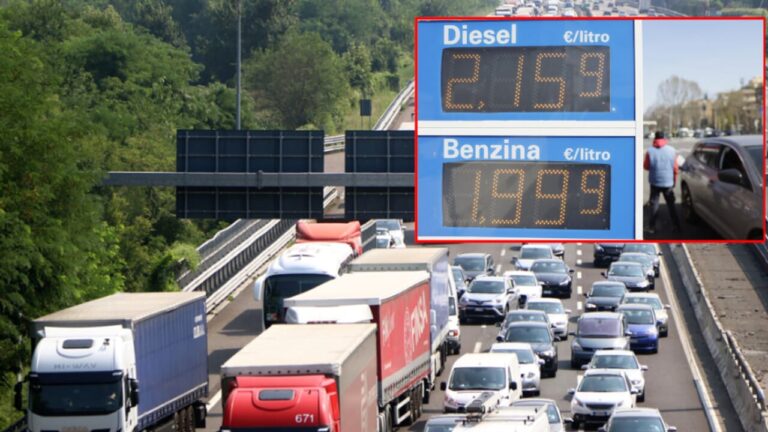
The countdown has begun. Precisely in the days of the great summer counter-exodus, the tax discount which has so far attenuated, at least in part, the rise in diesel prices risks running out. And for millions of motorists, the return from holidays could coincide with a new blow at the pump.
Tomorrow 24 August the decree passed by the government which lowered the excise duty on diesel by 14 cents per liter expires, a discount that reaches around 17 cents also considering VAT. However, the government has announced that it also wants to cover August 25th through a provision from the Ministry of Economy that uses the mechanism of the so-called “mobile excise duties”. The resources, according to estimates circulated so far, would essentially be sufficient for another day.
The problem comes immediately afterwards: without a new extension, from August 26th diesel risks losing the discount of around 17 cents per litre.
How much diesel could cost from August 26th
The risk is far from theoretical for family budgets, especially since diesel has already returned to very high levels. According to the latest data published by the Ministry of Business and Made in Italy, updated to 22 August, on the national road network self-service petrol costs on average 2.008 euros per litre, while diesel has reached 2.128 euros. On the motorway it goes up to 2,085 euros for petrol and 2,200 euros for diesel respectively.
The small town with fuel at 20 cents less than the national average: it is the “mayor’s petrol”
If all the other price components remained unchanged and the tax discount disappeared completely, the theoretical price of diesel on the ordinary network could therefore approach 2.30 euros per litre. For a 50 liter tank it would mean around 8.50 euros more. On 60 liters the increase would exceed 10 euros.
What is the mobile excise tax that can save the discount
The game now revolves around the mobile excise duty, a mechanism that allows the State to use the increased VAT revenue collected when the international price of oil increases to temporarily reduce excise duties on fuel.
In essence, when petrol and diesel become more expensive, the VAT collected by the State also increases. Part of this extra revenue can be returned to motorists through a reduction in the tax component of the price.
It is the instrument invoked for months by the secretary of the Democratic Party Elly Schlein, who asks for the extra revenue produced by the price increases to be returned to citizens. But the sums available so far would be limited: for August 25th there is talk of around 12.7 million euros, barely enough to maintain the current reduction for another day.
Hence the issue that the government will have to resolve in the next few hours: find new coverage or let the excise duty on diesel return to the ordinary level.
The European tax on oil companies’ extra profits
Meanwhile, a possible source of resources is also being sought in Brussels. Italy, Germany, Austria, Poland, Portugal and Spain have asked for the opening of a European discussion on the taxation of extra profits made by oil companies during the new energy crisis.
The initiative started from the German Finance Minister Lars Klingbeil and was formalized with a letter to the Irish Presidency of the Council of the European Union.
The goal is to arrive at a coordinated system at community level, avoiding a series of different national taxes. According to the six governments, oil companies are benefiting from exceptional refining margins and levels of profitability while families and businesses suffer the effects of rising prices.
The issue should land on the Ecofin table on 18 and 19 September in Dublin. Italy also therefore supports the hypothesis that a part of the extraordinary profits of the oil sector will be used to finance interventions against high energy costs.
The pressure on the government
However, the opposition asks not to wait for September. The leader of the 5 Star Movement Giuseppe Conte has called for the convening of an extraordinary Council of Ministers to address the high cost of fuel and other increases that are eroding purchasing power.
Consumer associations are also pushing for an extension. Assoutenti asks to maintain the cut until at least September 6, also financing it through the extra profits of oil companies and energy companies.