

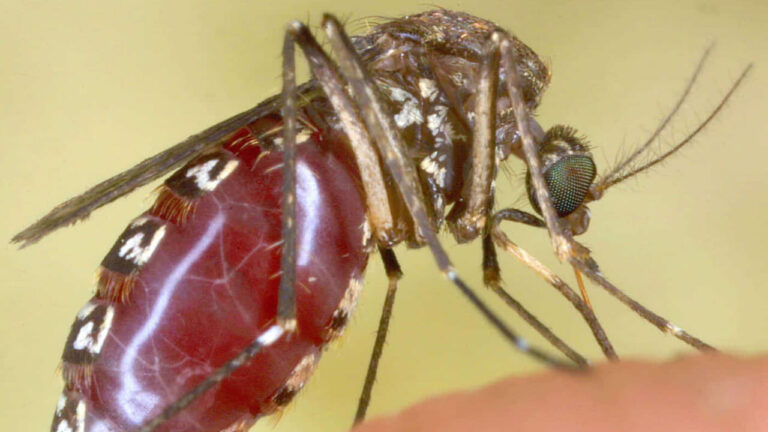
Every summer history repeats itself: fixed or mobile mosquito nets on the windows, citronella candles, traps with UV light, insecticides that leave an acrid smell in the garden or on the terrace. Yet, the sting always arrives. Just as, punctually with every summer season, technology also arrives that promises to eliminate the mosquitoesinsects of the order Diptera. There are those who focus on lasers, those on ultrasound devices, those who invent new sensors destined, sooner or later, to enter the list of inevitable hoaxes summer.
This does not appear to be the case with the French startup Tornyol System, which published a video showing a silent 40 gram autonomous mini-drone designed to detect and eliminate mosquitoes in domestic environments. Based on the open source LeSonar 2 ultrasound system, the mini-drone is capable of operating even at night or in low light conditions, detecting movements of the order of 0.1 millimeters. Thanks to 380 integrated microphones, the system detects the echoes of ultrasonic waves reflected by mosquitoes, reconstructing their position and movements in real time.
undefined
In this way the mini-drone is able to distinguish female mosquitoes, the only ones that bite and can transmit infectious diseases such as West Nile fever, better known as West Nile, allowing the flying robot to intercept and neutralize them without resorting to chemicals. The startup, selected by the “Y Combinator” accelerator, among the most influential in Silicon Valley, has not yet disclosed details on the speed of the drone, the battery capacity, the autonomy or the materials used.
The limits of the anti-mosquito drone
The declared objective, however, goes beyond the simple elimination of individual mosquitoes: the project aims to map the entire reproductive cycle of these insects to understand precisely where they feed and where they lay their eggs. The ambitious project, scheduled to launch in 2027, was developed by the two French engineers Alex Toussaint and Clovis Piedallu. The Tornyol System mini-drone is already available for pre-order in the United States, upon payment of a $100 deposit. Buyers will be able to choose between two formulas: a $50 per month subscription, which can be canceled at any time upon returning the device in good condition, or the definitive purchase of the mini-drone at a price of around $1,100.
“To date, however, the main limit is represented by autonomy: the mosquito killer mini-drone can fly for only three minutes. After this time, it must necessarily return to the charging station, where it remains for at least 30 minutes”. Michele Rocchi, educator and consultant in, explains it to Dossier The Vermilion Ai generative. To then add: “The question to ask engineers is only one: how many mosquitoes can a single mini-drone eliminate in 180 seconds? In all likelihood, very few. To obtain significant results it may therefore be necessary to employ a swarm of drones capable of operating simultaneously.”
Then there is the issue of costs. “We are talking about a device that is anything but cheap. It is therefore worth asking whether a solution of this type is really more efficient than a natural predator, such as bats“. Despite these questions, according to Rocchi “the basic idea of the two engineers has considerable potential, bordering on genius”. However, its effectiveness in the field remains to be verified, which represents the true testing ground of the technology.
Ai and laser against mosquitoes
A separate chapter concerns the use ofartificial intelligence in the fight against mosquitoes. In this context, energy engineer Steven Cheng, founder of the Chinese company NenPower (Shanghai), has developed a prototype that combines an artificial vision system and an automatic targeting mechanism to identify and eliminate insects.
To build the computer vision system, Cheng first photographed thousands of mosquitoes using a digital SLR camera equipped with a high-magnification telephoto lens. The collected images were then merged into an archive used to train the AI. In this way the system learned to distinguish mosquitoes from other objects in the environment, identifying and locating them in real time.
undefined
Once the recognition phase was completed, the designer focused on the targeting system. For this purpose it integrated a laser mounted on a high-precision platform, installed on a support capable of quickly orienting itself in multiple directions. The two technologies, namely artificial vision and pointing, operate in a synchronized manner.
According to the founder of NenPower, the prototype was tested for an entire night in a test area, obtaining encouraging results. If the system were to prove its effectiveness even in more extensive tests, times could become really complicated for mosquitoes. And, at that point, the famous “Zanzara” of the Piccolo Coro dell’Antoniano would no longer have the role of the friendly protagonist, but that of the target.
The natural bacterium that limits viruses
There are also different strategies to address, and hopefully resolve, the problem. In Honduras, for example, they were used genetically modified mosquitoes to combat the spread of dengue. These are specimens of “Aedes aegypti” infected in the laboratory with the natural bacterium Wolbachia, capable of reducing the transmission of arboviruses responsible for diseases such as dengueZika and chikungunya.
The innovative method was tested by the Doctors Without Borders organization, after having already demonstrated its effectiveness in other countries characterized by a high incidence of dengue, a viral disease transmitted mainly by mosquitoes and widespread especially in tropical and subtropical areas. “In some contexts, especially in the fight against malariathis approach has already produced interesting results”, underlines Rocchi.
The international humanitarian organization, which collaborated with the Honduran Ministry of Health, the World Mosquito Program and the National Autonomous University of Honduras, assures that the method is safe for both humans and the environment. Furthermore, it highlights how it has already been successfully applied in numerous countries, from Australia to Brazil, from Colombia to Mexico. “The results demonstrate that transmission of the virus is significantly reduced in areas where the bacterium Wolbachia is maintained at high levels in the local mosquito population,” the organization explains.
The incompatible male technique
Stably reduce the presence of mosquitoes capable of transmitting virus dangerous means strengthening health prevention, especially in the most exposed urban and peri-urban contexts. But there is more: intervening on the dynamics of populations over time allows for more long-lasting, effective and sustainable control, keeping the number of insects below the epidemiological risk thresholds. This is the aim of the research conducted at the Casaccia Research Center ofAeneason the outskirts of the capital, in collaboration with Google (Debug project) and with Sapienza University of Rome.
For the first time in Europe, a platform developed by Ena was tested on a large scale for the application of the “Incompatible Male Technique”, a sustainable strategy for the control of the tiger mosquito and other vector insects, capable of naturally reducing the fertility of females. Google is responsible for breeding the colony of tiger mosquitoes producing incompatible males developed by Enea, selecting the male specimens and managing their boxing and air transport from Miami to the release areas. Sapienza University of Rome contributes by validating the technique and monitoring the untreated control areas.
Recommended byWHOthe World Health Organization, as an effective and safe strategy against diseases transmitted by mosquitoes, the technique is based on the release of large quantities of males which, thanks to the symbiosis with Wolbachia, a widespread and harmless bacterium for humans, are incompatible from a reproductive point of view with wild females. The first results showed a marked reduction in fertile eggs of the tiger mosquitowith an 88 percent decline in the species’ ability to produce them and survive the winter compared to control areas.
Dossier is the exclusive subscription investigative section of The Vermilion. If you want to support our journalistic work and subscribe, Click here.