

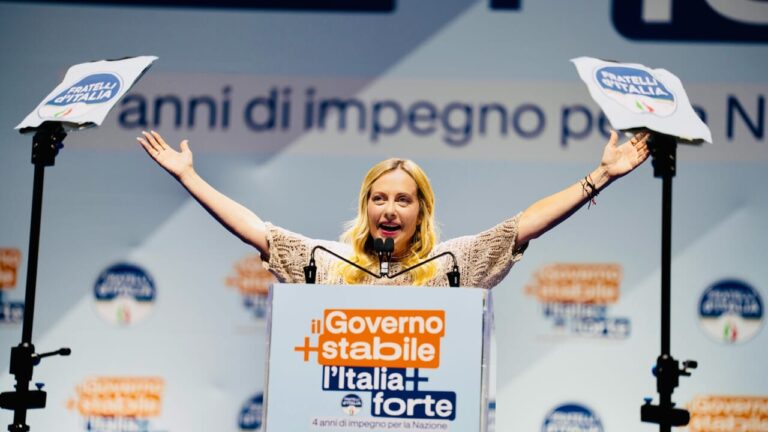
“We intend to increase the share of oil that can be extracted from our seas, because it makes no sense to go and buy oil in Qatar if we have it in Basilicata.” This is perhaps the only ‘news’ in the speech given by Giorgia Meloni on the occasion of his celebration in Bari as prime minister of the longest-serving government in republican history.
From the Apulian stage, the Prime Minister launched a new energy policy idea to provide an answer to citizens who, between the war in Ukraine and the blockade of the Strait of Hormuz, are dealing with rising bills. Our country has a small treasure in hydrocarbon reserves, but the pressure has to clash with a complicated reality: discoveries are at a standstill, drilling is stalled and our resources are limited.
How much are our reserves worth?
Let’s start from the basics. As reported by the relation “The national energy situation in 2025” by the Ministry of the Environment (Mase), our oil requirement was equal to 44,594 Ktoe (thousands of tonnes of oil equivalent). The national offering contributed approximately 9 percent. This means that almost all of our demand is met by importing resources from abroad. As regards crude oil, Libya is the main supplier (24 percent), followed by Azerbaijan (16.6) and Kazakhstan (13.1). The demand for gas, however, amounted to 63.4 billion cubic meters (national production stopped at 3.4 billion). And a good part of the gas arrived from Algeria: 22.2 billion cubic meters (provisional values).
As we have seen, our reserves contribute to a marginal fraction of energy needs. In 2025, communicate the National Mining Office for Hydrocarbons and Georesources, an increase in the national production of natural gas of 12.2 percent was recorded, while there was a slowdown in that of crude oil (-11 percent). The exploitation of our deposits has led to a reduction in Italian hydrocarbon reserves.
Because every year we leave 7 billion euros in the ground: “Here’s how to pay 20 cents less for petrol” – by Pierfrancesco De Robertis
When we talk about reserves we enter the field of probabilities. Reserves, in fact, are distinguished according to an international classification into: certain, probable and possible. In the first case, these are estimated quantities of hydrocarbons that can, with reasonable certainty (probability greater than 90 percent) be produced in the conditions existing at the time considered. Probable resources refer to resources that can be recovered with reasonable probability (greater than 50 percent). Finally, the “possibles” represent the hydrocarbons that are estimated to be able to be recovered with a very low degree of probability (far less than 50 percent).
Considering 2025 production, gas reserves amount to 34,674 million cubic meters (-11.7 percent) and 76.9 million tons of oil (-1.6 percent). Doing a quick calculation with the price of crude oil around 100 dollars a barrel, Italian oil reserves would be worth around 48 billion. Resources that can be useful for saving citizens and supporting the industrial fabric in this period of rising petrol prices.
Italian production
In 2025, national natural gas production reached 3.2 billion cubic meters of natural gas and 3.8 billion kilos of crude oil. Resource extraction is carried out through exploration permits and cultivation concessions. The former are exclusive mining titles that allow one or more exploratory wells to be carried out in search of a new deposit. When this is identified, an application must be submitted for the cultivation concession that allows it to be put into production. As of December 31, 2025, there were 44 exploration permits and 182 cultivation concessions, onshore and offshore, in Italy. In the concessions there were 1,554 active wells, of which 1,492 were productive (573 producing and 919 non-producing).
In recent years, mining titles, awarded by decree of the Ministry of Economic Development, had decreased. In 2022 they were 226 (248 in 2021), the following year they dropped to 213 and in 2024 they dropped again to 195, before returning to 226 in 2025. Added to this swing in research and resource extraction is a stalemate in the discovery of new hydrocarbon deposits. No gas wells have been found to exploit since 2024, while the “thirst” for oil has lasted since 2009.
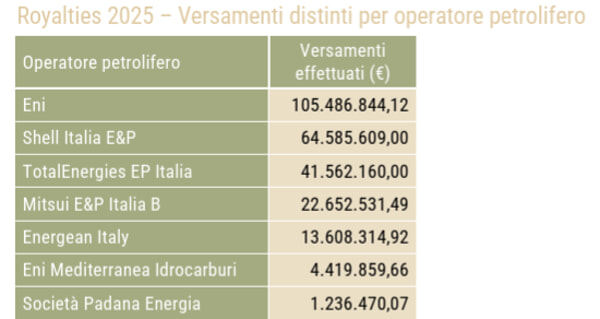
Hydrocarbon deposits are an unavailable asset of the State. A private company which, thanks to the concession, carries out production must pay royalties to the State, the Regions and the Municipalities involved in the activities linked to the deposit. In 2025, operators paid more than 256 million euros in rates, of which just over half went to the Regions. Eni is the main operator having concessions, including in joint ventures, for 1,054 wells (out of 1,556) for the cultivation of hydrocarbons. A total that also takes into account the fields in which Eni Mediterranean hydrocarbons operates. Therefore the state subsidiary pays the majority of the royalties (105.4 million euros), followed by the Italian subsidiary of the British Shell (64.5 million) and the Italian subsidiary of the French TotalEnergies (41.5 million).
To prevent Italian reserves from becoming increasingly depleted, it is necessary that national production is at least compensated by new discoveries. But exploration drilling has been at a standstill for years. The last one on land dates back to 2018, while at sea in 2024. The stop to activities is the combination of the Conte I government’s moratorium (2019) and the Plan for the sustainable energy transition of suitable areas (2022) canceled with some sentences of the Lazio Regional Administrative Court in February 2024. Now the government wants to reverse the trend.
Where the deposits are located
Basilicata, as Meloni recalled, is a good starting point. As regards the location of proven reserves, 94.2 percent of those of oil fall on the mainland, mostly in Basilicata. In 2025, 3,293 thousand tonnes were produced in the region compared to 241 in Sicily, 16 in Emilia-Romagna and 5 in Molise.
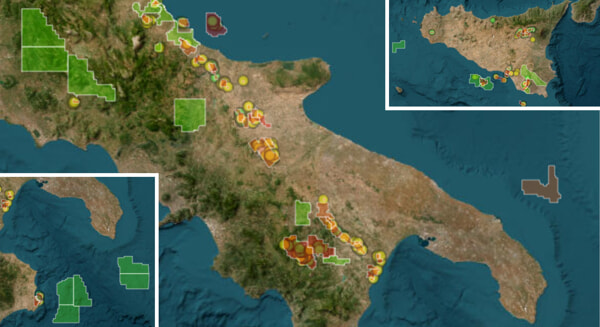
In the province of Potenza, in Val d’Agri, the largest oil field on land in all of Western Europe was discovered in 1987. It is made up of approximately 40 wells, and all are under concession from a joint venture of Eni and Shell Italia E&P. The Val d’Agri Oil Centre, as Eni writes in its local sustainability report dated 2024, boasts a nominal treatment capacity of 104 thousand barrels of oil per day and 4.6 million cubic meters per day of gas associated with crude oil. The total daily production of hydrocarbons reaches 34.4 thousand barrels of oil.
Production in Italian Texas
Also in Basilicata, in Gorgolione (Matera), there is the Tempa Rossa oil field. Discovered in 1989, it extends over an area of over 290 square kilometers and affects the territory of 13 Lucanian municipalities. So far, 6 wells have come into operation while another 2 are under construction, for research purposes and to ensure the stability of production. The concession is divided between TotalEnergies Ep Italia (50 percent), Mitsui E&P Italia (25 percent) and Shell Italia E&P (25 percent). Since January 1, 2022, 53.9 million barrels of crude oil and 204.8 million cubic meters of gas have been extracted (as of September 6, 2026). According to the most accredited estimates, there are 480 million barrels of crude oil in the field.
Another very important field is that of Campo Vega made up of 21 wells, all with the operator Energean Italy. Vega is an offshore oil field located in the Strait of Sicily, 20 kilometers south of Pozzallo (Ragusa). Energean holds a 100 percent stake after acquiring Eni’s 40 percent stake in 2020. The Vega A platform has been active since 1984 and, with a depth of 124 meters, is the largest in Italy. The platform has a processing capacity of 60 thousand barrels of oil per day and is supported by the Leonis tanker with storage and offloading functions. An industry survey estimated reserves of 17.3 million barrels of oil and natural gas equivalent.
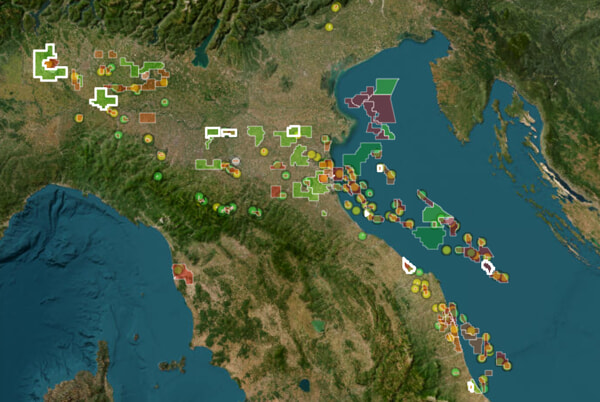
As for the rest of the concessions present in Italy, the Po Valley and in particular Emilia-Romagna have provided a fundamental contribution to national production in the past. But their centrality has been decreasing and today Emilia-Romagna is worth 0.44 percent of the national production of crude oil and 8.3 percent of that of gas (excluding marine areas).
Dossier is the exclusive subscription investigative section of The Vermilion. If you want to support our journalistic work and subscribe, Click here.