

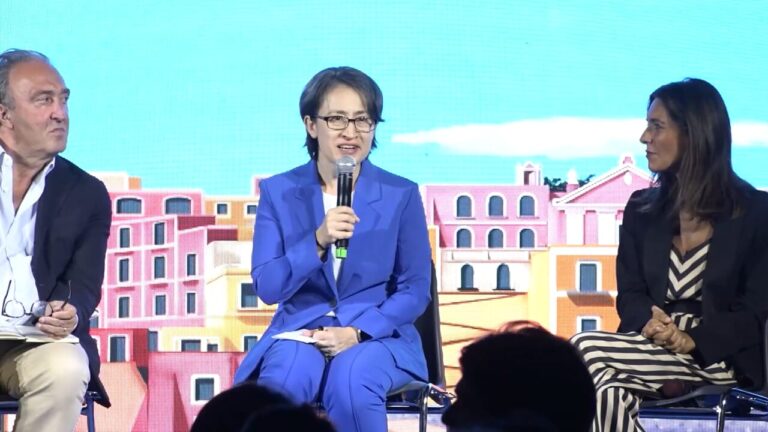
The arrival in Ventotene of the vice president of Taiwan, Hsiao Bi-khim, is the big surprise of the second edition of the European Conference for Freedom and Democracy. But also an international case. “Twenty-one or Taiwan, no island is so small that it doesn’t have a voice and no society is so small that it doesn’t have freedom,” the vice president says.
His presence remained secret until the end for security reasons. When the news became public, the spokesperson of the Chinese Foreign Ministry, Mao Ning, announced that she had presented formal representations to Rome and Brussels, branding the trip as a reprehensible gesture destined to fail: according to Beijing, the authorities of the Democratic Progressive Party and individual Taiwanese politicians would seek visibility at any cost to pursue independence under the cover of the words “democracy” and “freedom”.
Beijing reiterated its firm opposition to any form of official interaction between Taiwan and countries that maintain diplomatic relations with China. Although Taiwanese foreign ministers occasionally travel to Europe and other countries that do not have official diplomatic relations with the island, it is rare for such a high-profile official as a vice president to make such a visit, given the possibility of retaliation by Beijing against the host country. China claims that Taiwan is its own province, a position that the island, governed by a democratic government, firmly rejects.
“Taiwan loves peace, but must defend itself”
It is no coincidence that the challenge takes place in Ventotene, the island of confinement where in 1941 Altiero Spinelli and Ernesto Rossi wrote the Manifesto for a free and united Europe. A short distance from where his remains rest, Hsiao Bi-khim chooses to speak of peace. The Taiwanese people, he assures, “love peace just like you Italians”. But this does not take anything away from the need to “do more to strengthen our defense against the threats of large countries”: not to wage war, he specifies, “but as a deterrent and a tool to pursue peace”, to be combined with “dialogue intended as a solution even for the problems that seem more difficult”.
Our thoughts inevitably turn to Eastern Europe. “Ukraine is a very painful situation and it is also a warning to all of us,” says the vice president. “We don’t want Taiwan to be the next Ukraine, war is not an option for us. And we must do everything we can to ensure peace prevails.”
As for relations with Washington, complicated by the unpredictability of the Trump administration, Hsiao does not back down: “Taiwan will continue to seek support from the United States, also because we have common interests in the region, while the United States is in a situation of complex competition with China.”
To describe the condition of her island, the vice president uses the metaphor of cats: small and docile animals, but also resilient, capable of “taking great leaps, and who know how to live in small spaces and in difficult situations”. A reminder to the present – but above all to the future – of Taiwan, with the awareness that “when you are on the right side of history, your influence is greater than the size of your island and your people and we want to continue to have the opportunity to speak to the whole world”.
Picierno: “Intimidation cannot decide who participates”
The vice-president of the European Parliament Pina Picierno is the leader of this three-day initiative in Ventotene which brought together dissidents from all over the world who fight against regimes.
Hsiao Bi-khim’s participation was kept confidential until his arrival, to avoid pre-emptive pressure from China. “In Ventotene no one decides who can be there, much less a regime. No one can establish who can be hosted on European soil, which voices can be heard and which presences must be hidden.
It is a simple and very clear message: intimidation cannot decide who participates in our democratic debate.
Freedom of confrontation cannot be negotiated with autocracies. And Ventotene, today more than ever, must continue to be the place where freedom and democracy defend themselves without fear.”
Who is Hsiao Bi-khim
Hsiao Bi-khim is a Taiwanese politician and diplomat, Vice President of Taiwan since May 20, 2024. Born in Kobe, Japan, to a Taiwanese father, Hsiao Ching-fen, and an American mother, Peggy Cooley, she grew up in Tainan, speaking Mandarin, Taiwanese and English from an early age, and was raised in a Presbyterian family. As a teenager she moved to the United States, where she graduated from Oberlin College and Columbia University.
On November 20, 2023, Democratic Progressive Party presidential candidate Lai Ching-te officially named her as his vice presidential candidate for the January 13, 2024 presidential election, which the ticket later won. Beijing has included her several times in its sanctions lists, branding her as an “uncompromising pro-independence”.
Hong Kong, organizers of Tiananmen vigils condemned
Meanwhile, in Hong Kong, a court in recent days sentenced three former organizers of the vigils in memory of Tiananmen, the protests repressed in 1989, to prison terms ranging from five years and two months to seven years and three months for crimes against national security, at the end of a trial criticized by the United Nations, human rights organizations and several foreign governments.
The three defendants, Lee Cheuk-yan, 69, Chow Hang-tung, 41, and Albert Ho, 74, have been in prison since they were charged in 2021. Lee and Chow were found guilty of “incitement to subversion” in August, while Ho pleaded guilty in January.