

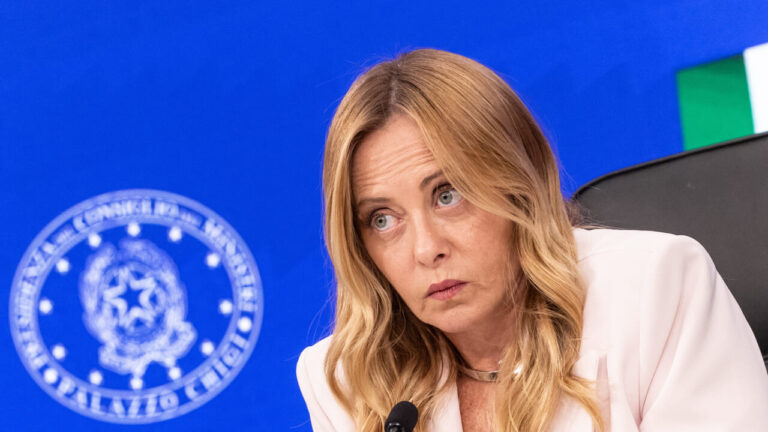
Prime Minister Giorgia Meloni announced with great fanfare that she had “abolished one of the most hated taxes by Italians”: the car tax, the tax that car and motorbike owners must pay every year. The measure, contained in the law decree for economic support and the containment of the effects deriving from the continuing increase in the cost of fuel, concerns small and medium-power cars (under 80 kW) and all motorcycles, for a total of over 14 million vehicles involved. Be careful though: the text, also reported in the statement from the Council of Ministers, does not speak of abolition, but of an exemption valid for 2027, therefore only for next year. At least for the moment.
Abolition or exemption
The Prime Minister spoke of a “structural” measure and assured that the objective is to make it “definitive”. However, the text of the decree is clear: “The decree introduces, for 2027, the exemption from paying the tax for a vehicle. Natural persons who own a car benefit from it, and taxable subjects such as those who use the vehicle on lease or rental, petrol or diesel, including hybrid fuel, with a power not exceeding 80 kW; when the person owns more than one subsidized vehicle, the exemption applies to the one with the lowest power. Anyone who does not own cars falling within the limits indicated can benefit from the exemption for a motorcycle or moped”.
Today, therefore, it is more correct to talk about exemption rather than actual abolition. The CDM press release explains that the rule has a “temporary” nature because it is included in a law decree, an instrument adopted to counter an emergency situation, but with the prospect of making it permanent in the next economic maneuver: “The measure also applies in the territories of the regions with special statute and the autonomous provinces, subject to agreement with each autonomy holder of the tax, and is accompanied by a transfer in favor of the regions and autonomous provinces to compensate for the reduction in revenue. The exemption is provided for the year 2027, in prospect of a subsequent abolition of the tax, which the government intends to follow up in the next budget law”.
A concept reiterated by the prime minister also in a video published on her social media accounts: “The abolition of car tax is not only valid for 2027. As the government has already largely guaranteed and reiterated, the measure is designed to be structural, therefore definitive”.
The money to be returned to the Regions
Beyond the Prime Minister’s reassurances, some question marks still remain regarding financial coverage. The framework in which the next budget law will be drawn up is far from clear, just as it has not been specified where the 2.3 billion euros to be allocated to the Regions to compensate for the lost revenue will come from. The revenue from the stamp duty, in fact, is collected by the local authorities. “We are not talking about a provision that someone else has to pay for – explained Giorgia Meloni in the post-Cdm press conference – and therefore we will transfer to the Regions the share of the resources which clearly represents a loss of revenue for them”.
The concept was also underlined by the deputy prime minister and foreign minister, Antonio Tajani, on Radio Anch’io: “The payment of the tax will be removed from 70% of cars, then it will become a structural choice. And all the money will be returned to the regions, which in this way will not have to spend on recovering it from those who evaded it. The financial source is there and the money will be found, and therefore we will not have to increase taxes. The abolition of the car tax had been an idea of Silvio Berlusconi, already in 2017, and therefore it cannot be considered a form of electoral propaganda because we are voting in a year.”
The other unknowns
The elections scheduled for 2027 represent another unknown. In fact, once next year’s deadline has passed, it will be up to the new executive – whether Meloni is still at the helm or not – to confirm the farewell to the tax for subsequent periods and, above all, to find the economic resources for such an onerous measure. Everything will also depend on the evolution of the international scene, from the crisis in the Middle East to the conflict between Russia and Ukraine. For the moment, the only certainty concerns 2027. A measure that is certainly popular because it affects the “most hated” tax, but which at present is equivalent to a one-off “discount” between 150 and 200 euros based on the engine capacity (higher for cars close to the 80 kW limit and lower for small cars). In conclusion: the law is there and the good intentions too, it remains to be understood where the money will come from, especially if the measure were to become truly “structural”.