

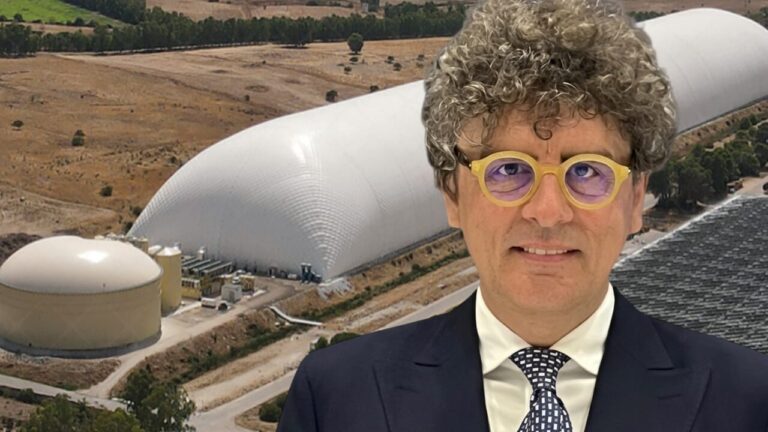
“Our world cannot wait.” The Energy Dome claim is a warning, but also a promise. The urgency of finding alternatives to fossil fuels finds an answer in the same company that raises global concerns. Because with its patented technology the start-up aims to unravel a knot that is still difficult for the energy market to untangle: how to make up for renewable sources when the sun sets and the wind stops. The company offers a mechanical system that uses CO2 to avoid new emissions. The idea has already raised hundreds of millions of euros in investments and funding rounds. Only time will tell if Energy Dome will be the new Italian “unicorn” and if it will have solved the energy issue.
What it is and how it works
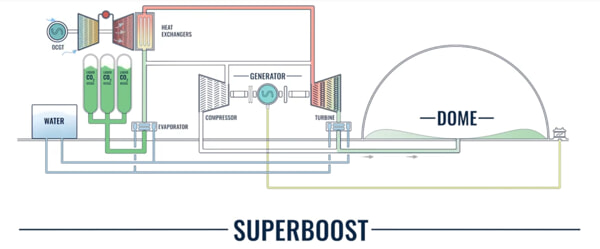
The company’s top management explains how it works in a paper published in the journal of the American Society of Mechanical Engineers. The patented technology is the CO2 battery, a closed-circuit system made of a “balloon”, turbines and tanks capable of producing energy when the grid needs it. The protagonist is carbon dioxide, used in its purest form to avoid impurities that could damage machinery. The gas is stored inside a dome which works like a real balloon. The gasometer, this is its technical name, is flexible and can change its volume according to the needs of the moment.
When demand on the energy market is low, CO2 is taken from the dome, which deflates. The carbon dioxide passes, through a duct, into a compressor which causes the gas to reach a pressure of 68 bars (the normal pressure at sea level is just over 1 bar) and a temperature above 400 degrees Celsius. A process powered by electricity produced in excess by renewable plants. To avoid wasting this energy, CO2 is made to flow through thermal storage sections (Tes) where it then releases heat to fluids stored in dedicated tanks. Finally, it is cooled in a condenser and, now in a liquid state, is stored in a series of high-pressure tanks.
If the electricity grid instead needs energy then the discharge phase is activated. The carbon dioxide is evaporated and the gas at high pressure and temperature passes through a turbine, driving an electric generator which feeds energy into the grid. Finally, an exchanger cools the CO2 which at this point returns to inflate the elastic dome.
However, there is also another version of the technology that integrates with combined cycle gas turbines by recovering waste heat. In practice the system instead of storing heat and therefore consuming energy during charging, it uses the high waste temperatures of gas turbines to heat the CO2 when it is necessary to activate the turbine. A solution recommended for data centers and network managers. Efficiency, the company reports, thus reaches 115 percent.
The business
The CO2 battery patented by Energy Dome is part of the family of long-duration storage technology (LDES) and aims to produce energy from its periodic reuse. Systems like this try to meet energy demand when renewable sources are not usable (there is no wind, it is cloudy or the sun is setting).
These are “plug and play” systems, which can be activated when needed. There are different solutions available: pumped hydroelectric energy storage, lithium ion batteries and indeed the compression of gases such as carbon dioxide. The first option is the most exploited but is limited to the orographic characteristics of the area. Lithium ion batteries have a theoretical nominal efficiency of around 95 percent, but the real efficiency in operation, considering aging and auxiliary consumption, falls between 70 percent and 80 percent. The CO2 battery, on the other hand, offers a real net efficiency of around 75 percent, comparable to the operational efficiency of lithium and the system has an expected life of 30 years.
In their paper, the Energy Dome leaders highlight some critical points of lithium ion batteries: they have a relatively short life (7-10 years) if used with a reduced depth of discharge, they have significant replacement costs and disposal of the equipment is challenging. To this we can add the dependence on China for rare earths and critical materials. And then there is the greater ease of obtaining authorization permits for more tested technologies present in the area, such as those that make up the CO2 battery. These are all figures and considerations that were able to convince institutions, investment funds and multinationals to finance the team of Italians behind the start-up.
Funding raised
In 2021, just two years after founding, the company announced the closing of an $11 million funding round. Among the signatories were venture capital firm 360 capital, multi-family office Novum Capital Partners and Barclays bank. The money was then used to support the 2.5 MW by 4 MWh demonstration plant in Ottana (Nuoro), validated in June 2022. In the meantime, the idea had already convinced A2A to sign a memorandum of understanding with Energy Dome for the realization of their first commercial project.
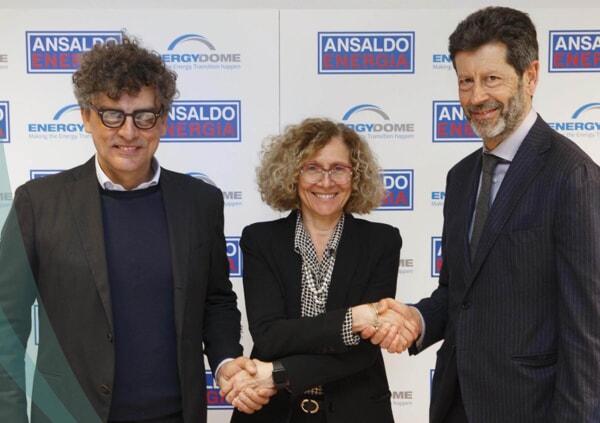
Which will also become operational in Ottana in 2025, two years later than initial estimates. But until then agreements and investments have flowed in. A non-exclusive license agreement was signed with Ansaldo energia to collaborate on the marketing of plants in Europe, the Middle East and Africa. Energy Dome will provide the CO2 battery technology, while Ansaldo will guarantee the equipment, engineering and construction of the new storage systems.
In 2022, it was planned to build 30 plants in the next five years. Also in that year, an 11 million dollar convertible financing round was closed with Cassa Depositi e Prestiti, Barclays and Novum capital partners. Europe also believed in the project, so much so that first the European Innovation Council (with 17.5 million euros) and then the European Investment Bank (with 25 million euros) financed Energy Dome.
Further resources came from the B round of financing (55 million euros) which saw Eni Next and Neva Sgr, the venture capital arm of Intesa Sanpaolo, among the underwriters. At the end of 2023 Energy Dome earned media attention for the 35 million euro investment of Breakthrough energy catalyst, the fund created by Bill Gates.
In 2025, the already excellent names supporting the project were joined by Google, which has the objective of powering its activities with zero carbon emission energy by 2030. These are all cases that make the company’s business model very clear: the sale of energy to operators (energy storage as a service) or the supply of the CO2 battery for those who want to manage their system independently while controlling its ownership.
Ottana and the other projects
To date there is only one operational Energy Dome plant, the Sardinian one in Ottana. The company, which owns and manages the infrastructure, has signed a distribution contract with Engie. During the discharge phase, the turbine generates 200 megawatt hours of electricity in 10 hours and is therefore able to supply electricity to approximately 14 thousand families. The entire system occupies approximately 5 hectares and the dome dominates the landscape, which can contain a maximum of two thousand tons of carbon dioxide.
The “dome” was designed to withstand winds of up to 160 kilometers per hour, reports the specialist magazine IEEE Spectrum. In case of risks, the company could also empty the dome with a mid-day notice to avoid dispersion into the environment. If the gas were released into the air, the equivalent of the carbon dioxide produced by approximately 1,000 people traveling on a return flight from Rome to New York in economy class would be released in that area.
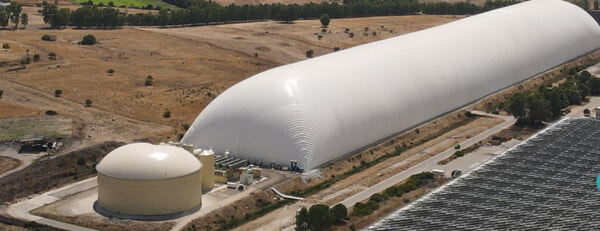
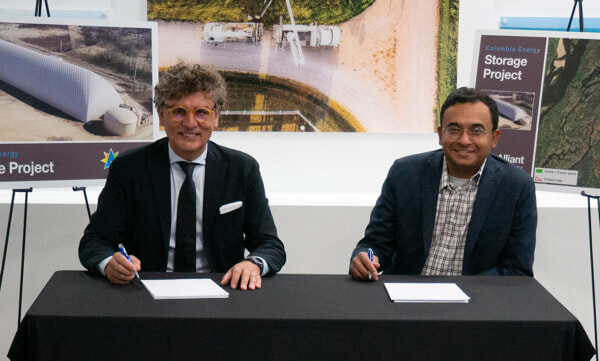
However, the analysis of the possible costs and benefits of the project, as we have seen, convinced energy operators to invest in Energy Dome. A 20 MW/160 MWh 8-hour plant is expected to be built in India by 2026. NTPC, the subcontinent’s largest utility, will complete the infrastructure next to its Kudgi thermal power plant. The plant in Wisconsin (United States) is also in the pipeline, with a supply contract signed by Alliant energy, which will power around 18 thousand homes. Other projects are in development or under construction: in Arizona (United States), in Ireland (part of the agreement with Google) and in Australia (with the state company Sec).
Who’s behind it
The Energy Dome industrial center is concentrated in Piacenza. The Emilian plant can count on an area of 18,500 square meters used for production and as a warehouse, flanked by 1,500 square meters of offices.

What Energy Dome will be, however, is decided in Milan where the headquarters and legal offices are located. And where the company’s founders also trained: Claudio Spadacini (CEO), Dario Rizzi (technical director) and Francesco Oppici (commercial director). The three attended the Polytechnic of Milan, obtaining master’s degrees or degrees in mechanical or energy engineering. Their paths crossed for the first time at Exergy, another energy start-up founded by Spadacini. Together, they then created Energy Dome which aims to revolutionize the renewable energy market.
Dossier is the exclusive subscription investigative section of The Vermilion. If you want to support our journalistic work and subscribe, Click here.