

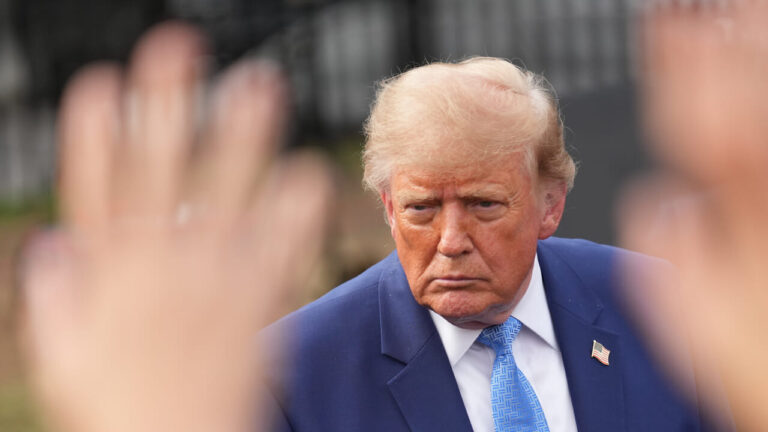
Three commercials worth over a million and a half dollars, all paid for with taxpayers’ money. In recent days, Donald Trump has found himself in a storm with the accusation of having used public money to broadcast videos on various television channels, including during the very popular NFL games, just before the mid-term elections.
Trump commercials
The first video, accompanied by the song “Love me”, shows some images of the president, the second the speech at Mount Rushmore for the 250th anniversary of the USA, while the third shows a sequence of images and videos of the president of the United States in which the audio accompanies slogans against communism and socialism, with a superimposed text that exalts the successes of his administration.
Not only that, according to an investigation by the Wall Street Journal, Trump would have used some funds intended for Customs and Border Protection, the federal agency that deals with border security.
The criticisms
The case triggered a real wave of criticism, not only from the opposition. The NGO Public Citizen and the democrats presented formal complaints, defining the initiative as “shameless and ethically unacceptable”. MP Jamie Raskin is also harsh: “A blatantly unethical conduct. The commercials could constitute a serious crime of theft and misappropriation of public goods for election campaign purposes.” Even some members of the Republican Party distanced themselves, such as the leader of the conservatives in the Senate, John Thune: “The campaign should not have been paid for with taxpayers’ money. It’s a good commercial. I like the message but it shouldn’t be paid for by taxpayers.” A strategy also condemned by Senator John Cornyn, while conservative MP Thomas Massie preferred to focus on irony: “Don’t worry, using public money for the president’s advertising campaign has been done in the past and is completely legal, in a banana republic.”
The response from the White House
The Trump administration has meanwhile rejected all accusations through communications director Steven Cheung, who called the criticisms “highly dishonest”, branding them as fake news. In an official statement titled “Presidential public service announcements are nothing new,” the White House defended the ads, calling them “public service announcements”: “These are public service announcements, intended to remind Americans to love their country and understand what makes it worth defending.” The defense is based on two main arguments. The first concerns the very nature of the videos, which are not of an “electoral” nature because they do not contain an explicit invitation to vote and Donald Trump does not appear as a candidate directly present on the ballots. The second argument concerns historical precedents, summarizing the public service announcements released in the past by presidents such as Woodrow Wilson, Franklin D. Roosevelt and, in recent times, by Barack Obama for Obamacare and Joe Biden for Covid vaccinations.
US law
But what does the law say in the United States? The criticisms reported by American newspapers are based on three fundamental regulatory pillars that the three commercials allegedly violated. The first is represented by the prohibition on propaganda provided by the Federal Appropriations Laws, according to which federal law strictly prohibits the use of funds appropriated by Congress for the purposes of “propaganda, self-aggrandizement or partisan political advertising”. A public service announcement should inform citizens about a service or an emergency, while in this case the videos promote and celebrate the work and policies of the sitting president. The second pillar is the Hatch Act, the law that strictly prevents employees of the executive branch of the federal government from engaging in partisan or electoral political activities while carrying out their institutional duties. Finally, there are the rules of the Federal Communications Commission (FCC), which impose stringent advertising transparency constraints on television broadcasters and platforms.