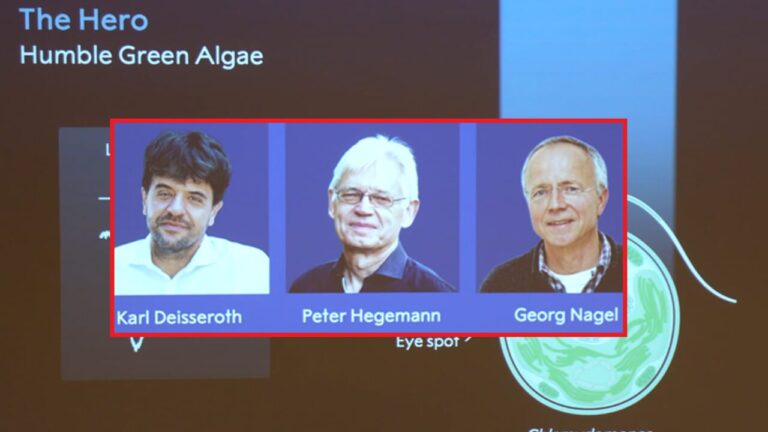
The winners of the 2026 Nobel Prize for Medicine are Karl Deisseroth, Peter Hegemann and Georg Nagel. The three scientists laid the foundations of optogenetics, the discipline that combines genetics and optics to study the behavior of cells.
The winners were announced from the Karolinska Institutet in Stockholm by the secretary general of the Nobel Assembly, Thomas Perlman. The three scientists will share 12 million Swedish crowns (1 million more than in recent years), equal to approximately 1.066 million euros.
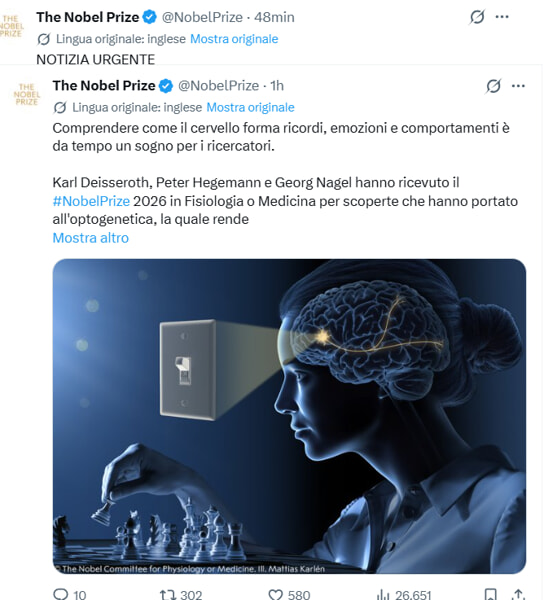
Karl Deisseroth, Peter Hegemann and Georg Nagel jointly won “for their discoveries relating to light-activated ion channels and optogenetics”, reads the prize citation. In particular, their research has laid the foundations for controlling nerve signals with light. Their discoveries and experiments have made it possible to study the brain in great detail, to the point of being able to turn on or off the activity of individual nerve cells in a living brain. This method is now being used in laboratories around the world to understand how the brain organizes emotions and memories.
The winners of the Nobel Prize for Medicine 2026
Karl Deisseroth, who will turn 55 in November, is among the youngest scientists awarded the Nobel Prize for Medicine so far. He teaches bioengineering, psychiatry and behavioral sciences at the Howard Hughes Medical Institute and Stanford University.
Peter Hegemann will turn 72 in December and is Hertie Senior Professor of Neuroscience at Humboldt University in Berlin.
Georg Nagel turned 73 in August, is professor of Molecular Plant Physiology at the Department of Molecular Plant Physiology and Biophysics – Botany I at the University of Würzburg. The discoveries awarded today were made at the Max Planck Institute for Biophysics in Frankfurt.
Hegemann and Nagel paved the way for Nobel-winning research with the discovery of the protein called “channelhodopsin” which, if introduced into cells, makes them sensitive to light. Subsequently, the American Deisseroth transferred the channelrhodopsin gene into the nerve cells of rats and, by illuminating them with blue light, managed to trigger a nervous signal. In other experiments this special light switch made it possible to control nerve cells in the brains of live mice.