

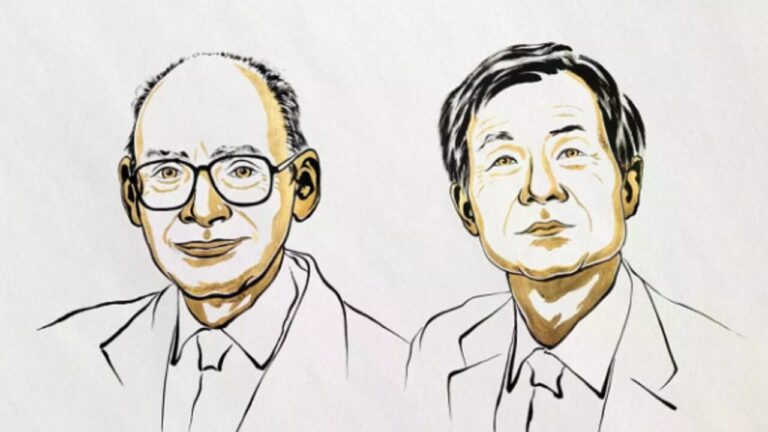
The 2026 Nobel Prize in Chemistry went to Henri B. Kagan, of the University of Paris-Sud, and Kenso Soai, Tokyo University of Sciences. The Swedish Academy awarded them “for the discovery of nonlinear effects and autocatalysis in asymmetric organic synthesis”. In essence, the two scholars have solved a puzzle that has tormented scientists for over a century: how to guide chemical reactions to achieve homochirality (i.e. the presence of a single mirrored form of a molecule).
The studies
“The chemistry of life is what chemists call homochiral, from the Greek for ‘same’ and ‘hand’. Like hands, all amino acids exist in two mirror-image variants, but only one of them is found in the proteins of our cells. The other is rarely found in nature,” writes the Swedish Academy.
“For a long time, chemists wondered how homochirality could emerge. When they began experimenting with chemical reactions capable of forming two mirror-image molecules, they always got equal proportions of both in the test tubes,” summarizes the Nobel organization. “However, chemists strove to produce only one of these mirror images, because in the development of molecules intended to interact with living things – as in the case of drugs – only one of the two mirror images will have the desired effect,” the commission states.
“Henri Kagan and Kenso Soai have provided a solution to a chemical mystery more than a century old: how homochirality can emerge spontaneously,” Heiner Linke, chairman of the Nobel Committee for Chemistry. Kagan took the first decisive step in 1986, when he discovered a new way to manipulate chemical reactions. This allowed him to create a greater excess of one of the mirror images than previously thought possible.
Soai took the next step. In 1995, a landmark publication described how he had engineered the first-ever chemical reaction with the potential to be homochiral. In 2003, he finally succeeded. He presented a reaction in which only one of two possible mirror images was formed. Apart from life itself, no one had ever achieved such a result.
“Thanks to Henri Kagan and Kenso Soai,” concludes the Swedish Academy, “we now know how homochirality can emerge. Their discoveries have been decisive for chemists designing reactions for drug production.”