

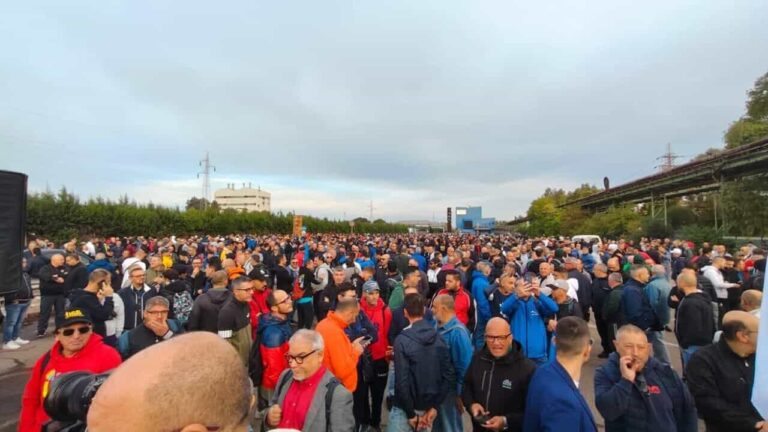
Not just redundancy pay, but a future for factories and for those who work there. This is the request that accompanies the 24-hour national strike today, Monday 12 October, in the former Ilva factories. From Taranto to Genoa and Novi Ligure, employees of Acciaierie d’Italia and related workers are protesting against the production block and the absence of a concrete prospect of restarting.
The mobilization, proclaimed by Fim, Fiom, Uilm and Usb, could continue in the next few days. In Taranto, after an assembly in the management car park, a group of workers and delegates occupied a stretch of state road 106. In Genoa the procession left from Cornigliano towards the prefecture, with the mayor Silvia Salis, the president of the Region Marco Bucci and the deputy mayor Alessandro Terrile. Assembly and garrison also in Novi Ligure.
Why the workers go on strike
The confrontation on 8 October at Palazzo Chigi did not give the answers the unions were expecting. The government has indicated coverage of the redundancy fund until next June, with 80 million euros for that in derogation intended for related procurement and another 45 million to integrate the treatment of Acciaierie d’Italia employees up to 70 percent of the salary. The measures should be included in a decree expected in tomorrow’s Council of Ministers. For metalworking organisations, however, the answer is “completely insufficient”: there is no project that clarifies how and when to return to production.
The unions contest the postponement of the industrial prospects for the sale of the company to a new manager and ask for commitments on decarbonisation, with new electric furnaces instead of blast furnaces.
Alongside investments, they demand extraordinary tools for workers: recognition of strenuous work and exposure to asbestos and pollutants, the possibility of early retirement and incentives for those who voluntarily choose to leave the company. “We need financial resources”, says the secretary of the Fiom of Taranto Francesco Brigati, who asks for public intervention to start the transition.
The stop in Taranto also puts the North in crisis
In Taranto the plants are already at a standstill, awaiting the hearing on 20 October in the Court of Cassation on the provision of the Court of Appeal of Milan which requires the stop of the hot area. Acciaierie d’Italia explained that the raw materials, no longer purchased in view of the shutdown, have also run out.
The hot area is the heart of production: through blast furnaces and steel mills, the steel also destined for processing in the Northern factories is obtained. Genoa and Novi Ligure do not have their own hot processing area: they therefore depend on the semi-finished products to be transformed. If these do not arrive, their lines also stop. The company announced the temporary shutdown of the two sites by November 15th.
One of the disputes is concentrated precisely here. Unions and administrators ask to purchase material on the market to keep the factories active. According to Salis, in Genoa the plants work and the products have a market: “There is no reason to stop the plants.” The mayor asks to freeze the decision on the sites in the North, which have different conditions from Taranto.
The fear of being left without income and without prospects
In Novi Ligure, Alberto Pastorello of Uilm talks about 550 families at risk and raises another problem: by switching from the company advance to the direct payment of INPS, the redundancy fund could arrive late. “We risk not having a euro for Christmas,” he warns. It is a concern expressed by the union, linked to the time needed to count the hours and settle the sums.
The crisis concerns the group managed by Acciaierie d’Italia, in extraordinary administration since February 2024 after the lack of liquidity and the failure to reach an agreement on financing between ArcelorMittal and Invitalia. Management is entrusted to commissioners Giancarlo Quaranta, Giovanni Fiori and Davide Tabarelli.
Today workers are asking that income protection be accompanied by an industrial plan. The mayor of Taranto Piero Bitetti rejects the idea that the workers are happy to be laid off: they want to work, support their families and continue to live in the area. A request that runs through the entire protest: to prevent the transition from becoming an endless wait.
A systemic crisis
The former Ilva dispute is part of the broader crisis in the Italian steel industry, caught between high energy costs, weak European demand and competition from Asian imports. In the case of Acciaierie d’Italia, financial difficulties, management instability and delays in the investments necessary to rehabilitate and modernize the plants also weigh heavily. Reduced production also compresses revenues and makes it more difficult to sustain factory costs, fueling a vicious circle that public aid can stop, but cannot resolve on its own.
To get out of it, capital, stable management and an industrial plan capable of keeping production, employment and health protection together would be needed. These are the demands of the workers who today, from North to South, have invaded the streets of three Italian cities that are key to steel production.