

“The connection drops during operations and some military missions fail.” This is what Kiev denounces after the sudden limitations reported on Starlink, Elon Musk’s satellite network which has become an essential tool for the Ukrainian armed forces. A case that opens at the moment in which Donald Trump increases pressure on Volodymyr Zelensky to stop the attacks on Russian refineries.
The coincidence fuels Ukrainian suspicions, although at the moment there is no official confirmation that all this was ordered by the White House. Starlink, for its part, has not confirmed changes to the service or admitted restrictions. For many, however, it is no coincidence that the stop occurred just four days after the words with which the American president effectively dumped Zelensky and lashed out against the energy targets hit by the Ukrainians in Russian territory.
What happened and why the drones risk stopping
Serhiy Beskrestnov, Zelensky’s advisor for military technology, reconstructs what happened, whose statements are reported by Guardian. On the evening of Tuesday 13 October, some terminals intended for military and national security purposes lost connection when moving at over 160 kilometers per hour. In this case we are talking about drones, even if restrictions and disruptions would also have been reported by soldiers in the field.
“Our armed forces were not warned about these restrictions and this caused the failure of several missions,” Beskrestnov denounced. For the councilor, the episode would be linked to the political context.
The point is above all the use of the satellite network to guide the drones. Ukraine also relies on Starlink to reach medium-range targets behind the front, in Russian-occupied territories. A limitation linked to the speed of the terminals could therefore compromise this type of operation.
Activist Serhii Sternenko, close to military circles and among the first to report the problem, claims that interruptions subsequently occurred even at lower speeds. It was he who put forward the hypothesis of an intervention by SpaceX at the request of the American administration: a reconstruction, we underline, still to be verified, but which fuels quite a few suspicions.
Russian refineries at the center of the clash with Washington
Behind the tensions between Kiev and Washington are, as already mentioned, the Ukrainian attacks on the Russian oil industry. Trump wants them to stop immediately and points to them as a cause of the rise in diesel prices. For Kiev, hitting refineries and oil infrastructure means putting pressure on a strategic sector of Moscow.
Also complicating the relationship with the United States is the issue of intelligence. According to Ukrainian Air Force spokesman Colonel Yurii Ihnat, Kiev did not receive any warning before the first wave of Russian ballistic missiles yesterday evening, Tuesday 13 October. For the next three, however, reports arrived from “foreign partners”, whose identity was not specified.
The United States has been providing information about impending attacks for years. Trump denies having interrupted this collaboration and Zelensky himself, in an interview with NPR broadcast on Wednesday, said the exchange continues. However, the Ukrainian president confirmed that his military advisors had received threats of possible limitations.
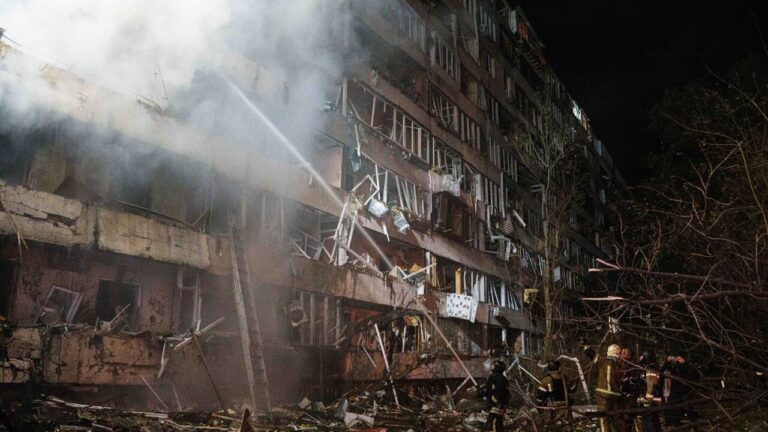
Meanwhile, the consequences of the bombings are concrete. According to Zelensky, late Tuesday evening Russia launched 39 ballistic missiles and 120 attack drones against Kiev and Kharkiv, hitting power plants and substations that power the capital.
At least 600 thousand people remained without power. A balance that could get worse, the Ukrainian president warned, while accusing Moscow of having launched a deliberate attack and of not taking seriously Trump’s declarations on an energy truce that appears increasingly distant just as winter approaches.