

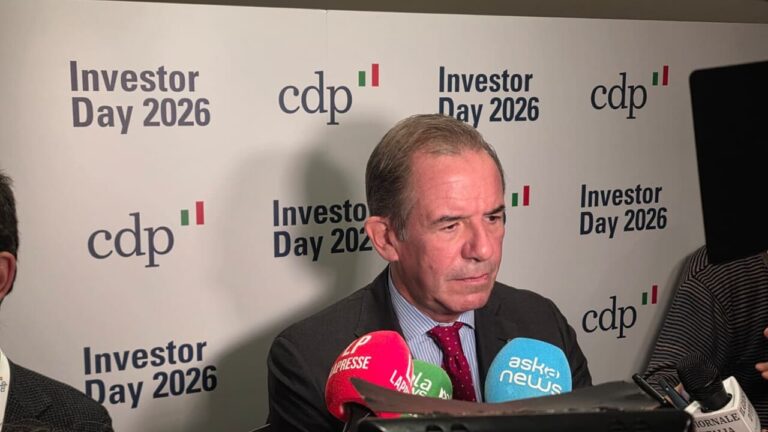
Public resources cannot cope alone in the face of the enormous challenges of the digital, energy and infrastructure transition. This is the message launched by the president of Cassa Depositi e Prestiti – a financial institution controlled by the Italian State that manages postal savings to finance public administration investments and support the growth of businesses – Giovanni Gorno Tempini, during his speech at the Bocconi University in Milan on the first Investor Day of CDP. An opportunity to take stock of the opportunities that Italy offers to international investors today. The event, Thursday 15 October, strengthened the dialogue with the market and presented the group’s role as a strategic platform for the country’s sustainable growth to over 150 investors. The meeting was attended by the top management of CDP, together with the management of the main investee companies (including Eni, Poste Italiane, Snam and Terna) and representatives of the most important global finance giants.
“Public money is not enough”
“As we all know, the world needs enormous investments. The main challenges are well known: the triple transition, digital and energy, to which must be added defence, artificial intelligence, new supply chains and public infrastructures. But one thing is clear: public money is not enough”, said Tempini in front of the audience of partners and representatives of companies in the CDP portfolio.
Analyzing the economic situation and the financial markets, the president of CDP underlined how the role of the State has become essential again. “And this government is doing well,” Tempini remarks. “If we look at it from a historical point of view, we come from a period of very low rates. This period is over for many reasons, so we are getting used to having bond rates again which, if you exclude the decade that goes from the great crisis to the beginning of the 1920s, was an exception because money that cost so little had never been seen before. We should get used to different rates”, says Tempini again. “Italy”, he underlined, “has had a series of promotions by rating agencies in recent years which have contributed to increasing the level of trust and which, frankly, in a long career I had never seen so concentrated. Obviously we must keep the bar straight because this is very important”.
“A bridge between public and private capital”
Hence the need to build a solid bridge between public and private capital, taking the Next Generation EU approach as a model. “How can we build this bridge? There are three key words: trust, competence and a long-term vision. This is the recipe for mobilizing capital, adapting it to market conditions and generating good returns, understood not only as financial returns, but also as an impact on society, for example through investments in social infrastructure or housing”, he continues.
In this context, the nature of Cassa Depositi e Prestiti is confirmed as strategic. “CDP is not a sovereign fund nor a bank in the traditional sense, but a development bank. We operate as a natural bridge, working with financial leverage to support private capital through credit, equity, venture capital and direct support to public administrations, which often lack resources and technical skills”, he points out.
“Italy is not a risky choice”
Finally, a passage dedicated to the Italian context and the change of perception on the part of foreign markets: “Thanks to the stability, budgetary discipline and stability of our industrial fabric, Italy is no longer a risky choice, but a place where it is essential to be and invest. Cdp’s mission is precisely to guide this drive for growth”.
“The first investor event we will do every year”
“This is the first of one of the events that we will do repeatedly every year to maintain relationships with our investors. Today we have around 550 investors, increasingly international, who buy our financial products, our bonds issued on the market. We also recently came out with a dollar bond and keeping a direct line and communicating with investors on how Cassa is evolving, what activities it does and if I may say also representing how the country is reacting to the various economic and geopolitical challenges, is a way to raise awareness and appreciate what has been done.” This was stated by the CEO of CDP, Dario Scannapieco.
The CEO underlined that “the results we have had in the market recently are very flattering, there is a great deal of attention on Italy, and a better knowledge of Cassa Depositi e Prestiti and this can be seen precisely in the success of our latest issues”. Today “is the beginning of a dialogue because we believe that by knowing CDP better there is a greater capacity to appreciate what we do”.
The day at Bocconi
The day at the Milanese university then continued with panels and speeches. “The vision behind the foundation of Bocconi was first and foremost an entrepreneurial vision. Ferdinando Bocconi was a visionary entrepreneur: he was the first to open department stores in Italy and make ready-made clothes accessible to the general public. But he also wanted to have an impact, and this spirit was transformed into the creation of a private non-profit university”, said the ‘landlord’ the rector Francesco Billari. “Today we would define it as an early public-private partnership, given that the first rector of the university was also the secretary of the Milan Chamber of Commerce. Since then we have always been close to the world of economics and business”, he adds.
Artificial intelligence, the main and most “current” topic, was then discussed at length. “It’s nothing new. When you look at the development of technological cycles in different eras, there have always been these two aspects: on the one hand massive investments, on the other returns that arrive in the long term, since technological changes take time. Compared to the past, the real difference lies in speed”, reiterated Fabio Massoli, CDP’s CFO, in his speech.
The arrival of agentic AI risks upending traditional business models. “For years we have considered large company size as an absolute value, capable of guaranteeing economies of scale on costs. Now we are entering an era in which smaller companies will be able to use intelligent agents to expand their productivity. This will change the general approach”, continued Massoli.
“This could accelerate Italian and European productivity”
A paradigm shift that could benefit the Italian and European economy. “If Europe risks losing the game on infrastructure investments, the rate of technology adoption in our continent is faster than in the rest of the world. The backbone of our system is made up of small and medium-sized enterprises: the agility of these companies will allow them to benefit from this transformation more than large corporations. This can create an acceleration of productivity for Europe and especially for Italy”, he concludes.
Esposito (Poste): “Save up to 10% per year without any impact on the workforce”
And artificial intelligence is the determining factor in supporting business growth and efficiency. This is the vision of Poste Italiane, structured along two fundamental lines: the internal integration of technology into processes and the optimization of offers intended for customers. “We consider AI as a key enabler of the group’s growth and productivity. The real turning point lies in the ability to integrate it into business processes, completely redesigning them: from administrative activities to the entire logistics chain”, comments Giuseppe Esposito, head of Investor Relations at Poste.
On the cost front, the company estimates savings of up to 10% per year on the supply chain by 2030, with no impact on the workforce. At the same time, an important retraining plan is planned: “We estimate that up to 15-20% of our employees will be retrained to be employed in other roles”, adds Esposito.
Marracino (Accenture): “AI a challenge for Italian productivity”
“86% of companies globally are increasing technological investments in AI, but only 18% see the value in the field. At a European level the figure falls below 10% and in Italy we are in the low single digits”, reported Roberta Marracino, Talent Lead at Accenture. “The real challenge is cultural even before technological. The typical trend is to insert AI into schemes that belong to the old world”, he continues. But “the adoption of AI represents a crucial opportunity also at a macroeconomic level” and “Italy has been facing the problem of productivity for at least thirty years: this is the opportunity the country has to make the leap in quality”, he concludes.
“How to use this enormous amount of data?”
“Today, AI democratizes access to data. Anyone can have the complete history and the most up-to-date trends at their fingertips to make decisions. For us the priority is to understand how to use these tools to speed up the collection of information”, says Alberto Chiandetti, Portfolio manager Fidelity International, in his speech.