
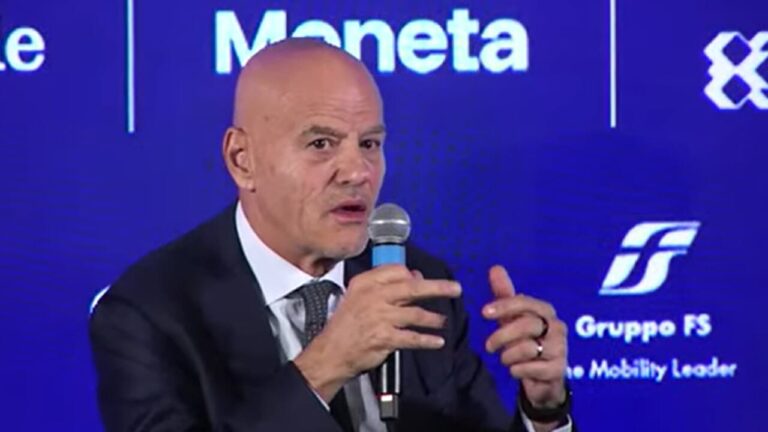
“We are fighting for who will have supremacy in energy.” Claudio Descalzi, CEO of Eni, describes the new global economic and geopolitical competition in this way. Interviewed at the Moneta Economic Forum, the manager identifies access to energy sources as one of the decisive factors in determining which countries will continue to grow and which will risk falling behind.
His reasoning starts from a fundamental change: oil and gas are no longer just goods to be bought and sold on the international market. They have become instruments of power, conditioned by wars, the security of trade routes and the choices of governments.
“Those who have the energy now are the United States, the Gulf countries, Russia, Iran,” says Descalzi. And the problem is above all for those who do not have sufficient resources, such as Europe and China.
The disappeared Russian gas and the new dependence on the United States
Before the war in Ukraine, Russian gas arrived in Europe mainly through pipelines. Today the market has changed profoundly. Descalzi speaks of around 150 billion cubic meters of Russian gas having disappeared, largely replaced by supplies from Norway, the United States and Canada, but above all by American ones (according to data from the European Commission, the actual reduction is therefore around 116 billion cubic metres) and the United States are among the main commercial beneficiaries of this transformation: in 2025 they supplied around 58% of the liquefied natural gas imported into the European Union. But Russian gas was not replaced just by increasing purchases from other producers. Europe has also reduced consumption, diversified suppliers and invested in infrastructure to import LNG.
It is here that a new vulnerability emerges: energy dependence on Russia has been reduced, but part has been replaced by dependence on American gas and international LNG markets, more exposed to competition between buyers
Oil, the hidden cost of tankers
To explain how wars have transformed the energy market, Descalzi offers an example. Transporting an oil vessel from the Persian Gulf to Rotterdam can involve additional logistics, freight and insurance costs of between $30 and $40 per barrel, according to the manager. “If I send a ship to Rotterdam from the Gulf, I have a logistics, insurance and freight cost of around 30-35, in some cases 40 dollars a barrel. It means that if the price is 70, you have to put these 40 on top of it”, claims the CEO of Eni.
It means that it is not enough to know how much oil costs at origin. We also need to calculate how much it costs to get it safely to the refinery. And tensions in the Strait of Hormuz make this problem particularly real. Attacks on maritime traffic and increased risks along the Gulf routes can rapidly increase the costs of transporting and insuring oil tankers.
“It’s not so much the volume that’s missing, but the whole part of logistics and very high costs”, concludes Descalzi.
Why China risks an energy crisis
However, according to Descalzi, there is another large country exposed to this transformation: China, a country that needs increasing amounts of energy to power industry, robotics, artificial intelligence, data centers and defense. “China doesn’t have the energy: it produces 4 million barrels a day and has gas, but it is not enough for a population of one and a half billion and for the great growth in robotics, space and defense”, claims the manager.
The data confirms this: China produces around 4.3 million barrels of crude oil per day, but in 2025 it imported an average of 11.6 million. The dependence on foreign supplies is therefore very significant and the Persian Gulf has a decisive weight: in 2025 around half of China’s crude oil imports came from the Middle East, also considering the Iranian supplies estimated by analysts.
However, Beijing is rapidly increasing electricity generation from renewable and nuclear sources, and the International Energy Agency expects these new sources to meet growth in electricity demand between 2026 and 2030.
“If Europe is a victim, it is Europe’s fault”
Descalzi is particularly harsh on European responsibilities. In his opinion, the continent has made the mistake of considering energy ancillary to other economic and political priorities. “If Europe is a victim, it’s Europe’s fault. It’s like when you run a 100 metres, you’re not a victim because you finish last, you probably don’t have the same skills or you haven’t trained”, observes the manager. “It’s the fault of those in Europe who considered energy something accessory, not central, it was a serious mistake. It’s as if I said that food or water are accessories and there are other more important things: I probably can’t live long.”
“The solution is to open our eyes, new leadership and pragmatism and attribute the value of technologies to tools.”
Claudio Descalzi, CEO of Eni
“Renewables in Europe have become an ideology to give political content to an absolute void – adds Descalzi – We have become blind, we thought we were doing something that could not be done while others competed. We must cry for our mistakes, it is not the fault of the USA and China. The solution is to open our eyes, new leadership and pragmatism and attribute the value of a tool to technologies”.
Nuclear, renewables and gas: what Descalzi proposes
For the Italian future, Eni’s CEO believes it is necessary to develop nuclear power, continue to invest in renewables and maintain an adequate availability of gas. “We need energy and we know very well that we have to do nuclear power. France thought about it 70-80 years ago, we said no twice in the 80s, so now we should make up for the time we lost”, claims Descalzi. “We need the solutions today and tomorrow, so they must be a little different – explains Descalzi – Nuclear is part of this solution, renewables are also part of it, without however giving them this enormous responsibility that crushes them and makes them almost useless if they have to replace everyone, given that they don’t have this strength. We need gas, which however we don’t have”. Hence the most controversial message: for the CEO of Eni, a group whose activity includes the production and marketing of oil and gas, it is necessary to continue investing in fossil fuels to guarantee adequate supplies.