

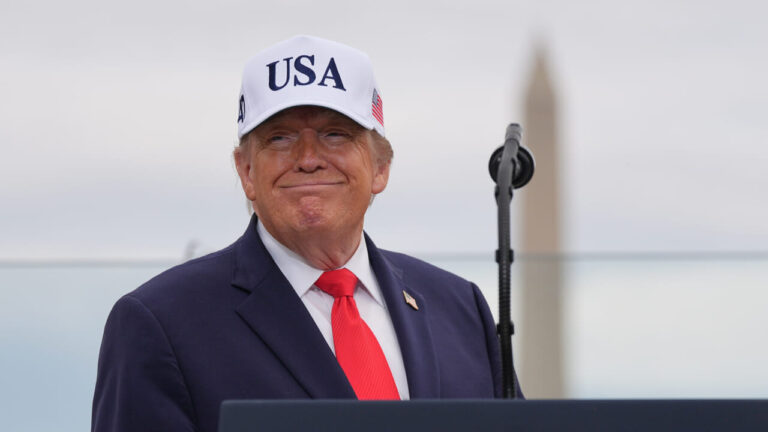
The slap at Trump makes Brussels and Meloni breathe a sigh of relief
There are no official reactions, and perhaps there could not have been. Garbo wants that when a foreign country goes to vote the chancelleries don’t let slip anything other than a classic “we respect the will of the sovereign people, we collaborate with all those who the people elect”. But behind the officialdom, it is not difficult to see a sigh of relief from Italy and the European Union at the outcome of the American midterms and the resounding defeat suffered by Donald Trump.
On the other hand, the fronts that the occupant of the White House had opened in these two years were many, but almost all of them converged on considering the European Union as a counterpart and no longer as an ally. At certain moments Trump almost seemed to participate in the parlor game inaugurated by Putin who saw the European Union as a “strategic” victim of the geopolitical re-foundation of the world. China, the United States and Russia, this was the new Yalta that the new planetary big players imagined, with the EU reduced to disappearing from the radars of major world politics.
From Ukraine to bills: what changes for Europe after Trump’s defeat in the midterm elections
Trump’s attack on the European Union had passed through the tariff issue, through his attitude towards Ukraine, which had recently been essentially abandoned to its fate, and on the other hand through the increasingly close understanding with Putin, thanks to the agreements on oil and various minor partnerships. All elements of a single strategy that has gradually revealed itself clearly.
Partly due to the private interests of Trump himself (we are talking about billions in earnings achieved through bitcoins, speculation on the stock market and oil) and partly to follow the founding dictates of the Maga doctrine according to which America must return to taking care of America, the United States had made a 180 degree reversal compared to the foreign policy of US presidents from the post-war period to today. The midterm instead puts the church back at the center of the village, as an old French proverb says, and it will now be a question of understanding with what effectiveness and with what timing. However, it will be quite clear that on Ukraine the “new” congress will not support Kiev’s sell-out to Putin, and it is not difficult to think that it is the president himself, although a “lame duck”, who will put things right. It is no coincidence that the only reaction coming from Brussels was that of Kaja Kallas, “EU foreign minister”, who underlined the pro-Kiev turn. Also because beyond the vote of the two branches of Congress, the midterm essentially decrees the political end of Trump and the Maga experience, and it will be the GOP leaders themselves (the Republicans) who, if they want to hope to regain the White House in two years, will somehow force Trump to change policies.
The post-Maga
The president is important, but the party apparatus has its weight, and everyone is already looking to the future. The same thing also applies to the Italian government. It’s true, Giorgia Meloni had initially placed all her chips on the table of the occupant of the White House, but she had the intelligence to understand – even if belatedly – that the relationship with Trump made her lose more than gain consensus. The sentences against the Pope, the war on Iran, the personal insults had contributed to her finding the courage to free herself from an embrace that had become poisonous. The prime minister can therefore afford the luxury of not feeling sorry for what happened in Washington, even if out of personal rather than institutional decency she has shown no signs of political satisfaction.
Ultimately, that’s fine for her, a weak Trump is much more convenient for her than a strong Trump: he won’t be able to remind her too zealously of Italy’s commitment to NATO spending, he won’t be able to disengage on the Ukrainian front and the European (and Italian) contribution will thus be able to continue to rely on US aid, he will have to somehow ease the pressure on the Middle East (Iran but also Israel) contributing to the resolution of a crisis and the reopening of Hormuz and therefore to the fall in the price of oil. For now Meloni has limited herself to not commenting (“we’ll talk about Trump another time”), but she will certainly have breathed a sigh of relief.