

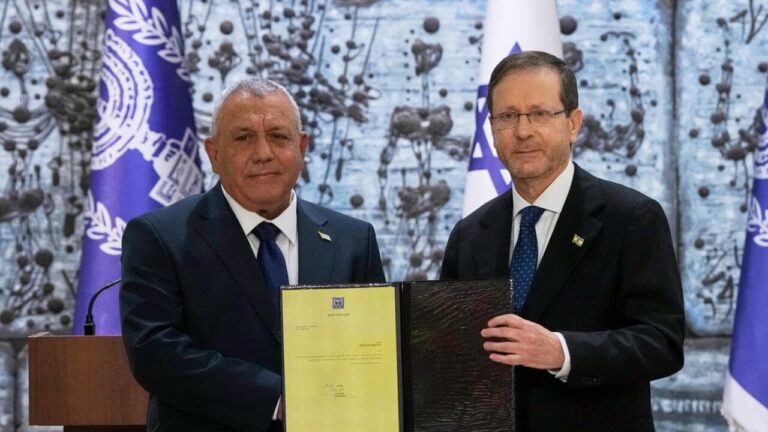
Crucial day in Israel. President Isaac Herzog officially entrusted the leader of the Yashar party, Gadi Eisenkot, with the task of forming the next government: “The State of Israel needs a stable government. I expect Gadi Eisenkot to do everything to form a government that represents the entire country, both those who supported him and those who did not.” Eisenkot now has 28 days, under the Basic Law, to form a new executive. If more time is needed, the president may grant an extension of up to a further 14 days.
Eisenkot’s words
Eisenkot, during the official ceremony of conferring the office in Jerusalem, remarked that this is “one of the most delicate moments” in the history of Israel’s democracy. “It is possible and appropriate to quickly establish a new government, which enjoys a large majority in the Knesset. Seventy-four parliamentarians have expressed no confidence in the continuation of this government and its leader: this is the will of the people, and we will do everything to realize it. I undertake with this mandate to form a national emergency government. If the members of Likud and Religious Zionism really believe that this is the moment for unity, as they declared before the president, I cannot imagine a which is why they should not come to support a government under my leadership and according to the principles I have presented.”
“For me – he added – unity is not a political bargaining chip or a mere stratagem, but a supreme value that expresses true and pure collaboration. We find ourselves probably in the most complex and delicate political situation since the foundation of the State. Creative and anomalous moves will be necessary, but we do not have the privilege of dragging ourselves with the times or returning to new elections: the challenges that await us are too many. No one will be able to keep all the commitments made and all of us are called to compromise. This is also a sign of leadership: knowing how to decide and establish priorities. Anyone who tries to block the formation of a government for personal reasons will be remembered by history as someone who did not save Israel in a moment of emergency.”
“Israel – he concluded – is in a moment of emergency, there are open war fronts and not all objectives have been achieved. We are in one of the most fragile moments that Israeli democracy has ever known due to the delegitimization against the institutions of the State which has brought us to a dangerous point. For this reason there is great urgency for a new leadership that we can trust”.
The meeting with Lieberman
According to Israeli media, Eisenkot and Yisrael Beytenu leader Avigdor Lieberman are expected to meet tomorrow in an attempt to resolve differences over the formation of a new government and coordinate the parliamentary agenda of the so-called “change bloc”. The meeting will be held the day before the new Knesset takes office.
The main point of disagreement between the leaders of Yisrael Beytenu and Yashar concerns the fact that Lieberman explicitly excluded support for any minority government or an executive that depends on parties led by Arab representatives. This position significantly narrows Eisenkot’s chances of gaining the necessary parliamentary support. Lieberman instead expressed his willingness to negotiate with ultra-Orthodox parties, breaking with his historic opposition to any form of collaboration with them. He also hinted that some Likud MPs might abandon Netanyahu’s bloc.
This apparent reversal of position on the ultra-Orthodox issue has sparked criticism and fueled accusations that Lieberman is thwarting Eisenkot’s efforts to pursue personal ambitions to become prime minister. Accusations that Lieberman denies.
Who is Eisenkot
Born in Tiberias on May 19, 1960, Eisenkot will have the difficult task of finding the right balance. Among the options on the table is to form a minority government with the external support of the Arab parties which have a total of 19 seats; create a coalition with ultra-Orthodox parties; create a government of national unity together with the outgoing Israeli Prime Minister Benjamin Netanyahu.
Never before had the task of forming a government come to a Mizrahi from the large community of Middle Eastern Jews. The Israeli Mizrahi, coming from North Africa and the Middle East, have in fact historically suffered discrimination from the elite of their country of European origin. Gadi Eisenkot, 66, comes from a working-class family of Moroccan Jewish immigrants. For 40 years he rose through the ranks of the Israeli army, eventually becoming chief of staff.
The general currently leads the main opposition party, the centrist Yashar, after entering politics in 2022. His son Gal was killed aged 25 in combat in the Gaza Strip following the October 7 attacks, as were two of his nephews. Eisenkot also served as an observer in Netanyahu’s war cabinet, but resigned after eight months, accusing the prime minister of not having a clear strategy. He has since positioned himself as a moderate alternative to Netanyahu, while maintaining a hard line on security matters. Eisenkot is credited with formulating Israel’s so-called “Dahiyeh Doctrine,” a military strategy that involves using disproportionate force in areas from which militants launch attacks.