

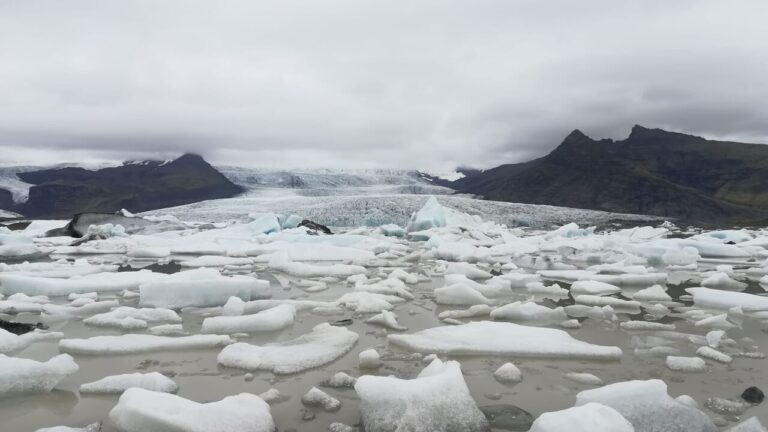
About 2 thousand years ago, the Arctic ice began to advance again. The beginning, invisible to us, of a new, looming ice age (or rather, of a new “glacial period”, given that technically we are still within an ice age, but in a warm period defined as interglacial). On the best part, however, something has changed: our species has begun to burn enormous quantities of fossil fuels, warming the atmosphere and thus nipping in its tracks a natural climate cycle that has already begun. In short, by polluting, we have stopped the next glaciation. At least according to a study just published on Science by a team of researchers coordinated by Columbia University.
The frozen remains in Northern Canada
The research focused on the Barnes Ice Sheet, located in the Nunavut region of northern Canada. This is the last remnant of the Laurentide ice cap, a colossal mass of ice that between 95,000 and 20,000 years ago covered a large part of North America, reaching a thickness of more than three kilometers.
Unlike most glaciers, the Barnes Ice Sheet is frozen directly onto the rock below and does not slide. This unique feature allowed the vegetation buried beneath to be preserved during periods of ice expansion. By analyzing the plant remains that gradually resurfaced from 1960 to today with the carbon-14 method, researchers were able to trace the exact chronology of the movements of the ice sheet margin, and therefore determine how much it has expanded, and contracted, in recent millennia.
Dating that changes the history of the climate
The analyzes showed that the Laurentide ice sheet had reached its minimum extension around 3,000 years ago, and then began to expand again around 2,000 years ago following global cooling. According to the authors, this recovery should have officially marked the beginning of a new glacial period. A thesis in direct contrast with previous theoretical models, which predict the start of a new glaciation only in tens of thousands of years.
The discovery also confirms the intuitions of some climate scientists in the 1970s who argued that a new global cooling was imminent. Although it would have taken a few thousand more years to notice a drastic drop in temperatures, and almost 30 thousand for the Laurentide ice cap to return to cover the American continent, the trend reversal – according to the authors of the study – was actually underway, confirming that the climate system had already entered the initial phase of accumulation.
The definitive extinction of the ice cap
However, the increase in temperatures recorded since the last century has disrupted this process. Since the 1960s, the amount of ice melted during the summer has exceeded that accumulated in the winter, interrupting glaciation. Simulations indicate that the Barnes Ice Sheet is destined to disappear completely within a few centuries, erasing the last remaining fragment of the Laurentide Ice Sheet.
The definitive disappearance of this glacier will alter the dynamics of future glaciations. Historically, the Laurentide ice cap played the role of a nucleation point: its freezing mass created feedback mechanisms capable of further cooling the surrounding atmosphere and stimulating the formation of new ice. Without this support structure, the planet’s natural cooling dynamics will face a completely new and unpredictable situation.