

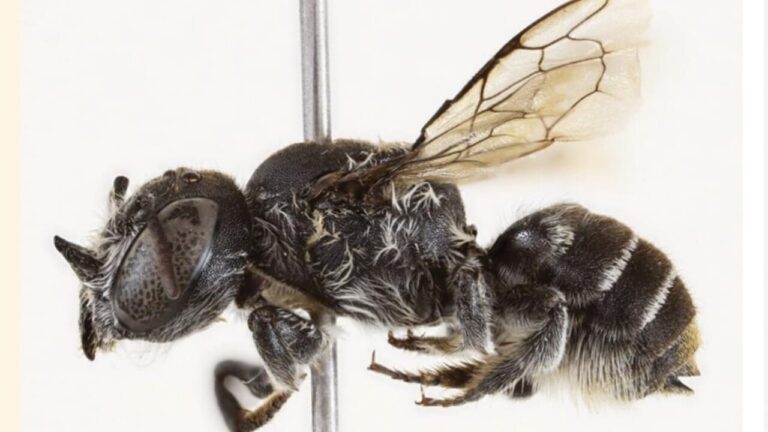
Her name is Lucifer, she has two showy horns on her head, but she is interested in honey (and not souls). A new species of bee has been discovered by a group of researchers in a very isolated area of Western Australia. The “horned” bee, whose full name is “Megachile Hackeriapis Lucifer”, lives only in the Bremer Range region, an area of the Goldfields between the towns of Norseman and Hyden, known for its gold mines and threatened by land exploitation.
The new bee species “Lucifer”
The images of this curious specimen were published in the scientific journal Journal of Hymenoptera Research by a team of researchers from Curtin University and the Pensoft scientific platform: it is the first new species of this group identified in over twenty years and highlights the vulnerability of Australian biodiversity. Biologist Kit Prendergast, lead author of the study and research associate at the Curtin School of Molecular and Life Sciences, identified the bee during an investigation of a critically endangered wild plant, Marianthus aquilonarius, which grows only in the Bremer Range: “I observed this little bee visiting the flowers of Marianthus and a mallee tree. The female had a singular face, with two tiny horns. Genetic and morphological analyzes later confirmed that it was a an unknown species”.
The term lucifer, from the Latin “bringer of light”, is also an ironic reference to the “demonic” appearance of this bee, characterized by a black color and two horns, which make the profile of the head unique and even more threatening. This discovery, according to Dr Prendergast, demonstrates how little Australia’s pollinator fauna remains: “It is incredible that such a distinctive species has remained unnoticed in an area studied for decades. But its limited distribution makes it potentially vulnerable to mining activities and climate change.”
The Megachile lucifer bee belongs to a group of pollinators that are fundamental to local ecosystems. Its presence in the same microhabitat as the endangered Marianthus aquilonarius suggests a possible coevolution or direct ecological dependence. “Many mining companies do not yet conduct systematic surveys of native bees – the researcher recalled -. We could lose key species for the reproduction of rare plants before we even know them.” The study was published in conjunction with Australian Pollinator Week, the national week dedicated to pollinating insects: a reminder of the need to protect not only threatened species, but also some of the often invisible habitats that host them.
2 minutes of reading