

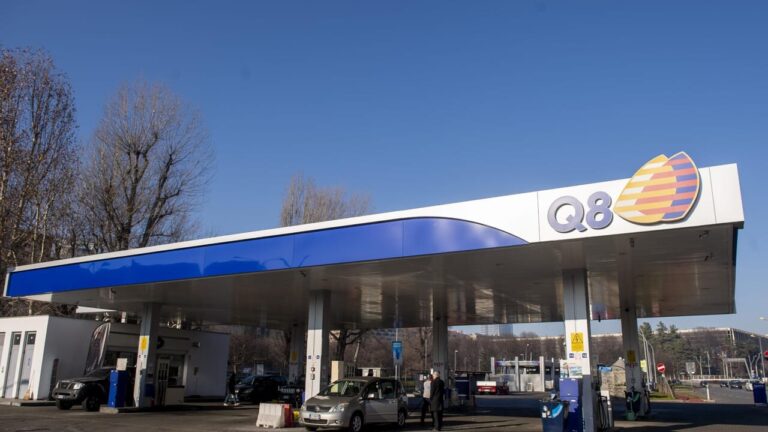
Not just Eni. Q8, a group controlled by Kuwait, has also announced that it will extend the application of the price cap on petrol and diesel, introduced last October 1, until 31 December 2026. “In consideration of the current national emergency situation and following the requests of the Italian government, Q8 Italia has decided to extend the price cap on petrol and diesel prices until the end of the year”, announced the oil giant. Initially, the Q8 fuel price cap was scheduled for October only.
How the Q8 price cap works
“With this decision, Q8 Italia – we read further in the note – intends to provide a concrete contribution in response to the needs represented by the government, combining support for consumers with a responsible approach, attentive to the evolution of market conditions and the economic sustainability of the entire supply chain”. The follow-up to the initiative will take place “according to a modular approach, which takes into account the different operating models present in the company’s distribution network. Q8 Italia will continue to provide adequate support to managers and partners, in order to help ensure the economic sustainability of the entire supply chain”. Q8 Italia “reserves the right to define the application methods of the measure, taking into account market developments and supply conditions”.
Translated: unlike Eni, which set the limit at 1.99 euros per liter for petrol and 2.16 euros for diesel, Q8 has not adopted a fixed threshold, but one that changes depending on the territory and the distributors. In the press release announcing the extension, the company made it clear that it will work like this for the next few months too.
Meloni and the emir
Fuel prices in Italy have increased significantly in recent months, especially due to the ongoing war in the Middle East. The increases have caused several protests, especially from hauliers and farmers, who in recent days had also organized road blockades especially in Southern Italy. On Friday, October 23, almost all of these lockdowns ended.
Prime Minister Giorgia Meloni made a quick visit to Kuwait a few days ago. In the bilateral meeting with the Emir, Kuwait’s willingness to extend the price cap on petrol and diesel, already applied by Q8 in recent weeks, emerged. “A concrete signal of the solidity of relations between Italy and Kuwait and of the Italian government’s ability to promote a constructive dialogue with strategic partners, translating the diplomatic confrontation into significant measures for citizens and the production system”, was the comment from Palazzo Chigi sources to the press agencies.
The situation at petrol stations
Last Friday 23 October Claudio Descalzi, CEO of Eni, announced that the group will maintain the price cap concept until the end of the year: “As regards its level, we will monitor the market and price dynamics, as well as the supplies actually available in relation to our logistics structure, to evaluate it over the period”.
The innovation announced by Eni began on Monday 28 September, setting a price cap on the Enilive network (almost 4 thousand distributors in Italy) of a maximum of 1.99 euros per liter for petrol and 2.19 euros for diesel, approximately 17 cents less than the average levels considered by the company at the time of the announcement. The ceiling was initially scheduled for thirty days, but the company immediately left open the possibility of an extension until the end of the year, as then happened.
Eni’s choice generated a domino effect. The Azerbaijani group Socar, which controls Italiana petroli (IP), has announced an intervention to control fuel prices on its network. A ceiling with a national maximum price has not been set. The measure therefore came into force progressively and with different conditions on a network of over 4,500 service stations, starting with those owned by the company, around two thousand, and then extending to the others. From October 1st, Q8 also introduced a price cap on petrol and diesel for thirty days. A single maximum price valid for the entire network was not communicated as Eni did, but there was talk of a “modular approach”. It has therefore now been extended until the end of December.
Tamoil Italia, a company belonging to the international Oilinvest group, has also decided to adopt “a series of measures aimed at mitigating the price of fuels marketed through its network of branded distributors”. The measures adopted will remain in force until 31 October 2026.
The best price
Overall, the initiatives of Eni, IP-Socar, Q8 and Tamoil involve over ten thousand distributors, more than one point of sale in two, according to the Ministry of Business and Made in Italy. The latest data collected by the Observatory on fuel prices indicate that today the average price in “self service” mode along the national road network is equal to 2.018 euros per liter for petrol and 2.261 euros per liter for diesel. On the motorway network, however, the average self-service price is 2.042 euros per liter for petrol and 2.302 euros per liter for diesel. On the Osservaprezzi website and app, made available by the Ministry of Infrastructure and Transport, it is possible to check which distributors offer the most advantageous prices in your vicinity.