
There is a big deal that could turn into a giant real estate and financial bubble. In Italy, 83 new data centers have been announced, for a total investment of 25.4 billion euros by 2028. A digital gold rush powered by artificial intelligence, with billions in international capital ready to finance huge buildings full of servers. But there’s a problem: you need electricity to power them. A lot. And we need networks capable of transporting it where and when it is required.
Terna announced that – as of 30 September 2026 – there were 586 connection requests for new data centers, with a total power of 108.96 gigawatts. To understand the size of the phenomenon, a comparison is enough: last July 15th, in the middle of summer, the peak in electricity demand for the whole of Italy was around 58 GW. The overall power required for the new data centers is thus almost double the maximum power absorbed simultaneously by all homes, factories, companies, offices and infrastructures in the country. A comparison that gives the measure of the distance between the ambitions of the proponents and the dimensions of the current Italian electricity system.
Of course, some of the requests are for preliminary projects, some may be oversized and others will never see the light of day. The problem is precisely this: how many of the billions announced correspond to concrete industrial investments and how many to speculative operations, awaiting authorizations, energy and above all customers?
The risk of bubble: Microsoft cancels the contract because there is no electricity
The first big wake-up call comes from the United Kingdom. Microsoft has abandoned the agreement with Nscale, a British company specializing in artificial intelligence infrastructure, for a 50 MW data center in Loughton, Essex. The building was supposed to house around 23,000 Nvidia GPUs, the powerful processors needed to develop artificial intelligence systems. Microsoft had agreed to use the site’s full capacity. The infrastructure was expected in 2027, but connection to the electricity grid may not be available until the 2030s. Too late for an industry where customers have to get their systems up and running within a few years, and where technology quickly becomes obsolete.
The case is particularly significant because Nscale, also backed by Nvidia, declared more than $103 billion in contracts, only 2.6 billion were truly active and the revenues actually achieved in the first half of 2026 were just 141 million dollars, compared to a net loss of more than one billion. The risk is clear: billion-dollar contracts built on the promise of infrastructure that has yet to be financed, completed and powered. If a connection is late, the customer can cancel. And a data center without a customer can become a very difficult investment to repay.
Data centers in Italy
To support the demands for new data centers, new power plants would be needed and (with new nuclear power still over the horizon) renewable sources, large storage systems, power lines, transformers, power stations and greater import capacities. It is not enough to build a photovoltaic system next to the servers: a data center must also be powered at night and when the sun and wind do not produce enough. The necessary investments could also have consequences on energy prices. Very high additional demand can impact electricity markets, while strengthening networks entails costs to be shared according to tariff rules.
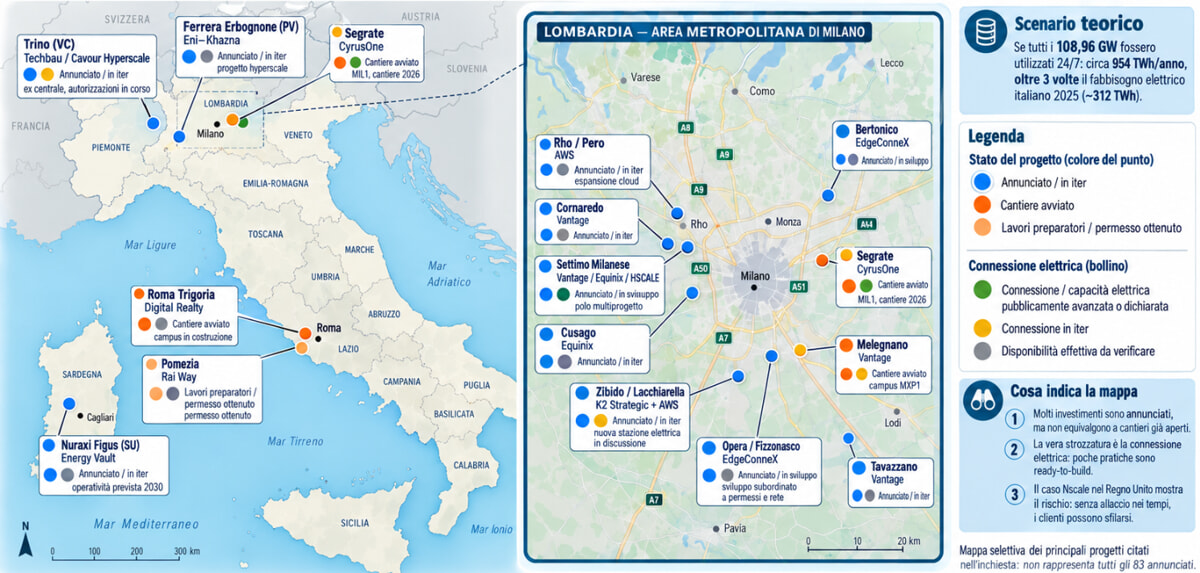
The concrete situation is very different from the extreme scenarios: according to the update of Terna’s Econnextion portal, published in mid-October, of the 586 requests only 16 are classified ready-to-build, for a total power of 1.9 GW, just 1.7% of the total power requested. Fifteen concern Lombardy and one Piedmont.
Research presented on October 9 by the Italian Data Center Association offers another snapshot: of the approximately 1,839 MW of qualified commercial capacity planned, only 230 MW are physically under construction. Another 673 MW are in development and 936 MW in the preliminary phase. To demonstrate how wide the gap between announcements and realizations can be, the Polytechnic University of Milan also urges caution. Of the 10.5 billion in investments expected in 2023 for the following three years (i.e. to date), 7.1 have been made. 32% did not materialize within the timescales initially indicated in the last three years.
Where the new data centers will be built and who will invest the billions
The large concentration of new data centers should arise in Lombardy, especially in the Milanese hinterland. The Ministry of Business and Made in Italy has declared seven programs of national strategic interest which, according to the values communicated by the Government, exceed 25 billion euros in total.
| Investor | Location | Investment announced |
| Vantage | 4 poles in Lombardy | €8 billion |
| K2 Strategic | Zibido–Lacchiarella | €5.3 billion |
| Equinix | Settimo Milanese, Cusago | €4 billion |
| Techbau | Trino (VC) | €4 billion |
| EdgeConneX | Opera, Fizzonasco, Bertonico | €3 billion |
| Energy Vault | Nuraxi Figus (SU) | €1.49 billion |
| Amazon AWS | Rho/Pero, Zibido | €1.2 billion |
The largest investment is that of Vantage data centers, an international group supported by investors such as DigitalBridge and Silver Lake. The 8 billion euro program includes campuses to be developed in Melegnano, Settimo Milanese, Cornaredo and Tavazzano, between the provinces of Milan and Lodi. Also south of Milan, K2 strategic, controlled by the Asian Kuok group, aims to invest 5.3 billion in a campus between Zibido San Giacomo and Lacchiarella, with an expected capacity of up to around 400 MW. The project is still dealing with administrative procedures and infrastructure issues, including the new Lacchiarella Ovest power station.
Equinix, an American multinational already present in Italy, has announced a 4 billion program between Settimo Milanese and Cusago. EdgeConneX, a company controlled by the EQT investment group, plans around 3 billion in direct investments in the municipalities of Opera, Pieve Emanuele-Fizzonasco and Bertonico, in the Lodi area. Amazon, through AWS, has an expansion plan worth around 1.2 billion in the areas of Rho-Pero and Zibido San Giacomo. In this case the large technological operator is directly involved in the development of its cloud infrastructure.
In Piedmont, Techbau aims to reconvert the former Galileo Ferraris power plant in Trino, in the Vercelli area. The Cavour hyperscale campus project is worth around 4 billion and envisages a power of 300-400 MW. But the ministerial timetable places the single authorization by 2027 and the entry into operation of the first batch at the end of 2028. Finally, in Sardinia, Energy Vault proposes to transform the former mining site of Nuraxi Figus, in Sulcis, into a campus for artificial intelligence in 2030, with a program worth around 1.49 billion.
Not all are projects only on paper, some projects have already passed some concrete stages of the implementation process. In Segrate, for example, the American CyrusOne started construction of a 27 MW data center in March 2026. In Rome, Digital Realty is building its campus in Trigoria, while Rai Way has obtained permission for a new 35.2 MW infrastructure in Pomezia.
The problem of data centers without customers
There is another aspect that could become as decisive as electricity availability: not all large Italian programs have a publicly identified end customer. It’s one thing to build an infrastructure for a customer who has signed a multi-year contract with adequate guarantees. Another is to buy land, obtain permits and prepare the connection hoping that, once the work is finished, a large technology group will decide to rent the spaces. Colliers’ documentation for EdgeConneX is exemplary. In January 2026, land was purchased in Opera for a data center of approximately 60 MW. But the property manager specifies that the development still depends on obtaining permits and grid connections. Completion is expected in 2029, with the start of revenues in 2030.
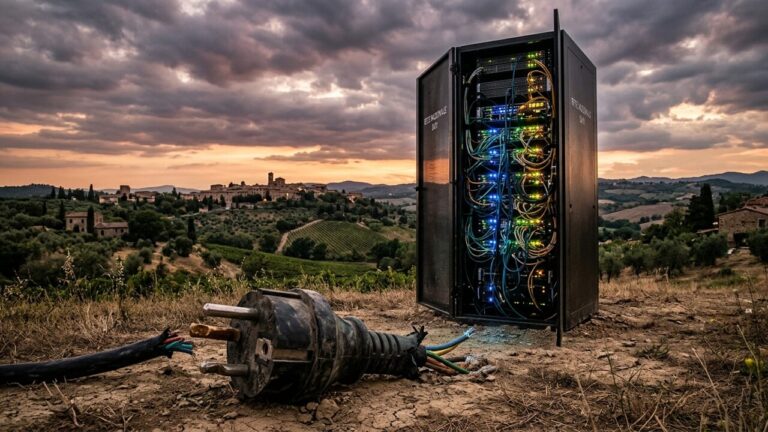
The Nscale case shows the most dangerous mechanism. An investor buys land, obtains financing and builds an infrastructure counting on a future customer. If the electricity connection is late, the customer can cancel. The value of the building decreases, the debt remains and a new user must be found. The consequences depend on the stage of the project. If work has not started, the loss may be limited to land, planning, permits and advance payments. If the data center is almost completed, much more capital may be tied up, in addition to interest on loans. In the worst case scenario, there may be write-downs, debt restructurings, forced sales or bankruptcies of project companies.
How much could a slowdown impact Italy? A simulation offers an order of magnitude. If only 20% of the 25.4 billion expected for 2026-2028 were not spent within the three-year period, investments of approximately 5.1 billion euros would be postponed. If the 32% deviation already recorded in the previous three years were repeated, the figure would rise to around 8.1 billion.
The most exposed companies
Behind the billion-dollar announcements there are operators with very different financial dimensions. Vantage has the highest Italian nominal exposure: around 8 billion distributed between Melegnano, Settimo Milanese, Cornaredo and Tavazzano. But the group also has a financial structure of a different size compared to smaller operators. In June 2024, the international company had completed a $9.2 billion capital raising transaction, led by DigitalBridge and Silver Lake.
More exposed is Techbau, promoter of the 4 billion project in Trino, Piedmont, with the first lot of Cavour hyperscale campus scheduled by 2028. The planned investment is equivalent to approximately 4.6 times the company’s annual revenues on October 19, 2026 it announced a turnover of 862.5 million euros and a net profit of 92.599 million in the financial year 2025-2026. However at realization and financing of the project could involve other investors.
Another region, another company and projects always moved to the future: the 1.49 billion euro Sardinian plan of the US company Energy Vault is enormously superior to the available liquidity of the parent company, which through its subsidiary Energy Vault Sulcis Srl promotes an investment of approximately 1.49 billion euros in the former Nuraxi Figus mining site. In the first half of 2026 the group recorded a net loss of $62.2 million and had approximately $148 million in liquidity at the end of June. For the Sardinian “vault” the program looks to 2030 and, as with other projects, all that remains is to wait.
Dossier is the exclusive subscription investigative section of The Vermilion. If you want to support our journalistic work and subscribe, Click here.