

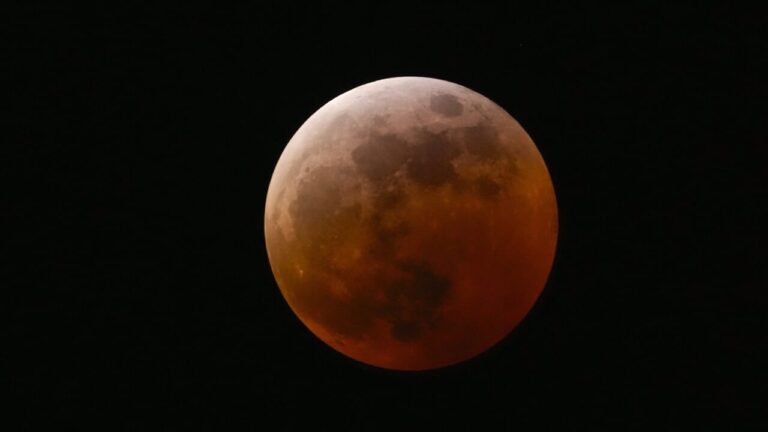
The danger that the asteroid affects our planet has faded. But it could still do damage: there is still a probability of 4 percent that ends up colliding against the moon in 2032. And with its 60 meters in diameter, without an atmosphere to curb its descent and with a much less gravity of the terrestrial one, the impact risks filling our orbit of debris, which could damage our satellites, and endanger the international spatial station. To reset the risks, in the scientific community there are those who propose a radical solution: destroy 2024 YR4 with an atomic bomb before the date of the fateful rendezing.
The idea comes from a group led by the Brent Barbee aerospace engineer, of the NASA Goddard Space Flight Center, and is detailed in a study deposited for now on the Pre-Prit Arxiv.org server (an archive in which research is published that have not yet been accepted by a scientific magazine). The research is reviewed the information we have available on 2024 YR4 and its trajectory, and then discussed the options available to mitigate the risk of an impact with the moon.
As a rule, the technique deemed simpler and more secure to perform is the one that plans to deviate the orbit of an asteroid using a kinetic impactor: to pull him against a probe, and alter the trajectory the much that is enough to prevent it from hitting us. In the case of 2024 YR4, however, is not a safe option, at least according to the authors of the analysis: the mission should be prepared by 2032, and in this time interval only two close steps will be available. We would therefore find ourselves having to organize the launch quickly and with very scarce information on the asteroid, with the risk of making a few calculation and deviating it in our direction. And we would also be forced to organize a “good the first” mission, without having launch windows available to retry further ahead, in the event that something goes wrong during the take -off of the probe.
Their proposal is therefore to move on to strong ways: destroy the asteroid by launching us against an atomic bomb. To do this, you will have to collect as much information as possible on its route and on its composition. An opportunity will arrive in 2028, during the next close passage in the terrestrial orbit. If the risk of collision with the moon is confirmed, Barnabee and colleagues propose to deviate some of the probes that we already have in space, such as those of the PSYCHE or Osirir-Apex missions of NASA, to study the asteroid thoroughly, and consequently plan the launch to intercept it with an atomic head when it will still be beyond the orbit of Mars.
According to them, a head of about 100 kilotons would be enough (four or five times the bomb released on Nagasaki) to make sure to destroy the asteroid once and for all. However, it is not clear who would be willing to pay the cost, certainly very high, of such a mission. We will know more in a couple of years. In the meantime, you just have to wait.