

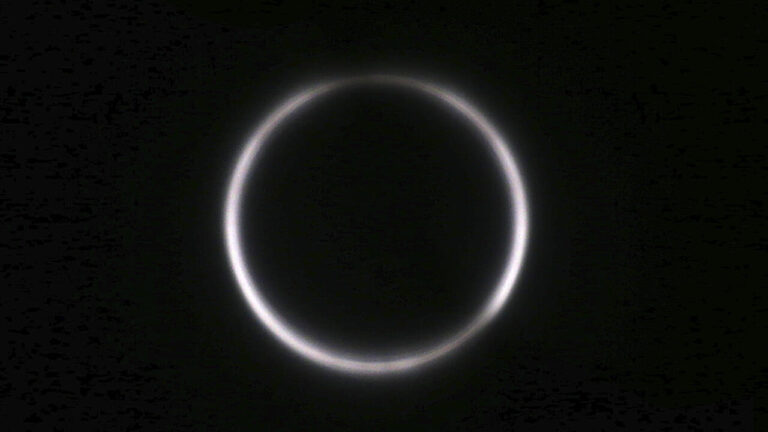
Today is the day of the first solar eclipse of the year: a “special” occasion, given that it will be an annular eclipse. A space show which, unfortunately for enthusiasts, will only be visible to the naked eye from Antarctica. Let’s see in detail what the so-called “ring of fire” is and when it occurs.
What is annular solar eclipse
On Tuesday 17 February the Moon will pass between the Sun and the Earth but, being at the furthest point from our planet, it will not be able to completely obscure the solar disk, leaving only the outer edge of our star visible, a fiery circle that creates a suggestive image, the result of a magical cosmic geometry. The Moon is in fact 400 times smaller than the Sun, which is 400 times further away from the Earth than our satellite. This relationship and the “game” of perspectives allows the two bodies to appear of similar dimensions, with the Moon able to block sunlight for a few moments. As mentioned, the phenomenon will be visible in its entirety only by researchers on duty in the Antarctic bases, while observers located in the southern ends of South America and Africa and in some points of the Pacific, Atlantic and Indian Oceans will be able to admire the spectacle only partially.
The peak after 1pm: will last two minutes
The peak of the eclipse is expected at 1.12pm ET, and is expected to last for about two minutes (one minute and 52 seconds to be precise). An event which, in addition to enthusiasts, also attracts the attention of researchers, as explained by Gerardo Capobianco of the National Institute of Astrophysics of Turin: “In the Italian-French Concordia station, in Antarctica, measurements will be carried out using a radiometer. The radiometer is an instrument used to measure the intensity of electromagnetic radiation, an instrument similar to those used on the meteorological satellites that observe the Earth”. “There are already observations planned also for the next total solar eclipse 12 August – added Capobianco – even if they will not be convenient from a scientific point of view. The event will not, in fact, be visible from Italy, because the Sun will set earlier, and even in Iceland and Spain there is little chance of observing it due to meteorological factors”.
As always, experts remind you that you should never look at the Sun without adequate protection, even during a partial eclipse. Only certified solar eclipse glasses or safe indirect observation methods, such as a pinhole projector, should be used. Conventional sunglasses do not offer sufficient eye protection.