

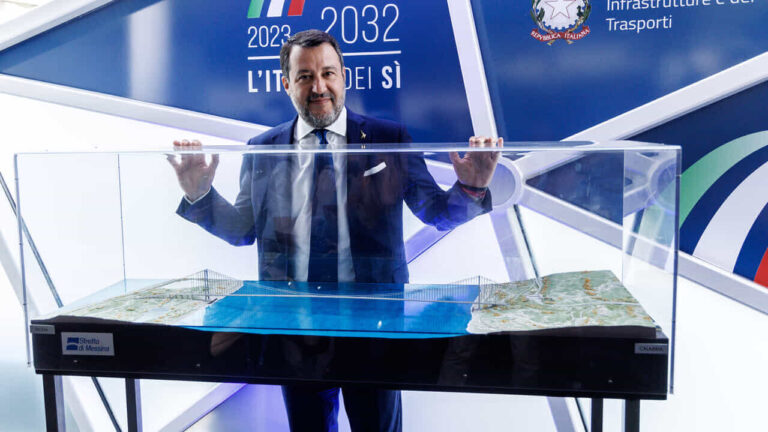
The government tries to secure the bridge over the Strait, but a serious rejection comes from the Senate. At the hearing on the Infrastructure decree, the president of Anac Giuseppe Busia said that the main issue is not resolved at all: for the Bridge, he argued, a new public tender is needed. Not a technical detail, but the heart of the problem. For Busia, the Italian legislator cannot “remedy” any incompatibility with European procurement rules with a national rule.
Costs, tolls and rules circumvented: the Bridge over the Strait rejected by the Court of Auditors
The point is this: over the years the project has changed a lot, both in costs and in the financial scheme. According to Busia, we have gone from a system in which the private sector would have had to bear a significant part of the expenditure to coverage that is now entirely public. And this is precisely where Article 72 of the EU Procurement Directive comes into play, which regulates changes to ongoing contracts: substantial changes, in general, require a new procedure, and the European Commission also recalls the 50% limit for some price increases compared to the initial contract.
What happens now
Busia also put the numbers on the table. The original base was around 4 billion, he recalled; then the reference value rose over the years, up to a framework in which today the overall cost of the project is indicated by the Ministry led by Matteo Salvini at approximately 13.5 billion. However, even if we chose the interpretation most favorable to the government, the Anac president warned, we would still be close to the limit, with the real risk of exceeding it also because there is not yet a definitive unitary executive project.
Not only that. Busia also extended the reasoning to the field of legality, warning that a construction site of this size “will attract the appetites of organized crime” and asking for stronger controls, limits on subcontracting and fewer procedural rules included in the decree, because they risk, in his opinion, making the process more opaque and less guaranteed.
The Strait of Messina aims to start work by 2026
A few hours later the reply arrived from the managing director of the Strait of Messina, Pietro Ciucci, still at a hearing in the Senate. The company’s line is the opposite: no need for a new tender, because the 2004 tender would have concerned the choice of the general contractor for the design and construction of the work, not a public-private partnership. As for price increases, Ciucci maintains that the general contractor’s fee – which went from 3.9 billion in 2006 to 6.7 in 2011 and to 10.5 billion today – has increased almost entirely as a result of the price indexation clauses, not due to variations such as to automatically trigger the European trap.
Ciucci also indicated the political-administrative timetable: approval process to be completed by the end of summer 2026 and start of the implementation phase in the last quarter of the year. It is the version of the government and the concessionaire company. But after the Busia hearing the picture appears clearer even in its fragility: the real open front is not only the engineering or environmental one, but the legal one. And there, more than the slogans, what Brussels and any judges say will count.