

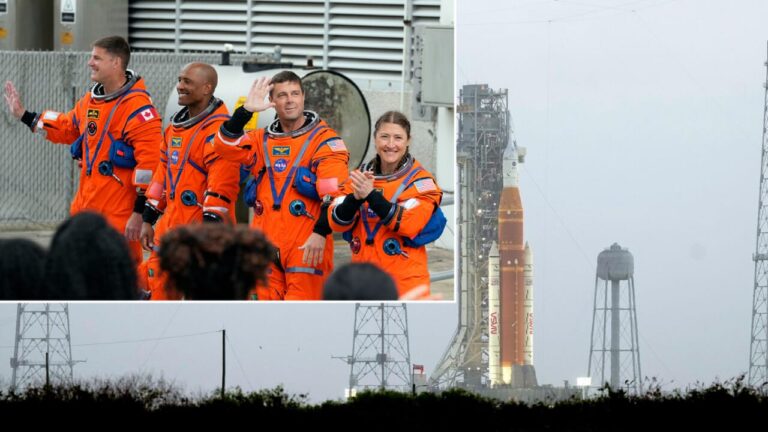
It was 00:35 Italian time when the Space Launch System rocket took off from the ground to take the Orion shuttle into space with the crew of the Artemis II program on board. The mission, despite the hitches and delays of recent weeks, thus began. What the astronauts will do and when they will return.
The launch
The usual countdown, the engines turning on and finally the rocket taking off into space leaving behind a gigantic cloud of smoke. Departure from the Kennedy space center in Cape Canaveral (Florida, United States) arrived 11 minutes later than scheduled. The first stage engines then shut down and separated from the upper stage. The Orion spacecraft then deployed its four solar panels to charge its batteries and began its journey.
Liftoff.
The Artemis II mission launched from @NASAKennedy at 6:35pm ET (2235 UTC), propelling four astronauts on a journey around the Moon.
Artemis II will pave the way for future Moon landings, as well as the next giant leap — astronauts on Mars. pic.twitter.com/ENQA4RTqAc
— NASA (@NASA) April 1, 2026
The crew successfully completed the “proximity operations” demonstration by manually driving the spacecraft to test onboard systems. During these operations, the astronauts reported a fault in the on-board toilet. Thanks to coordination with the mission control center in Houston, the crew was able to repair it.
The mission
Artemis II is the first manned mission of the Artemis space exploration program. The Orion spacecraft will reach the Moon after four days of travel. The astronauts will beat the Apollo 13 record of being the furthest human crew from Earth.
In this mission, considered a test, a moon landing is not planned. The astronauts will orbit the Moon, take photographs with sophisticated digital cameras and then head home. According to forecasts from NASA, the US space agency, Artemis IV will land on our only satellite.
Who are the astronauts
The Artemis II mission will make history as it will carry the first black person beyond Earth orbit. This is Victor Glover, the pilot of the Orion. American, Californian, he has a degree in engineering, and was a pilot in the US Navy, and pilot of aircraft such as the F/A 18 Hornet, the Super Hornet and the EA-8G Growler.
The commander is Reid Weiseman. Born in Baltimore, he was previously a ship’s engineer on the International Space Station for Expedition 41, from May to November 2014.
Christina Kock is an engineer and scientific explorer. She was in orbit on the Space Station in 2019 for Expeditions 59, 60 and 61. She was the protagonist of the first “spacewalk” in history carried out only by women.
Jeremy Hansen, Canadian, is an air force colonel and former military pilot. For Artemis 2 he is “mission specialist”. He is the first non-American to go this far.