

The biographical path of Arturo Quukers tells an out of the ordinary cultural dynamism. Figure of extraordinary originality, he was able to place himself in a completely personal way at the intersection of esotericism, science and initiatory thought. Graduated in Mathematics from the University of Pisa, a polyglot and profound connoisseur of ancient languages, in 1898 he joined the Theosophical society, starting an intense study activity that led him to deepen the cabal, cosmogony, ancient philosophy and sacred symbolism.
Rigorous scholar and brilliant controversy, it was first of all, a restless soul. In 1914 he joined the futurist movement and entered the magazine’s management committee Lacery. The following year he volunteered for the front. In 1923 he translated The strange case of Dr. Jekyll and Mister Hyde of Stevenson and cared for the first Italian edition of Occult philosophy by Cornelio Agrippa. He died in Budrio in 1946, retired into a voluntary insulation after having to cut any link with the world. And just a look at his tomb to grasp the symbolic bequest: a five -pointed star, the Tetraktys, the team and the compass.
Until 1925, he had held important roles within Freemasonry, before the fascist regime – initially observed with curiosity as a possible tool for spiritual rebirth – started the systematic repression of the initiatory companies. To isolate him further was also the rapprochement between the regime and the Catholic Church, sanctioned by the 1929 agreement: in that context, his openly anticlerical positions made him increasingly marginal.
The severe critic of the pseudo-exoteric fashions of the time, Rechini was beating to return his authentic initiatory vocation to the Italian Freemasonry, opposing both the exasperated rationalism and to the hegemony of positivist thought. Disappointed by the dual betrayal of Freemasonry and Fascism, he looked at the ancient imperial Rome, which he considered custodian of an archaic and perennial wisdom. The existence of a secret Pythagorean tradition came to hypothesize, transmitted over the centuries through figures such as Virgil, Dante, Ficino, Campanella, Bruno and Leonardo.
Collaborated with exceptional interlocutors such as René Guénon, publishing in magazines Atanòr And Ignisfounded by him, and taking care of the first Italian edition of The king of the worldOpera Guénoniana destined to inspire also the homonymous song by Franco Battiato.
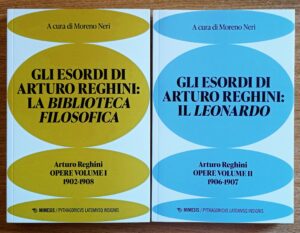
Much of his production – dense, visionary and complex – has remained unpublished until recent times. Today, the Mimesis publishing house is taking care of the full edition, starting from the youth texts written between 1902 and 1908. To make this company even more relevant is the careful curatorship and the full -bodied introductory essay by Moreno Neri, which reconstructs the initial stages of his thought and proposes texts that appeared in magazines today difficult to find.
The two volumes published so far testify to the extraordinary richness of his thought. The first collects the writings related to adhesion to the Teosophical Society and the activity of the Philosophical Library of Florence, which he founded in 1903, soon became a point of reference for those who were looking for alternatives to materialism and ecclesiastical orthodoxy. The second volume, however, includes the articles that appeared between 1906 and 1907 in the magazine Leonardodirected by Giovanni Papini – who called Rechini “a real magician”.
A job that not only fills an editorial gap, but offers the tools to follow the chaotic evolution of thought.